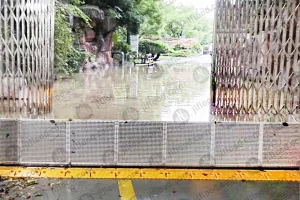
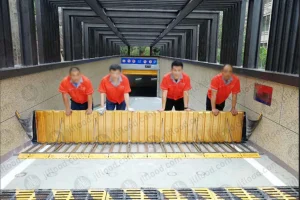
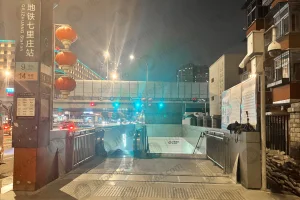
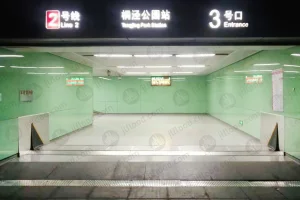
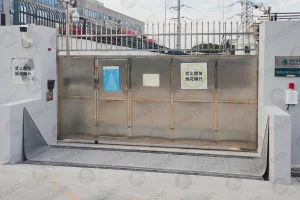
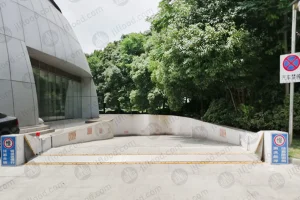
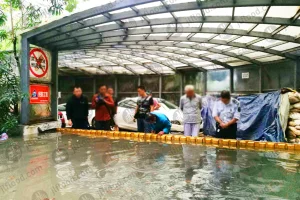
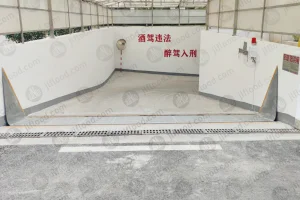
Directly engineered and manufactured in China factories to deliver instant, unpowered, hydrodynamic flood protection across public transit, electrical power grids, and underground commercial spaces.
In an era defined by intensifying global climate volatility, extreme precipitation events, and urban heat-island-induced cloudbursts, conventional flood protection paradigms are proving rapidly inadequate. Legacy solutions—such as manual sandbag deployment, drop-in stoplogs, and electromechanical flood barriers—exhibit single-point-of-failure vulnerabilities. Manual barriers require human foresight and physical intervention, which fail during rapid-onset flash floods; electromechanical gates rely on sensors, power grids, and backup generators, all of which are uniquely susceptible to catastrophic failure precisely when floodwaters submerge power infrastructure.
The global civil engineering sector has consequently transitioned toward Passive Hydrodynamic Automatic Flood Gates. Designed and mass-manufactured within high-precision China Factories, pop-up flood barrier systems utilize the fundamental laws of fluid dynamics—specifically Archimedes' principle of buoyancy and hydrostatic differential pressure—to trigger instant, automated protection without electricity, manual intervention, or digital command networks.
Advanced Chinese manufacturing facilities have advanced pop-up flood barrier technology from primitive mechanical counterweights to sophisticated structural, hydraulic, and metallurgical engineering. Modern factory designs incorporate Finite Element Analysis (FEA) dynamic fluid-structure interaction (FSI) modeling to optimize hydrodynamic buoyancy profiles.
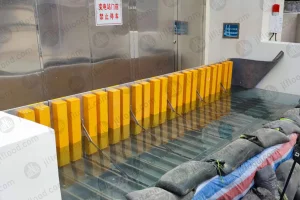
The embedded bottom frame serves as a fluid catchment pit. As surface runoff fills the chamber, buoyant density forces overcome mechanical latch friction. The water force rotates or elevates the panel leaf to form a tight vertical hydrodynamic seal against hydrostatic water heads up to 2,000mm.
China factories utilize proprietary multi-strand Ethylene Propylene Diene Monomer (EPDM) vulcanized compression seals. Engineered for ozone resistance, UV immunity, and chemical resilience, these triple-lip seal profiles yield near-zero leakage (<0.05 L/hr/m) under sustained hydrostatic loading.
Next-generation Chinese factory roadmaps integrate fiber-optic strain gauge arrays, water level telemetry sensors, and NB-IoT connectivity. While the physical gate requires zero power to deploy, real-time wireless posture telemetry notifies smart city municipal grids of gate status.
Evaluating performance vectors across primary urban flood control technologies:
| Performance Feature | Hydrodynamic Pop-Up Gate (China Standard) | Electromechanical Vertical Gate | Manual Modular Stoplog | Inflatable Rubber Dam |
|---|---|---|---|---|
| Energy Requirement | Zero Power (100% Passive Hydrodynamic) | High Power / Grid + Generator Backup | Zero Power (Manual Assembly) | High Power (Air Compressors) |
| Deployment Time | Instant (0.1 – 0.5 Seconds) | 30 – 120 Seconds | 1 – 3 Hours (Crew Dependent) | 15 – 45 Minutes |
| Blackout Reliability | 100% Fail-Safe (Mechanical Buoyancy) | Vulnerable to Electrical Failure | 100% (Subject to Human Delay) | Vulnerable to Compressor Failures |
| Traffic Drive-Over Load | Heavy Duty (A15 to E600 Load Rated) | Moderate / Elevated Substructure | None (Restricts Access completely) | Zero Drive-Over Capability |
| Surface Aesthetics | Flush Pit Embedment (Invisible) | Above-Grade Towers/Pillars | Requires Storage Racks | Exposed Surface Profile |
Chinese pop-up flood gate manufacturers work closely with civil engineering contractors and urban planners to tailor modular retaining configurations for critical infrastructure assets.
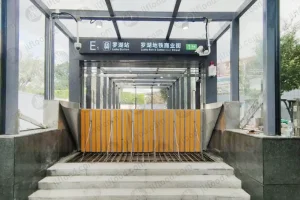
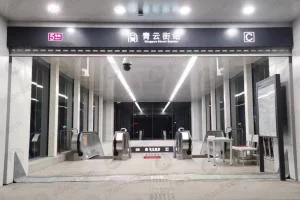
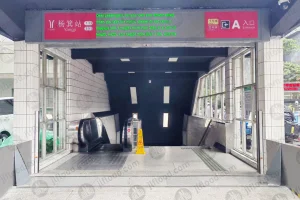
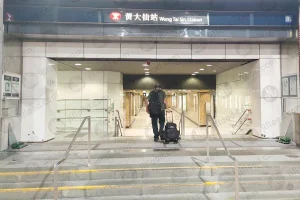
Metro station entrances, ventilation shafts, and connection channels represent high-risk water ingress points during cloudburst events. Integrated pop-up barriers sit level with passenger concourse tiles. Proven across major transit networks including Guangzhou Metro, Dalian Metro, Suzhou Metro, and Beijing Metro systems.
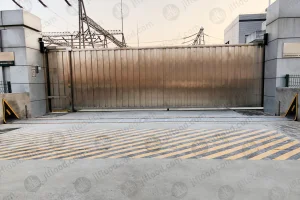
Power transmission substations are extremely sensitive to moisture and flood intrusion. A single submerged transformer bay can trigger regional grid blackouts. Perimeter driveway pop-up gates prevent incoming flash water while accommodating heavy utility repair vehicles up to 60 tons axle load.
Underground car parks in commercial complexes and high-density residential towers represent major financial liabilities during flooding. Embedded pop-up gates across basement ramps prevent total parking vehicle submersion without restricting daily vehicular transit traffic.
The manufacturing cluster centered in China's industrial zones (such as Jiangsu, Zhejiang, and Guangdong) provides unprecedented structural quality control, cost efficiency, and manufacturing agility. China factories specializing in hydrodynamic barriers operate under strict Industry 4.0 paradigms:
Structural aluminum panels (6063-T6 aircraft grade) and stainless steel frames (SUS304 / SUS316L) are processed via multi-axis fiber laser cutters and robotic arc welding cells compliant with ISO 3834-2 welding quality standards.
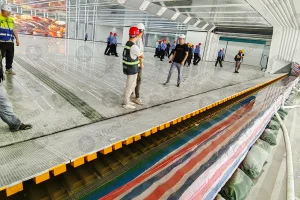
Leading China factories house dedicated full-scale hydraulic testing tanks. Every manufactured barrier batch undergoes hydrostatic head stress testing, panel deflection measurement, and sealing leak testing before export clearance.
Vertical integration—from raw billet extrusion and specialized rubber vulcanization to precision machining—enables Chinese factories to deliver custom structural spans within 15–20 days lead time, supporting tight global construction milestones.
Overseas EPC contractors, municipal authorities, and commercial property owners sourcing pop-up flood gates from China require absolute transparency regarding regulatory compliance, engineering documentation, and site interface protocols.
To facilitate seamless jobsite integration, China factory engineering teams provide complete Civil Interface Blueprint packages prior to casting concrete foundations. This includes 3D BIM Level 3 models (Revit/STEP), reinforcement rebar layout drawings, embedded stainless steel sub-frame anchoring specifications, and foundation pit drainage sump hydraulic calculations.
Addressing primary engineering, procurement, and operation inquiries from international specifiers and contractors.
Explore our complete catalog of hydrodynamic, embedded, flip-up, and substation-grade automatic flood barrier configurations directly from China manufacturers.