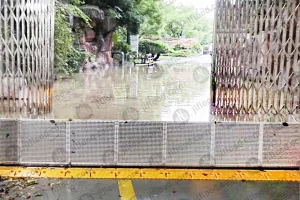
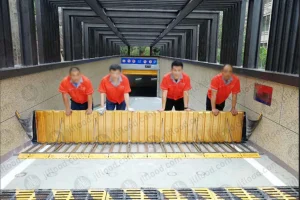
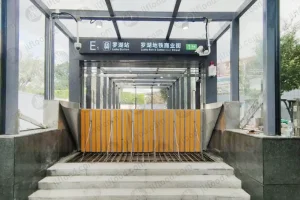
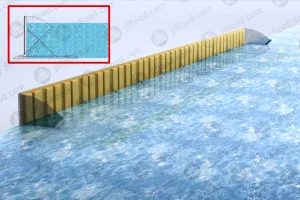
Explore our primary range of hydrodynamic automatic flood barriers, engineered for immediate power-free activation and certified via strict water testing protocols.
In modern civil engineering and urban flood mitigation, structural failure is not an option. Theoretical Finite Element Analysis (FEA) computer simulations provide foundational load-bearing calculations, but true reliability can only be proven through empirical full-scale hydrostatic water testing under extreme physical conditions.
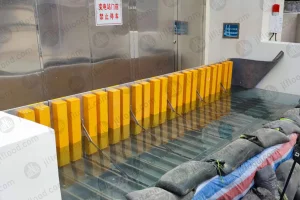
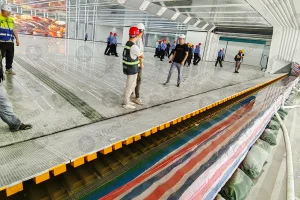
Every automatic flood barrier manufactured at Nanjing Junli Technology undergoes stringent full-immersion testing inside our specialized multi-stage hydraulic test pool. The barrier assemblies are subjected to maximum design water heads (up to 2.0 meters of hydrostatic depth) for continuous 72-hour operational testing cycles.
During these trials, multi-point laser telemetry sensors record structural deflection across the 6063-T6 aviation-grade aluminum panels to guarantee flexural stiffness remains well within structural safety margins ($f \le L/300$).
Real-world urban floodwaters are rarely static; they carry heavy dynamic loads, hydrodynamic wave surges, and debris impact forces caused by fast-moving vehicles or floating objects. Our testing facility deploys high-volume axial flow pumps to simulate flash-flood velocity vectors up to $3.5 \text{ m/s}$.
By simulating rapid hydro-buoyancy deployment under high flow velocities, we verify that the self-rising panel locks smoothly without jamming or tearing the dual EPDM/NBR perimeter seals.
As climate-induced extreme rainfall events intensify globally, international building codes (such as ASCE 24, FM 2510, and Eurocode EN 1991-1-6) are replacing manual flood defense guidelines with mandatory passive, self-activating hydrodynamic barrier mandates.
Historical reliance on manual sandbags or slide-in aluminum flood planks has proven catastrophic during nighttime flash floods or rapid urban inundation. Municipal infrastructure specifications now require passive automatic barriers that activate 100% mechanically, ensuring operational security even during complete electrical grid blackouts.
Modern flood barrier testing includes validating integrated IoT sensor packages. Substation asset managers and metro operators demand real-time feedback loops. Passive mechanical barriers are now retrofitted with IP68 micro-switches that broadcast deployment status, water level alerts, and barrier tilt angle to central SCADA network systems.
Standard door weatherstripping is insufficient for structural flood control. Testing protocols now rigorously measure allowable leakage rates in liters per hour per meter of wetted perimeter ($L/hr/m$). Advanced dynamic sealing matrices utilizing co-extruded fluoroelastomers and heavy-duty NBR assure zero-leakage performance under chemical-laden flood runoff.
Understanding manufacturer pricing requires evaluating structural alloy grades, embedded foundation depth, sealing dynamic engineering, and factory water testing documentation level. Below is an overview of baseline direct factory pricing estimates for commercial procurement.
| Barrier Model / Series Type | Standard Retaining Height | Primary Material & Finish | Water Test Validation Standard | Estimated Factory Price Unit ($ USD) |
|---|---|---|---|---|
| HM4E-Series Embedded Metro Flood Barrier | 0.6m – 1.2m | 6063-T6 Anodized Aluminum / SUS304 Frame | 100% Full-Pool Pressure Tested (72hr) | $450 – $850 / meter |
| HM4D-Series Heavy Duty Surface Automatic Barrier | 0.5m – 1.0m | High-Strength Aviation Alloy + Hot-Dip Galvanized Frame | Hydrodynamic Dynamic Surge & Debris Impact Test | $380 – $680 / meter |
| Self-Closing Substation Gate Barrier | 0.8m – 1.5m | 316 Marine Grade Stainless Steel Base / Composite Panel | Dielectric Breakdown & Zero Leakage Hydraulic Test | $520 – $950 / meter |
| Garage Ramp Flip-Up Flood Gate | 0.4m – 0.9m | Reinforced Structural Steel Panel with Anti-Skid Tread Plate | Wheel Load Rating (40 Tons) + Water Retention Test | $320 – $550 / meter |
| Pedestrian / Equipment Room Light Barrier | 0.3m – 0.6m | Lightweight Modular Aluminum Alloy | Standard Static Water Head Leakage Test | $220 – $390 / meter |
For EPC contractors, engineering consultants, and municipal procurement directors, evaluating a flood barrier supplier requires looking far beyond standard brochure claims. A comprehensive vendor audit must cover four fundamental pillars of E-E-A-T (Experience, Expertise, Authoritativeness, and Trustworthiness).
Ensure the manufacturer operates an in-house full-scale hydrostatic testing pool rather than relying solely on third-party CAD modeling. Ask for unedited video proof of water testing for units of equivalent span and height before placing production orders.
A reliable supplier must provide comprehensive CAD cross-sections, BIM 3D models (Revit format), concrete embedding rebar schedules, and localized drainage trough calculations to ensure seamlessly integrated civil works during construction.
When installing flood barriers at power substations or high-voltage transformer yards, barriers must be tested for electrical isolation, ground bonding continuity, and resistance against corrosive dielectric oil runoffs.
Evaluate the long-term total cost of ownership (TCO). Demand modular seal designs that permit straightforward replacement of elastomer gaskets without necessitating full panel removal or major civil demolition works.
Different urban environments face distinct hydraulic challenges. Nanjing Junli Technology delivers specialized flood defense configurations tailored specifically for four major high-risk infrastructure asset classes.
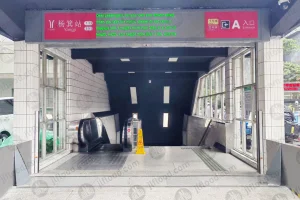
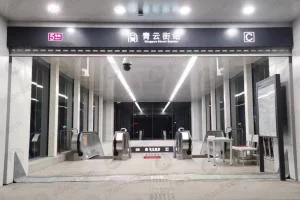
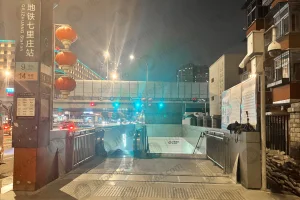
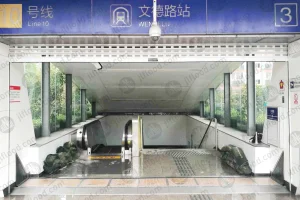
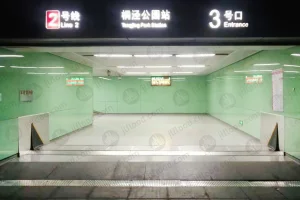
Subway station entrances, air vents, and interconnecting underground mall channels are highly vulnerable to urban surface water inundation. Our embedded automatic flood gates sit flush with the finished tile floor during normal operations. Upon water ingress, hydrodynamic pressure instantly activates the barrier, blocking water up to 1.5m design heads and preventing catastrophic flooding of underground track networks.
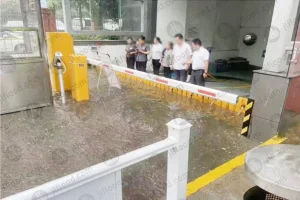
Power outages during severe typhoons or heavy rainstorms often stem from flooded electrical switchgear rooms. Our self-opening and closing substation barriers provide continuous 24/7 passive defense around perimeter gates, cable trenches, and transformer vaults—protecting critical electrical grid assets without requiring manual setup.
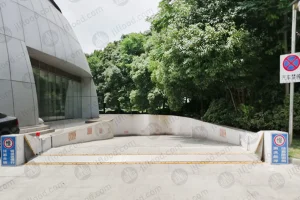
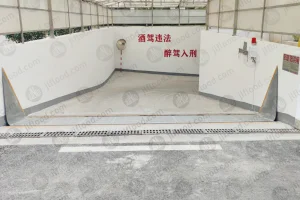
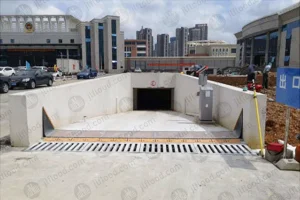
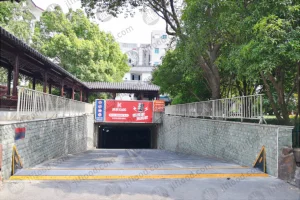
Underground parking ramps at commercial shopping centers, residential complexes, and hospitals are prime targets for flash flood damage. Our heavy-duty drive-over flip-up gates withstand 40-ton vehicle traffic under daily operations, rising automatically when storm runoff reaches critical thresholds to safeguard vehicles and underground building systems.
Public pedestrian underpasses and civil defense facilities require high-durability barrier installations. Featuring modular stainless steel embedded housings and tamper-proof mechanical locking assemblies, Junli systems deliver long-term protection against urban waterlogging while meeting strict public safety guidelines.
To ensure smooth integration across international project sites, Nanjing Junli Technology delivers end-to-end technical documentation, localized engineering adaptations, and rigorous compliance certification.
Every shipment comes equipped with complete English-language technical manuals, civil structural drawings, finite element analysis (FEA) reports, material mill test certificates (EN 10204 3.1), and factory water test reports detailing exact recorded leakage performance.
Our engineering design standards align with major global building codes, including US ASCE 24 flood resistant design standards, European Union Eurocodes, British Standard BS EN 13564, and China National GB specifications for underground civil defense flood protection.
We offer step-by-step remote video commissioning guidance, precision embedded frame positioning templates, and dedicated field engineering dispatch services for large-scale municipal infrastructure tenders worldwide.
Nanjing Junli Technology is pioneering continuous innovation in passive hydraulic engineering. Our tech roadmap outlines key advancements reshaping the global flood protection industry over the next decade.
Integrating polymer micro-capsules into perimeter EPDM seals that expand when exposed to water, automatically sealing microscopic gaps caused by debris or uneven concrete surfaces.
Developing ultra-lightweight hybrid carbon-fiber aluminum panel structures that increase maximum clear span capabilities to over 8 meters while reducing foundation recess depth by 35%.
Embedding wireless telemetry nodes into flood gate foundations to deliver real-time hydrodynamic load data, water depth metrics, and automated deployment alerts to municipal emergency command centers.
Incorporating dual directional hydraulic dampers to control rising speed during severe surges and enable smooth, automatic mechanical resetting once surface floodwaters recede.
Common questions from civil engineers, project procurement directors, and international distributors regarding flood barrier water testing, installation, and pricing.
Review the remaining high-performance automatic flood control systems, optimized for metro connections, electrical substation gates, and surface installations.