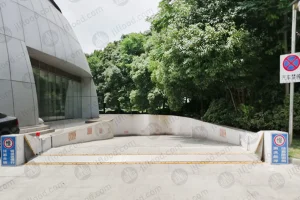
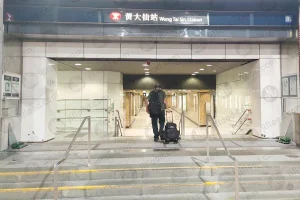
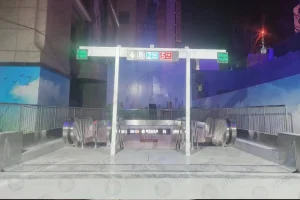
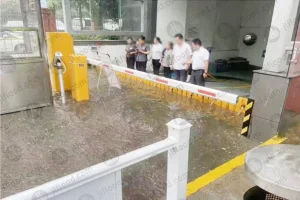
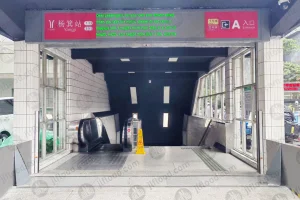
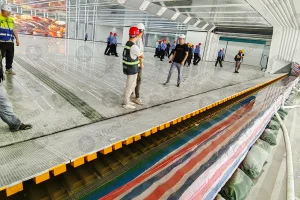
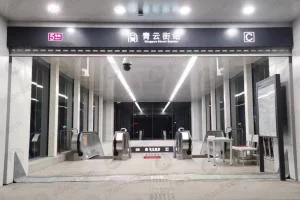
Featured self-rising, zero-electricity automatic flood barriers customized for Montevideo coastal surges, underground garages, and regional transit nodes.
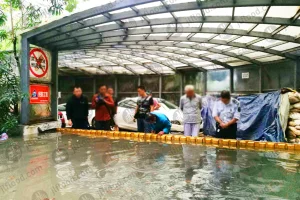
Analyzing Uruguay's unique coastal-estuarine dynamics, urban flood vectors, and the engineering necessity of verified hydrodynamic water testing.
The Oriental Republic of Uruguay presents a distinct hydrological profile characterized by its extensive Atlantic coastline, the sprawling estuarine dynamic of the Río de la Plata, and dense inland river networks such as the Río Uruguay and Río Negro. In urban epicenters like Montevideo, Ciudad de la Costa, Salto, and Paysandú, rapid urbanization combined with intensifying meteorological anomalies has amplified vulnerability to severe pluvial and coastal flooding.
A critical phenomenon impacting Uruguayan civil infrastructure is the "Sudestada"—strong, persistent southeasterly winds that drive severe storm surges up the Río de la Plata estuary. When heavy rainfall events coincide with a Sudestada surge, gravity-fed storm drainage networks in low-lying coastal areas experience severe backpressure. Underground parking structures, utility cable trenches, substations, and commercial basements turn into immediate catchment basins for high-velocity floodwaters.
For municipal engineers, EPC contractors, and commercial developers across Uruguay, traditional manual sandbags or motor-driven flood barriers present unacceptable failure modes. Power grids frequently collapse during severe storms, rendering electrical barriers useless unless equipped with redundant uninterruptible power supplies (UPS). Furthermore, manual barriers depend on rapid human deployment—an impossible assumption during sudden nocturnal pluvial events. This whitepaper outlines how hydrodynamic automatic flood barriers, rigorously validated through physical factory water testing, solve the operational challenges inherent to the Uruguayan climate.
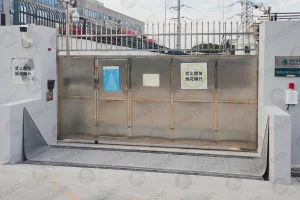
Hydrodynamic automatic flood gates operate strictly on fundamental physical principles: fluid buoyancy and hydrostatic thrust. Embedded flush within driveway thresholds or portal entrances, the barrier remains concealed within an underground stainless-steel foundation frame during normal operational dry periods, allowing heavy vehicular traffic to pass unhindered.
As surface runoff flows toward the entrance, water enters the front inlet grates of the subterranean chamber. The engineered hollow door panel experiences natural hydrostatic uplift forces.
Without requiring sensors, human intervention, or electric motors, the buoyant force pivots the barrier plate upwards around high-tensile stainless steel hinge pins as water levels rise.
As water reaches peak levels, hydrostatic head pressure presses the panel tightly against dual EPDM side seals and bottom gaskets, creating a watertight wall.
A flood barrier is an elastic structural element subjected to non-uniform hydrostatic pressure distributions. Under max head conditions (e.g., 1.5m to 2.0m water column), structural panel deflection must not exceed L/500 of the clear span width. Deflection beyond this index compromises the peripheral elastomeric seals, leading to catastrophically increased leakage rates. Factory water testing verifies these structural deflection profiles prior to site dispatch.
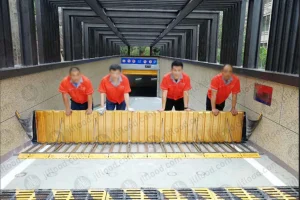
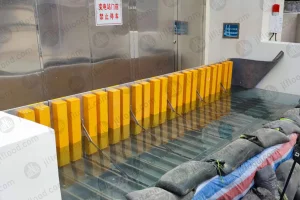
In global civil engineering, specifying flood defense based on 3D computer renderings or static FEA models represents a severe project risk. Real-world hydrodynamics involve turbulent dynamic pressure wave hits, debris accumulation, seal friction drag, and localized settlement forces. Nanjing Junli Technology subjects every barrier prototype and production series to full-scale water pool validation.
| Testing Criteria | Laboratory FEA Simulation | Standard Market Inspection | Junli 100% Water Pool Testing |
|---|---|---|---|
| Hydraulic Buoyancy Trigger | Theoretical Math Model | Visual Dry Lift Check | Real Hydro-Pool Inflow Validation |
| Sealing Gasket Deflection | Idealized Rubber Matrix | Uncompressed Contact Check | Pressurized Leak Rate Measurement (L/hr/m) |
| Structural Load Limit | Calculated Stress Map | No Physical Load Applied | Max Head Hydrostatic Load Application |
| Sediment Tolerance | Not Evaluated | Not Evaluated | Silt-Injected Basin Performance Verification |
Customized barrier architectures tailored to specific asset profiles across Uruguayan commercial, public, and industrial sectors.
Underground parking garages in Montevideo (Pocitos, Carretas, Punta Carretas) face sudden pluvial overflow. Embedded automatic barriers sit flush with the driveway slope, allowing heavy daily traffic (up to 20-ton axle loads) without disturbing vehicle ingress, rising automatically during downpours.
Substation gates and cable access vaults operated by power utilities require zero-downtime protection. Water ingress leads to transformer trip-outs and district blackouts. Passive hydrodynamic gates ensure security even when the grid fails during extreme weather events.
Facilities inside free trade zones like Zonamerica and WTC Free Zone, as well as port logistics corridors around the Port of Montevideo, house valuable inventory. Heavy-duty modular flood walls protect high-value warehouses from surface runoff damage.
Procurement teams and engineering cost consultants in Uruguay require clear visibility into budgeting metrics. Flood barrier pricing is governed primarily by span width, structural height, alloy selection, surface finish, and factory water-test certification levels.
The following table provides baseline budget estimations for planning commercial and infrastructure projects in Uruguay. Direct contract pricing varies based on custom civil embedment requirements and shipping logistics to Montevideo Port.
| Barrier Category & Model | Retaining Height (mm) | Clear Span Range (m) | Material Core Specs | Est. Price Range (USD/m) |
|---|---|---|---|---|
| Light Flip-Up Barrier (Pedestrian doors, cable trench) | 300mm – 600mm | 1.0m – 3.0m | Structural Aluminum Alloy + EPDM | $450 – $750 / linear meter |
| Standard Hydrodynamic Gate (Underground Garage Ramps) | 600mm – 1000mm | 3.0m – 6.0m | SS304 Frame + Al-Alloy Panel | $850 – $1,400 / linear meter |
| Heavy-Duty Substation Gate (Power Grid / Industrial Port) | 1000mm – 1500mm | 4.0m – 8.0m | Full Stainless Steel SS304/SS316 | $1,500 – $2,300 / linear meter |
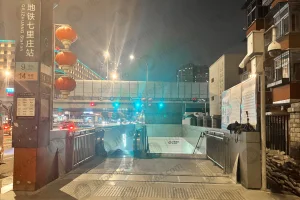
| Metro Infrastructure Array (Transit Portals / Deep Basements) | 1200mm – 2000mm | Modular Multi-Leaf (Unlimited) | Marine Grade Stainless + FEA Reinforcement | $2,200 – $3,500 / linear meter |
Note on Local Compliance & Import Duties: Products imported into Uruguay must comply with national civil engineering standards overseen by DINAGUA (Dirección Nacional de Aguas) and local municipal regulations (Intendencia de Montevideo). Junli Technology supplies complete engineering documentation, including CAD detail drawings, anchor stress calculations, and FAT water testing video verification to streamline local permitting.
Submit your site opening dimensions, required retaining height, and application details to our engineering team. We deliver complete drawing packages, FAT test protocols, and detailed CIF Montevideo price schedules within 24 hours.
Send Inquiry NowSeamless execution requires close coordination between flood control manufacturers and Uruguayan civil works teams. Junli Technology delivers end-to-end support for project design, embedment casting, site installation, and annual preventive maintenance.
For embedded hydrodynamic systems, a shallow trench is formed during concrete pouring at the driveway threshold. Primary considerations include structural leveling, concrete compressive strength (minimum C30/37 rating), and connecting the foundation chamber's bottom drain to the facility storm sump or gravity outlet to clear residual rainwater post-event.
Hydrodynamic barriers contain no motors or mechanical gears, reducing maintenance needs. Recommended maintenance routines include:
Addressing key technical, logistical, and commercial inquiries from Uruguayan engineers and developers.
Our hydrodynamic automatic flood gates operate entirely on buoyancy physics and hydrostatic head pressure. No electrical power, battery backup, hydraulic pumps, or sensor networks are used. As floodwaters fill the recessed ground chamber, the hollow panel naturally floats, lifts, and locks into the retaining position. It functions reliably during severe storms when the regional power grid fails.
Every project lot undergoes full-scale testing in our physical water testing pool prior to export. We issue a Factory Acceptance Test (FAT) Certificate detailing exact panel deflection under design water head, verified seal leakage rates (in L/hr/m), and high-definition video documentation of the water retention test tied to your unit's serial number.
Yes. Our embedded drive-over flood barriers are engineered for heavy commercial vehicular traffic. Standard units support single axle loads up to 15 tons, with heavy-duty reinforced models rated up to 30 tons. The top surface plate aligns flush with surrounding asphalt or concrete, eliminating vehicle bumps during dry periods.
For installations in high-salinity coastal areas like Montevideo, Punta del Este, and Colonia del Sacramento, we utilize marine-grade SS316 stainless steel for embedded frames, hinges, and hardware. Aluminum panels feature fluorocarbon (PVDF) corrosion-resistant coatings, passing 1,500-hour salt spray endurance testing to prevent pitting and galvanization.
Manufacturing and factory pool testing typically require 15 to 25 days depending on total linear meter volume and custom width specifications. Maritime freight shipping from China to the Port of Montevideo generally takes 35 to 45 days. We provide comprehensive export packaging, customs HS code classification, and complete shipping documentation.
Explore our complete range of specialized flood gates, subway entrance barriers, substation defenses, and factory water-tested systems.
Ensure long-term flood resilience for your Uruguayan development, substation, or municipal project with zero-power, hydro-buoyant automatic barrier technology verified by 100% factory pool testing.
Send Inquiry Now