
Tested, unpowered hydro-buoyant self-rising perimeter flood control gates deployed globally.
An authoritative analysis of monsoon deluge, urban inundation, and zero-electricity hydrodynamic barrier implementation for transmission networks.
Electrical energy distribution grids represent the circulatory system of modern industrial economies. In Pakistan, power infrastructure managed by entities such as the National Transmission & Despatch Company (NTDC), K-Electric (KE), and regional distribution companies (DISCOs including LESCO, IESCO, MEPCO, and PESHCO) faces compounding operational risks driven by extreme climate events. The devastating monsoon floods across the Indus River Basin, coupled with intense urban flash flooding in metropolitan centers like Karachi, Lahore, Rawalpindi, and Hyderabad, have highlighted a critical vulnerability: the physical submergence of high-voltage (HV) and extra-high-voltage (EHV) sub-stations.
When monsoon surge waters breach perimeter boundaries of 132kV, 220kV, and 500kV substations, the consequences are immediate and catastrophic. Ingress into switchgear rooms, transformer bays, cable trenches, and control buildings leads to flashovers, dielectric breakdowns, severe ground faults, and irreversible damage to gas-insulated switchgear (GIS) installations. Traditional flood defenses—such as manual sandbagging, static brick bunds, or electrically powered sump pumps—fail consistently during severe flood events due to grid blackouts, rapid inundation speeds, and human intervention bottlenecks.
Substation flooding incurs direct repair costs running into millions of US dollars per facility, but the indirect economic damage to Pakistan's manufacturing corridors—such as textile hubs in Faisalabad, industrial zones in S.I.T.E Karachi, and agricultural processing facilities in Punjab—is exponentially higher. Key grid challenges include:
Transitioning from reactive manual deployment to passive hydro-buoyant barrier technology that rises purely by hydrostatic water pressure without electricity, human monitoring, or sensor triggers.
High-tensile aluminum alloy construction rated for 40-ton vehicle driveover, providing 25+ years of continuous perimeter defense without degradation under harsh South Asian climatic conditions.
Why next-generation power substations are specifying power-free buoyant barrier arrays over motorized or manual barriers.
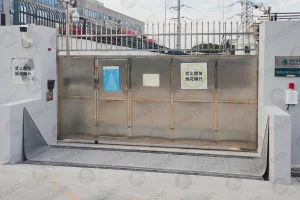
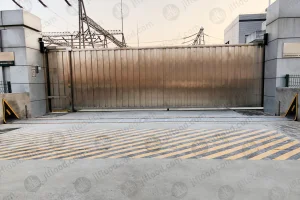
Nanjing Junli Technology Co., Ltd. has engineered a patented Hydrodynamic Automatic Flood Barrier framework that resolves the core vulnerability of legacy flood control systems: reliance on external power grids, sensors, and manual labor. Installed flush with the ground level of substation main gates, cable room doorways, or perimeter bund walls, the barrier remains hidden and vehicle-crossable during daily operations.
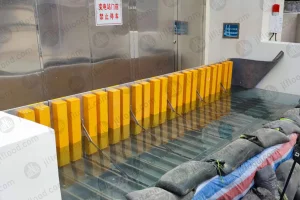
When floodwaters reach the warning threshold, water flows naturally through inlet grates into the recessed stainless steel foundation basin. As the internal water level rises, Archimedes' principle of buoyancy exerts upward force on the structural flood door panel. The panel pivots upwards, automatically creating an airtight, watertight retaining wall. The hydrostatic head pressure of the surrounding floodwater continuously presses the panel against multi-stage EPDM rubber seals, sealing the barrier tighter as flood depth increases.
| Evaluation Parameter | Legacy Sandbagging / Modular Panels | Motorized / Hydraulic Flood Gates | Junli Hydrodynamic Automatic Barrier |
|---|---|---|---|
| Power Dependence | Manual human energy required | High (Requires AC Grid / Diesel Genset) | Zero Power (100% Passive Hydro-Buoyant) |
| Activation Mechanism | Manual assembly (2-4 hours delay) | Electrical sensors / PLC relays | Automatic hydrostatic buoyancy (0.1s trigger) |
| Fail-Safe Operational Risk | High (Roads blocked, personnel missing) | High (Sensor short-circuit, power loss) | Zero Risk (Pure Mechanical Hydrodynamics) |
| Structural Load Tolerance | Low (Erosion / Seepage under head) | Moderate (Depends on actuator arm size) | Heavy Duty (Up to 40-Ton Driveover Weight) |
| Maintenance & Standby Cost | High recurring logistics costs | High (Motor servicing, oil, sensor checks) | Ultra-Low (Annual visual & seal inspection) |
| Sealing Efficiency | Poor (High leakage rates) | Moderate (Mechanical alignment dependent) | Near-Zero Seepage (Triple EPDM Sealing Profile) |
The structural stability of Junli substation flood gates is calculated under severe hydro-static thrust ($F_h$) and hydro-dynamic wave impacts ($F_d$). The total force exerted on a barrier panel of width $W$ and flood height $h$ is expressed as:
$$F_{Total} = \frac{1}{2} \cdot \rho \cdot g \cdot h^2 \cdot W + C_d \cdot \frac{1}{2} \cdot \rho \cdot v^2 \cdot (h \cdot W)$$
Where $\rho$ represents water density, $g$ is gravitational acceleration, $v$ is flood flow velocity, and $C_d$ is the dynamic drag coefficient. Junli panels utilize aircraft-grade 6063-T6 aluminum structural extrusions reinforced with internal honeycomb ribs, engineered to resist flexural deflection ($\delta < L/500$) under maximum hydrostatic head.
Integrated Defense-in-Depth strategies tailored for grid operators, EPC contractors, and municipal authorities.
A resilient substation flood defense requires a multi-layered barrier defense system. Junli Technology provides bespoke engineering layouts covering four critical zone defense layers:
Flush ground embedded hydrodynamic barriers spanning clear entry widths up to 20+ meters. Heavy vehicle capacity allows transport of massive power transformers during normal operations without structural wear.
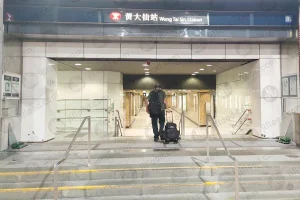
Compact, light-type modular flip-up barriers installed at pedestrian entryways of relay rooms, SCADA centers, and Gas-Insulated Switchgear halls to prevent splash back and flash urban waterlogging.
Custom embedded frame barriers sealing subterranean high-voltage cable channels and secondary control conduits, halting horizontal sub-surface water migration across substation zones.
Contact our engineering specialists today to receive custom AutoCAD embedded frame details, flood risk assessment guides, and wholesale factory pricing for your tendering specifications.
Send Inquiry NowAdhering to international electrical standards and Pakistan Standards & Quality Control Authority (PSQCA) framework.
Deploying critical flood barriers within high-voltage substation environments requires strict alignment with local civil engineering practices and international electro-technical standards. Junli Technology ensures all delivered systems satisfy rigorous electrical clearance and structural containment criteria:
How Nanjing Junli Technology delivers world-class precision engineering, rapid manufacturing scalable to massive infrastructure demands.
Headquartered in Nanjing, Jiangsu Province, Nanjing Junli Technology Co., Ltd. operates a modern, 15,000+ square meter intelligent production facility specialized exclusively in hydro-mechanical flood control systems. Operating at the intersection of civil defense engineering and automated smart manufacturing, our plant features:
Precision CNC fiber laser cutters and multi-axis robotic welding cells guarantee millimeter-accurate tolerances across single-leaf spans up to 6 meters and multi-panel arrays exceeding 50 meters.
Unlike trading companies or structural door shops, every Junli barrier model undergoes 100% full-scale water simulation testing in our specialized hydraulic testing basin, measuring seal deflection and response speeds under real water heads prior to container dispatch.
Direct answers to crucial technical questions raised by utility managers, structural consultants, and procurement managers.
The system operates strictly on fundamental physics—buoyancy and hydrostatic pressure. The barrier panel rests flush within a stainless-steel foundation chamber embedded at the substation gate. As rising surface floodwater enters the chamber via inlet grates, it exerts an upward buoyant force on the engineered hollow panel. The panel automatically pivots upward within 0.1 seconds. As the water head rises higher outside, the water pressure presses the panel tightly against structural frame seals. Zero sensors, motors, or electricity are required.
Yes. Junli heavy-duty substation flood barriers are structurally reinforced using high-tensile 6063-T6 aluminum alloys and heavy-gauge steel load frames. They are tested to withstand axle loads up to 40 tons (conforming to AASHTO HS-20 / H-20 standards), making them fully suitable for heavy transport trucks, maintenance vehicles, and cranes accessing power stations daily.
Standard hydrodynamic single-panel retaining heights range from 0.5 meters to 2.0 meters. Clear widths for single-span openings range up to 6.0 meters. For wider entrance gates (such as 10m to 30m substation perimeters), we engineer modular multi-leaf barrier arrays with removable intermediate mullions, ensuring seamless flood protection across any site span.
Maintenance is minimal compared to electromechanical systems. We recommend a biannual inspection schedule: clearing any silt or debris accumulated inside the bottom foundation chamber via the removable top drainage covers, inspecting the EPDM rubber seal strip integrity, and performing a simple manual lift test to verify smooth hinge movement.
All flood barrier components, embedded frame channels, and accessories are packed in heavy-duty export plywood crates with moisture-proof wrapping and anti-collision padding. Shipments are dispatched directly from our Nanjing facility to Karachi Port or Port Qasim, accompanied by comprehensive English installation manuals and CAD civil interface drawings.
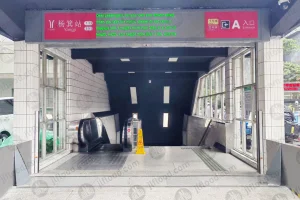
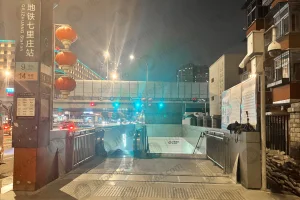
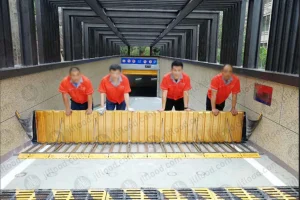
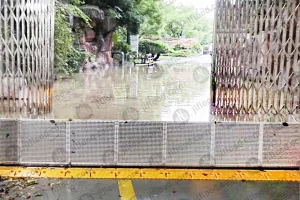
Explore our field-proven commercial flood barriers for substations, transit lines, and infrastructure projects.

Partner directly with Nanjing Junli Technology Co., Ltd. for engineering design, factory-direct wholesale pricing, and global logistics support.


