
Explore our certified hydrodynamic and self-closing barrier configurations designed specifically for high-capacity municipal entryways, subway portals, and underground connection channels.
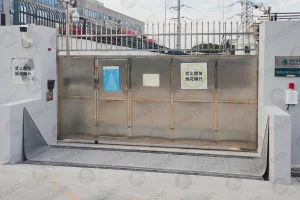
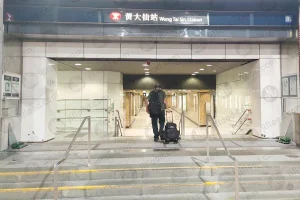
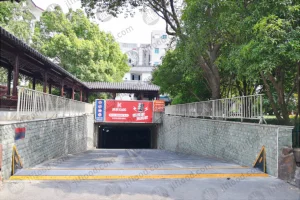
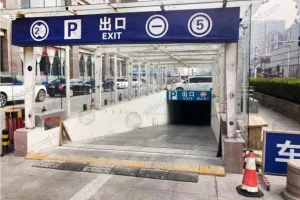
Rapid global urbanization coupled with increasing climate volatility has forced municipal authorities and transit operators to completely re-evaluate subterranean flood mitigation protocols. Modern mass transit networks—encompassing subway entryways, underground rail transit connection channels, pedestrian underpasses, and civil air-defence complexes—represent hyper-critical infrastructure assets. A single unmitigated flash-flood inundation event can result in multi-million-dollar rolling stock destruction, long-term structural power grid damage, severe operational paralysis, and catastrophic human casualty risk.
Historically, subway operator teams relied on manual deployment measures, such as stackable aluminum stop-logs, temporary flood walls, and sandbags. However, field data from major typhoon incursions across East Asia and severe cloudburst events in North America and Europe demonstrate a fatal flaw in manual flood defence: Human Error and Response Latency. Extreme precipitation frequently coincides with sudden grid failure, localized communication dropouts, and severe traffic blockades, leaving station personnel unable to deploy manual barriers before storm runoff crests station thresholds.
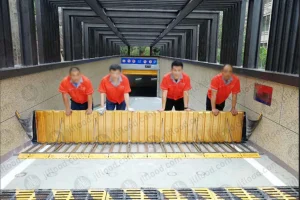
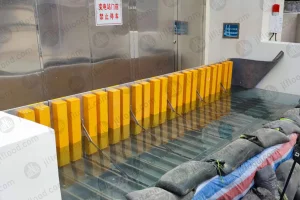
Consequently, international civil engineering specifications (including EU Eurocodes, US FEMA Technical Bulletins, and China Urban Rail Transit Civil Engineering Standards) have rapidly shifted towards mandatory integration of hydrodynamic automatic self-closing flood gates. These pop-up barrier systems rest flush within embedded floor basins during normal operational hours, enabling unobstructed passenger flow. When floodwaters reach a predefined baseline, natural hydrostatic water pressure and buoyancy dynamics automatically deploy the barrier panel without requiring electricity, motor actuators, or manual intervention.
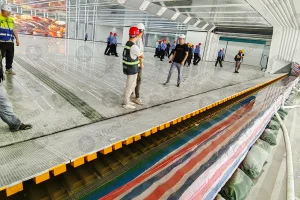
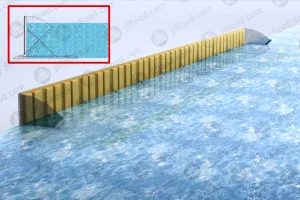
The engineering core of Nanjing Junli Technology’s wholesale automatic pop-up flood barrier relies on fundamental hydraulic physics: Archimedes' Principle combined with hydrostatic leverage. The structural housing consists of a heavy-duty embedded foundation basin, a hinged high-tensile barrier panel, dual-stage stainless steel hydraulic dampers, and continuous EPDM synthetic rubber seal profiles.
Incoming flood runoff enters the front inlet mesh of the embedded basin. As water fills the basin chamber, the engineered sealed hollow panel generates immediate positive buoyancy, pivoting upward automatically.
As water depth rises outside the entryway, external hydrostatic head pressure pushes firm against the deployed panel face, compressing the lateral and bottom EPDM gasket seals for zero-leakage retention.
Operating completely independent of power grids, batteries, wiring harness circuits, or electronic sensors, the system is immune to storm blackouts and electrical shorting.
| Technical Parameter | Junli Hydrodynamic Pop-Up Gate | Motorized Electric Flip-Up Gate | Manual Aluminum Stop-Logs |
|---|---|---|---|
| Deployment Trigger | Automatic Hydrodynamic Buoyancy | Electric Motor / Rain Sensor | Manual Labor Deployment |
| Blackout Reliability | 100% (No power required) | Low (Fails during outage/UPS fault) | N/A (Purely manual) |
| Activation Response Time | Instantaneous (< 30 seconds) | 1 - 3 Minutes | 30 - 90 Minutes |
| Standby Power Consumption | 0.00 kW/h | Continuous Sensor Draw | 0.00 kW/h |
| Pedestrian Drive-Over Flatness | Flush ground level (≤ 5mm gap) | Raised sill/housing bump | Extruded threshold track |
| Maintenance Requirements | Annual chamber debris flush | Monthly motor/wiring inspection | Storage rack & seal check |
Procuring specialized infrastructure equipment for subway projects requires absolute precision, stringent quality assurance, and scalar manufacturing capacity. Located in Nanjing, Jiangsu Province—at the center of China’s advanced metal fabrication and hydraulic engineering industrial cluster—Nanjing Junli Technology Co., Ltd. offers unparalleled supply chain advantages to global B2B procurement directors, EPC main contractors, and municipal authorities.
Our integrated manufacturing facilities bring design, extrusion, robotic welding, surface passivation, precision seal assembly, and full-scale hydrostatic testing under one rigorous ISO9001 quality management framework. Key factory advantages include:
Pop-up flood gates are engineered for versatile deployment across diverse municipal subterranean interfaces. Primary application nodes include:
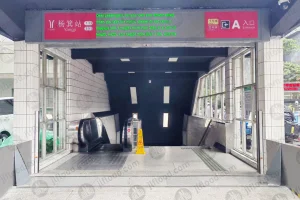
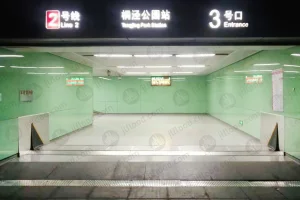
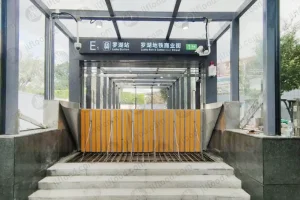
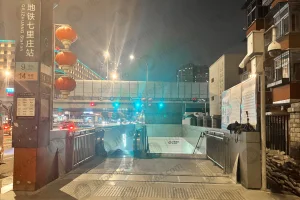
Installed flush at street-level pedestrian steps to prevent surface runoff accumulation from spilling down escalators into concourse halls.
Positioned in subterranean corridors connecting underground shopping malls directly to subway station concourses, serving as isolation barriers.
Vertical and angled pop-up barrier configurations designed to seal subterranean air intake shafts against intense storm surges.
Guangzhou Metro Yangji Station serves as a critical multi-line rail transit hub experiencing extreme tropical typhoon precipitation annually. Junli Technology engineered and supplied heavy-duty custom hydrodynamic flood barriers across high-risk entrance channels.
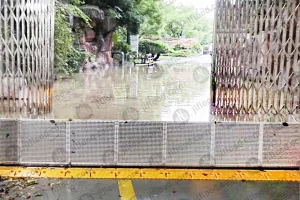
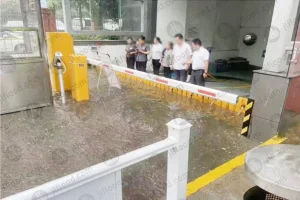
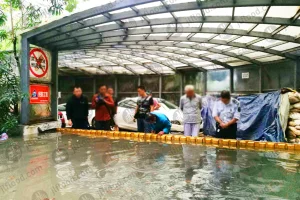
During Typhoon Bebinca and subsequent super-cell cloudburst events, the installed pop-up barriers deployed automatically as surface floodwaters submerged street curbs. The passive system completely isolated the subterranean station concourse, maintaining zero water ingress while nearby commercial basements suffered severe flooding. This field performance underscores why major metro authorities specify Junli hardware.
When evaluating wholesale flood control contracts for infrastructure projects, procurement officers must look beyond initial unit purchase prices to consider 25-year Total Cost of Ownership (TCO). Passive hydrodynamic pop-up barriers deliver substantial life-cycle cost advantages over conventional active electrical systems:
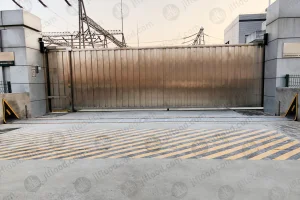
Explore our extended wholesale lineup including surface-installed units, power-free automatic gates, and power substation perimeter protection solutions.
Find authoritative answers regarding structural installation, hydrodynamic behavior, customized wholesale orders, and global project delivery.


