Explore our core wholesale selection of power-free, self-closing flood gates designed for metro systems, underground garages, and critical electrical substations.
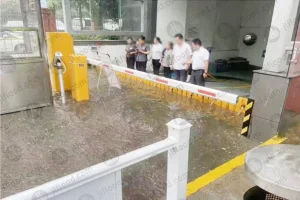
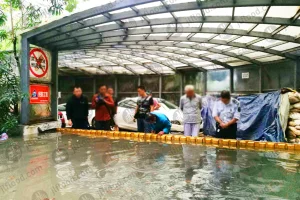
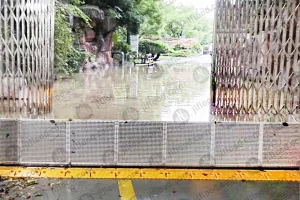
In modern civil engineering, urban waterlogging and sudden flash floods caused by severe climate events represent catastrophic threats to subterranean assets. Underground transit networks, electrical substations, commercial parking structures, and civil defense channels require resilient perimeter defenses. Traditional manual sandbags and motorized flood gates suffer from critical failure modes: manual deployment demands fast response times and available personnel during off-peak hours, whereas motorized gates rely on municipal electrical grids or battery backup systems—both of which frequently fail during severe storms due to grid blackouts and water immersion.
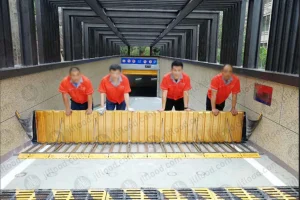
Nanjing Junli Technology Co., Ltd. has engineered an advanced solution: the Hydrodynamic Self-Closing Automatic Flood Barrier. Operating strictly on hydrostatic pressure and water buoyancy principles, this system achieves passive, zero-power automatic elevation. When floodwaters enter the surface gutter or recessed foundation basin, the hydrodynamic panel naturally rises to seal the structure. No human operation, electrical wiring, optical sensors, or mechanical pumps are required.
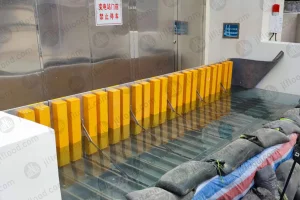
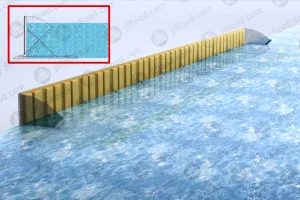
The fundamental principle relies on equilibrium displacement. As incoming water flows into the ground-embedded housing tray, the buoyancy of the structural hollow-chamber aluminum or composite panel overcomes its resting gravity. As the water head rises, the gate panel rotates upward along its mechanical pivot axis until it engages a continuous multi-lip EPDM gasket, creating a watertight barrier able to hold back dynamic flood heads up to 2.0 meters.
| Protection Metric | Junli Hydrodynamic Self-Closing Barrier | Motorized Electric Flood Gates | Manual Aluminum Demountable Stoplogs |
|---|---|---|---|
| Power Requirement | 0kW (100% Passive Hydrodynamic) | Requires 220V/380V Grid or UPS Batteries | 0kW (Manual Assembly) |
| Deployment Delay | Instantaneous (< 30 Seconds) | 1 to 5 Minutes (If Power Active) | 30 to 120 Minutes (Requires Crew) |
| Blackout Reliability | 100% Immunity to Power Failure | High Failure Risk during Grid Outage | Dependent on Crew Availability |
| Driveway Load Rating | Up to 60-Ton Axle Load (Heavy Trucks) | Varies (10T - 30T Average) | No Drive-Over Capability (Post-Mounted) |
| 20-Year Maintenance Cost | Minimal (Visual Inspection & Debris Flush) | High (Motor, Battery & Sensor Servicing) | Moderate (Storage & Seal Degradation) |
When engineering consultants, EPC (Engineering, Procurement, and Construction) contractors, and municipal procurement directors evaluate self-closing automatic flood barrier pricelists, understanding the underlying cost components is vital for Total Cost of Ownership (TCO) optimization. Wholesale pricing for hydrodynamic gates is calculated on a per-meter or per-system matrix based on structural engineering parameters rather than simple material volume.
Key variables influencing unit cost and project quotes include:
Standard modular units cover retaining heights from 0.5m to 2.0m. Single clear spans reach up to 6.0 meters, while wide driveway openings (> 20 meters) utilize modular multi-leaf interconnecting arrays with intermediate support posts.
Ground-embedded housings are engineered for varying live loads. Standard commercial garages require 20-ton passenger vehicle ratings, whereas metro access gates and logistics centers demand heavy-duty 30T to 60T structural reinforcement.
Panels are available in T6063-T6 High-Strength Anodized Aluminum Alloy, SUS304 Stainless Steel, or SUS316L Marine-Grade Stainless Steel for coastal, high-salinity marine environments subject to severe atmospheric corrosion.
By eliminating electromechanical components, sensors, wiring conduits, and backup generators, hydrodynamic automatic gates reduce total procurement and installation CAPEX by up to 35% compared to automated hydraulic barriers, while lowering 20-year OPEX close to zero.
Nanjing Junli Technology Co., Ltd. operates a specialized manufacturing hub in Nanjing, Jiangsu Province. As a integrated R&D and production enterprise spanning civil defense, smart energy, and hydraulic engineering, our facility delivers substantial cost advantages and technical precision to international buyers.
Our production ecosystem incorporates fiber laser cutting, automated robotic welding cells, CNC machining of structural hinges, and custom vulcanization processing for multi-lip EPDM sealing profiles. In-house tooling control guarantees micro-meter tolerances across embedded frame channels.
Unlike generic fabricators, Junli maintains a dedicated, full-scale hydraulic testing basin. Every design iteration and finished wholesale batch undergoes rigorous hydro-static pressure testing, dynamic rising velocity analysis, and zero-leakage verification prior to international packaging.
This concentrated industrial ecosystem allows us to offer OEM/ODM customization with lead times 40% shorter than European or North American manufacturers, supported by complete material test reports (MTR), mill certificates, and third-party inspection documentation.
Deploying flood barriers across international jurisdictions requires strict alignment with global flood mitigation and structural codes. Junli hydrodynamic self-closing flood gates are engineered to meet and exceed regulatory frameworks across key global markets:
Designed in compliance with FEMA Technical Bulletin 3-93 and FM 2510 flood mitigation standards for structural safety, allowable leakage rates, and hydrodynamic impact loads.
Conforms to EN 1991-1-6 (Eurocode 1: Actions on Structures) for hydrostatic and wave forces, combined with CE marking for structural metalwork under EN 1090-1.
Fully compliant with GB 50014 (Outdoor Drainage Design Standard) and high-speed rail/metro civil defense specifications applied in Hong Kong, Singapore, and Mainland China.
To ensure operational integrity under extreme environmental stresses, Junli offers specialized climate engineering packages:
Junli self-closing automatic flood barriers have been proven in field deployments across major municipal projects. Below are representative application scenarios:
Case Reference: Guangzhou Metro Yangji Station & Suzhou Metro Network
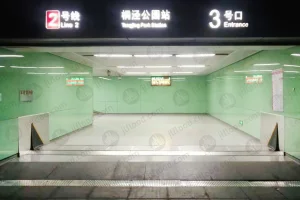
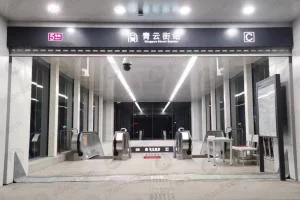
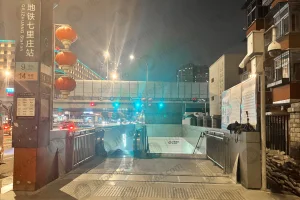
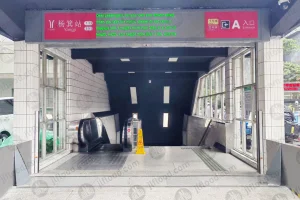
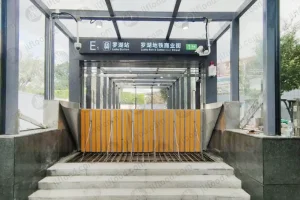
Underground subway concourses represent critical flood pathways. Surface-mounted (HM4D-0006E) and embedded-type flood barriers were installed at street-level pedestrian entrances and connection channels. During extreme rainfall, water rising at the entrance threshold automatically deployed the barriers, preventing inundation of active subway tunnels without requiring staff intervention.
Case Reference: State Grid 110kV & 220kV Substation Perimeter Gates
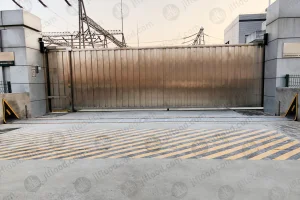
Power infrastructure failure during urban flooding triggers widespread blackouts. Junli wide-span substation perimeter gates allow continuous heavy maintenance vehicle transit under normal conditions. In flooding scenarios, the ground-embedded panel automatically seals the gateway, protecting high-voltage transformer rooms and switchgear cable trenches.
Case Reference: Wanda Plaza Shopping Mall Underground Garages
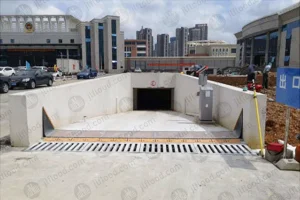
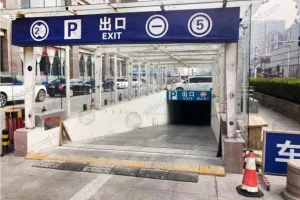
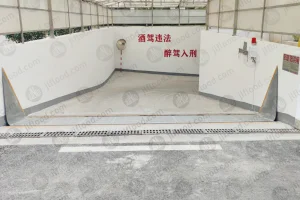
Basement parking structures are prime targets for storm runoff accumulation. Installed across vehicle access ramps, Junli heavy-duty barriers sit completely flush with the roadway surface. Cars drive over the reinforced top plate daily. When flash floods sweep down the ramp, the panel floats upward to block water ingress completely.
Case Reference: Jinan Civil Defense Underground Crossings & Guangzhou Airport
Protecting high-footfall public pedestrian tunnels and airport ground equipment rooms requires ultra-reliable perimeter seals. Junli stainless steel self-closing barriers maintain high aesthetic integration while offering instant passive defense against urban waterlogging.
As municipal authorities globally embrace the "Sponge City" concept and climate adaptation masterplans, flood control infrastructure is evolving from reactive manual labor to proactive autonomous systems. Over the next decade, two macro-trends will dominate the wholesale market:
Building regulations worldwide are shifting away from active electrical systems toward unpowered passive hydrodynamics. Standardizing passive self-closing gates into municipal building codes eliminates human error and grid dependency during emergency evacuations.
While the elevation movement remains 100% mechanical and power-free, modern Junli barriers can be equipped with micro-power IoT sensors. Limit switches and optical telemetry transmit real-time gate position status (Closed/Deploying/Sealed) to central Smart City SCADA control centers via LoRaWAN or 5G cellular modules.
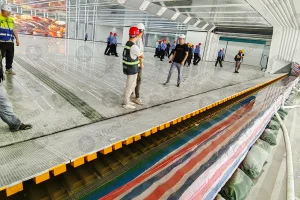
The system utilizes natural hydrostatic principles. The flood barrier panel rests flush inside a recessed ground basin. When surface runoff flows into the basin tray, water buoyancy lifts the lightweight hollow aluminum or composite panel. As water depth increases, hydrostatic pressure pushes the panel tightly against vertical frame seals, mechanically locking it into position. It requires zero electrical power, sensors, pumps, or human intervention.
Standard modular panels provide retaining heights ranging from 0.5 meters to 2.0 meters. Single-leaf clear spans can reach up to 6.0 meters. For wider entrances, such as multi-lane parking ramps or wide substation gates (> 20 meters), modular intermediate mullions are utilized to connect multiple barrier leaves seamlessly.
Yes. Junli manufactures embedded housing units rated for vehicle axle loads from 20 tons (standard commercial cars) up to 60 tons (heavy fire engines, logistics trucks, and military vehicles). The top cover plate is reinforced with internal structural ribbing to withstand continuous high-frequency traffic.
Embedded models require a concrete trench designed to accommodate the frame basin, along with a bottom drainage pipe connection leading to the site's storm sewer or sump pit to clear residual rainwater post-event. Junli supplies detailed civil engineering templates, rebar layouts, and step-by-step pouring guides for local contractors.
Because there are no motors or electrical drives, maintenance is straightforward: periodic flushing of the bottom chamber to remove leaves and sediment debris (semi-annually), visual inspection of the EPDM rubber seals, and manual lifting tests once a year. Replacement seal kits are modular and easily swapped on-site.
Review additional heavy-duty models, substation-specific flood gates, and specialized embedded configurations for infrastructure projects.