
Precision-engineered hydrodynamic barriers deployed directly from Chinese high-tech manufacturing hubs to critical infrastructure projects across Doha, Qatar, and the wider GCC region.
Analyzing Climate Risk Mitigation, Kahramaa Technical Specifications, and Architectural Integration of Self-Rising Passive Flood Gates for Electrical Grid Infrastructure in Qatar.
The State of Qatar, driven by Qatar National Vision 2030, has experienced an unprecedented expansion of critical infrastructure, industrial zones, and urban real estate networks. Core to this transformation is the national power grid managed by the Qatar General Electricity and Water Corporation (Kahramaa). Primary Gas-Insulated Substations (GIS) supplying key nodes—such as the Lusail Iconic Development, West Bay Commercial Hub, Hamad International Airport, Ras Laffan Industrial City, and the Mesaieed Industrial Area—represent multi-billion-dollar sovereign assets.
However, urban expansion combined with changing Middle Eastern atmospheric patterns has created an urgent vulnerability: high-intensity rain events, locally termed as violent torrential downpours or cloudbursts. While annual precipitation in Doha remains low, storm intensity per hour regularly exceeds civil drainage design capacity, generating flash surface runoff across impervious desert pavements.
Doha’s unique topography features low-lying coastal plains combined with enclosed natural depressions ("rawdas" and "wadis"). Rapid urban development has altered historical natural drainage channels. During sudden convective storm events, water accumulates rapidly against raised perimeter walls and vehicle access gates of transmission substations.
Why passive buoyancy-driven flood defense mechanisms superiorly outperform electric, manual, and modular stop-log barriers in high-stakes electrical utilities.
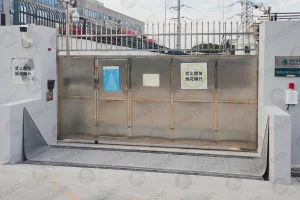
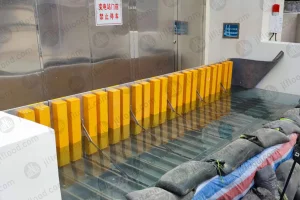
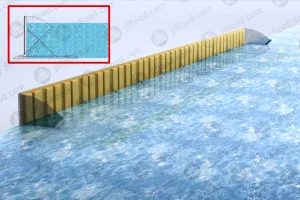
Unlike electro-mechanical flip-up gates that rely on sensors, emergency power generators, or human operator activation during a storm, hydrodynamic flood barriers operate purely on Archimedes' principle. Incoming floodwater fills the embedded ground basin, naturally floating the reinforced barrier panel up into a vertical locking position automatically.
Severe meteorological events in Doha frequently cause localized power distribution failures before floodwaters crest. Because hydrodynamic barriers require zero electrical power, battery backup, or hydraulic oil pumps, they deliver 100% fail-safe operational readiness precisely when power infrastructure fails.
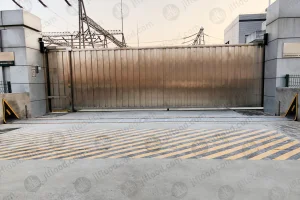
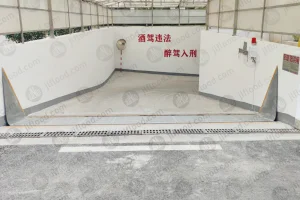
When dry, the hydrodynamic barrier rests fully recessed within a heavy-duty stainless steel frame flush with the substation road surface. Heavy transport vehicles, including SF6 gas trailers and multi-ton transformer trucks (wheel load capacity up to 60 tons / AASHTO HS-20), pass overhead without damaging the seal mechanism.
Equipment deployed in the Doha region must withstand severe marine salinity from the Persian Gulf, elevated groundwater table sulfates, and ground ambient temperatures reaching 55°C. Factory customized barriers for Qatar feature 316L grade stainless steel bottom frames, marine-grade anodized aluminum alloy (6063-T6) panels, and UV-stabilized fluorocarbon EPDM composite seals designed to prevent embrittlement under intense UV irradiation.
How Chinese specialized flood barrier manufacturing clusters (e.g., Nanjing Junli Technology) provide Middle East EPC contractors unparalleled strategic procurement advantages.
For GCC utility tender bids (Kahramaa, SEC, DEWA), main civil contractors face tight structural budgets. Traditional European flood barrier manufacturers operate on prolonged fabrication timelines with exorbitant custom engineering surcharges. Leading Chinese manufacturers leverage integrated industrial supply chains, advanced CNC laser profiling, robotic welding, and automated assembly to deliver identical or superior technical performance at 40% to 60% lower capital expenditure.
Furthermore, high-throughput manufacturing capacity allows Chinese factories to fabricate and dispatch full substation barrier lots (spanning 3m to 20m clear widths) within 15 to 20 operational days, drastically mitigating project delay liquidated damages (LDs) for EPC contractors in Qatar.
Information Gain in tender submittals is achieved through verifiable empirical evidence. Leading Chinese specialized factories operate dedicated full-scale hydraulic test basins. Every unit manufactured for Doha projects undergoes rigorous pre-shipment hydrostatic head pressure testing.
| Evaluation Parameter | Hydrodynamic Automatic Barrier (China Factory) | Traditional Electric Flip-Up Gate | Manual Aluminum Stop-Logs |
|---|---|---|---|
| Power Requirement | 0 kW (100% Passive Hydrodynamic) | 3.5 kW – 7.5 kW (Grid Dependent) | 0 kW (Manual Assembly) |
| Human Intervention | Zero (Fully Autonomous) | Low (Requires Control Signal) | High (Critical Personnel Risk) |
| Maintenance Overhead | Ultra-Low (Annual Visual & Wash) | High (Motors, Sensors, Wiring) | Medium (Storage & Gasket Wear) |
| Doha Extreme Heat Resilience | Superior (Passivated Steel/EPDM) | Moderate (Electronic Failure Risks) | High (Mechanical simplicity) |
| Total Cost of Ownership (10 Yrs) | Lowest (Zero Energy & Minimal Repairs) | Highest (Constant Maintenance & Power) | Moderate (Labor intensive) |
Architectural and civil engineering integration points for hydrodynamic barriers across commercial, utility, and transit sectors in Qatar.
Protection of main driveways, perimeter boundary gates, and subterranean cable entry rooms for 66kV, 132kV, and 400kV Kahramaa substations. Recessed foundation frame embeds seamlessly into reinforced concrete aprons.
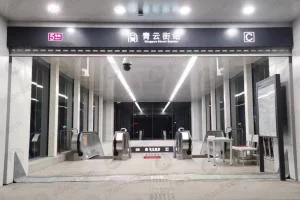
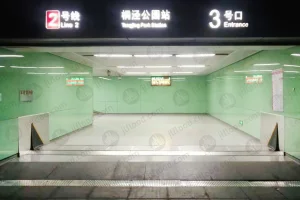
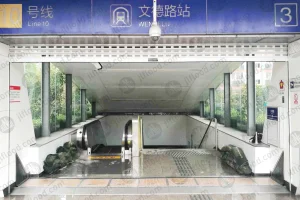
Securing traction substations (TSS), bulk supply points, and ventilation shafts along the Doha Metro Red, Green, and Gold lines against surface flood ingress during sudden desert deluges.
Perimeter defense for control centers and auxiliary electrical switchgear rooms within combined water and power plants (IWPPs) located in Ras Laffan and Umm Al Houl industrial districts.
Standard engineering specification criteria to incorporate into project tender submittals for Qatar infrastructure projects.
Our senior hydraulic engineering team provides complete technical support, civil drawings, and factory direct quotes tailored to Kahramaa and GCC utility specifications.
Send Inquiry NowDirect answers to crucial questions asked by consulting engineers, utility authorities, and civil contractors.
The barrier panel rests flush inside an embedded stainless steel ground chamber. When flash floodwater reaches the entrance, water enters the chamber through inlet grates. As the water level inside the chamber rises, natural hydro-buoyancy pushes the lightweight marine aluminum panel upwards. Hydrostatic pressure from the retained floodwater then forces the panel firmly against vertical rubber side seals, creating a completely watertight barrier. No motors, sensors, pumps, or electricity are involved.
Yes. Our surface and embedded substation flood barriers are structurally engineered and load-tested for heavy utility traffic. The top cover plate and internal load support ribs are manufactured from high-strength stainless steel or structural carbon steel, rated to handle heavy vehicle axle loads up to 40-60 tons (AASHTO HS-20 / EN124 D400 standard), making them ideal for transformer delivery gates.
We customize material selection specifically for Middle East environmental conditions. Structural ground frames utilize 316L grade stainless steel or hot-dip galvanized steel with multi-layer epoxy powder coating. Barrier panels feature marine-grade anodized aluminum (6063-T6). Sealing elements use UV-resistant, thermal-stable EPDM rubber designed to maintain elasticity up to 120°C ambient contact without cracking or degradation.
Yes. As surface floodwater subsides, water inside the barrier foundation chamber drains out through the integrated bottom drainage pipe connected to the site storm network. As the chamber empties, the barrier panel smoothly descends back into its flush, ground-level resting position under gravity, fully restoring unobstructed vehicle access.
Standard manufacturing lead time for custom engineered substation barriers is 15 to 20 calendar days. Ocean freight shipping from Ningbo/Shanghai ports to Hamad Port in Doha typically takes 18 to 22 days. Air freight options are available for urgent project milestones.
Explore our full portfolio of embedded, surface, and modular flood defense solutions engineered for high-reliability municipal and utility installations.
Direct factory pricing, custom engineering support, Kahramaa specification compliance, and rapid international shipping for all infrastructure developments across Doha and the Middle East.
Send Inquiry Now

