
Precision-manufactured flood defense gates field-tested for underground rail, substations, and commercial garages.

In an era defined by intensifying climate volatility, urban centers across the globe are confronting unprecedented hydrodynamic challenges. Municipal stormwater infrastructure, often designed based on historical 50-year rainfall metrics, is increasingly overwhelmed by extreme precipitation events, cloudbursts, and flash flooding. Structural ingress points—specifically underground parking ramps, metro transit portals, electrical substation doorways, and commercial basement accessways—represent the most vulnerable vectors for catastrophic water intrusion.
When extreme surface runoff meets structural openings, the financial damage extends far beyond physical asset degradation. Electrical short circuits, traction power outages in mass transit, destruction of high-voltage transformers, and business interruption liabilities can aggregate into tens of millions of dollars per event. Consequently, civil engineering standards have pivoted from reactive mitigation (e.g., manual sandbag deployments or temporary demountable aluminum stop-logs) toward unattended, hydrodynamic, self-actuating aluminum door protection flood barrier systems.
During severe urban waterlogging, localized grid collapse and power station trips are statistical certainties. Motorized electric flood gates or automated hydraulic barriers that depend on power lines or backup diesel generators suffer high fail-rate probabilities due to wiring short-circuits, relay submergence, or battery degradation. Purely hydrodynamic passive flood barriers leverage the natural buoyancy and hydrostatic head pressure of incoming floodwater to automatically raise and lock the structural aluminum panel—zero human operation, zero sensor dependency, and zero standby energy consumption.
This technical whitepaper examines the design principles, material science, Chinese manufacturing advantages, and deployment engineering of high-strength Aluminum Door Protection Flood Barriers manufactured by industry leader Nanjing Junli Technology Co., Ltd..
The operational longevity and structural integrity of an door protection flood barrier depend on three vital engineering pillars: profile structural modulus, gasket resilience, and passive mechanical leverage.
Structural door protection barriers must withstand extreme hydrostatic loads (horizontal force generated by static water depth) as well as hydrodynamic impact loads caused by wave action and floating debris. High-grade extrusions utilizing 6063-T6 or 6005A-T6 heat-treated aluminum alloy offer an exceptional strength-to-weight ratio, high yield tensile strength (≥205 MPa), and superior corrosion resistance in urban runoff containing de-icing salts, hydrocarbons, and alkaline chemicals.
Anodized surface coatings (film thickness ≥15 μm) or fluorocarbon powder coatings provide robust protection against atmospheric oxidation, UV radiation, and salt spray exposure, ensuring a operational service life exceeding 20 years in harsh urban environments.
Zero-leakage compliance demands continuous, high-performance elastomeric seal interfaces along both vertical jambs and the horizontal floor threshold. Utilizing specialized Ethylene Propylene Diene Monomer (EPDM) compound formulations engineered for wide thermal fluctuations (-40°C to +120°C):
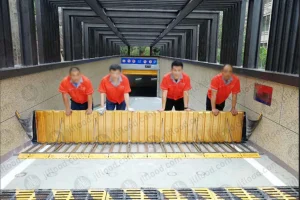
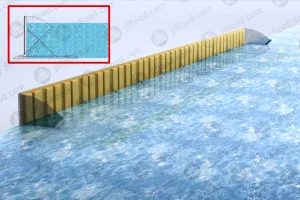
The automatic self-closing and self-rising flood barrier models (such as the Hm4d-0006D series) operate via an integrated bottom chamber. When floodwater reaches a pre-determined trigger level, water flows into the recessed stainless-steel bottom frame chamber. The custom hollow aluminum panel, engineered with optimized internal density and buoyancy distribution, lifts passively as water fills the reservoir. As water rises further, the hydrostatic pressure forces the panel firmly against the structural sealing frame, establishing a watertight barrier.
Multi-cavity internal rib reinforcement designs distribute bending moments evenly, preventing permanent deformation under maximum flood head.
Engineered dual-durometer rubber profiles ensure seamless compression against concrete or steel civil interfaces with near-zero leakage.
Activated solely by water density and hydraulic head pressure. Operates reliably during complete municipal blackout conditions.
Global procurement directors, EPC contractors, and municipal planning authorities increasingly partner with specialized Chinese manufacturers like Nanjing Junli Technology Co., Ltd. for large-scale urban infrastructure defense. China’s industrial manufacturing ecosystem provides distinct structural advantages:
China accounts for over 50% of the world's aluminum extrusion capacity. Located in the Yangtze River Delta industrial hub, Nanjing Junli Technology maintains direct vertical integration with top-tier smelting and extrusion facilities. This cluster efficiency allows rapid customization of custom structural profiles, large-span single-leaf extrusions (up to 6 meters clear span without central mullions), and specialized alloy tempering—delivering unmatched lead-time speed and cost efficiency.
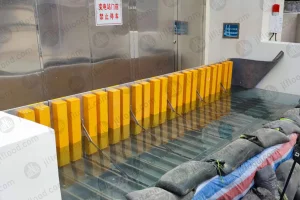
Unlike regional fabricators who rely solely on computer modeling, advanced Chinese flood barrier manufacturers maintain dedicated, in-house hydraulic test basins. Every production batch of Flood Barrier Water Testing products undergoes real-world hydrostatic loading, seal displacement measurements, and mechanical cyclic actuation testing before export shipping. Third-party inspection witnessing (SGS, TÜV, BV) and factory water-test video documentation accompany every international order.
No two architectural entrances are identical. Structural door openings vary widely in kerb height, concrete strength grade, finish elevation, and traffic loading requirements. China’s deep engineering talent pool allows Junli to deliver custom BIM models, CAD shop drawings, and tailored anchoring detail schematics within 48 hours of project brief submission.
| Barrier Technology Type | Actuation Method | Blackout Reliability | Maintenance Overhead | Application Suitability |
|---|---|---|---|---|
| Hydrodynamic Automatic Self-Rising Barrier | Water Buoyancy & Hydrostatic Pressure | 100% (No Electricity Needed) | Very Low (Annual Seal Clean) | Underground Garages, Metro Entrances, Substations |
| Manual Aluminum Stop-Log Demountable Barrier | Manual Human Assembly | High (Requires Human Presence) | Low (Storage Gasket Check) | Storefront Doors, Commercial Entrances |
| Electric Motorized / Hydraulic Drop Barrier | Electric Motor / Hydraulic Pump | Medium-Low (Fails on Grid Collapse) | High (Motors, Sensors, Fluids) | Controlled Access Checkpoints, Toll Gates |
| Traditional Sandbag Defense | Manual Stacking | Extremely Low (Slow & Permeable) | Extreme Labor Cost per Event | Emergency Temporary Use Only |
Aluminum door protection flood barriers are deployed across diverse urban environments, each presenting unique civil interface and load-bearing constraints.
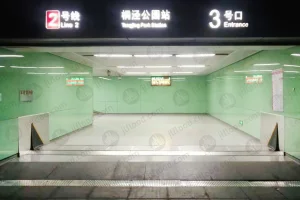
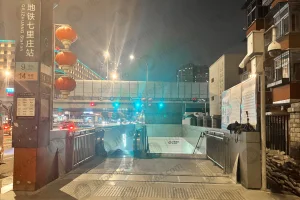
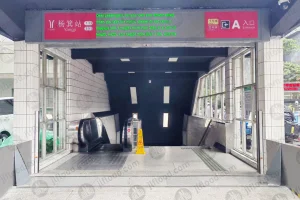
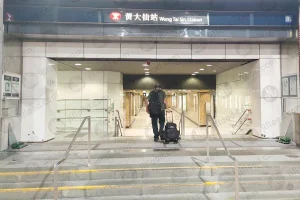
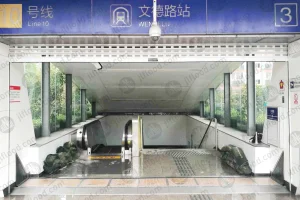
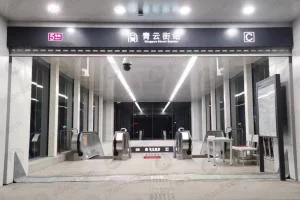
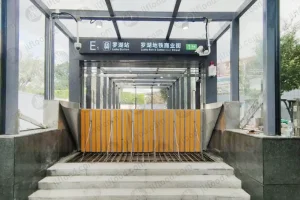
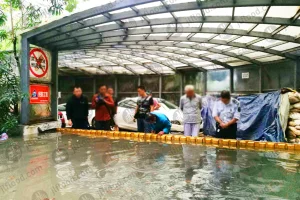
Subway portals represent high-risk funnels during urban flash floods. Water entering a single subway station can cascade into subterranean connection tunnels, paralyzing city-wide rail networks. Product configurations like the Metro Flood Barrier series feature flush-to-grade ground frames that allow unimpeded pedestrian traffic during normal operation. When floodwaters surpass kerb height, the hydrodynamic panel raises automatically, establishing a sealed dam up to 2.0 meters high. Field-proven installations include metro lines across Guangzhou, Beijing, Suzhou, Nanjing, Dalian, and Hong Kong.
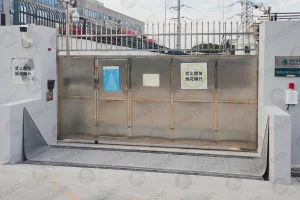
Substation door protection is vital for regional power grid security. Uncontrolled water ingress into switchgear rooms or transformer vaults causes explosive short circuits and long-term blackout disruptions. The Substation Flood Barrier range provides perimeter protection at vehicle access gates and equipment doorways. Designed for zero-spark passive operation, these barriers require no electrical connections, eliminating ignition hazards in high-voltage environments.
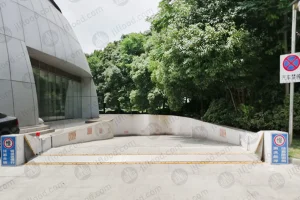
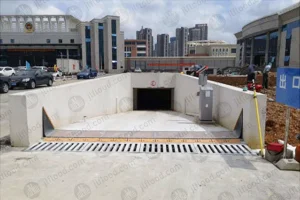
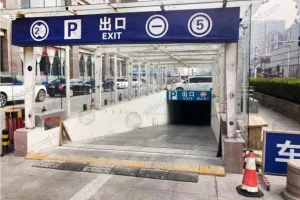
Underground parking ramps require flood barriers capable of supporting continuous heavy vehicle traffic. The Garage Flood Barrier system incorporates heavy-duty structural aluminum panels housed within a reinforced steel chamber capable of withstanding 30-ton to 40-ton vehicle axle loads (HS-20 / Eurocode loading standards). Cars drive over the flush top plate daily without noise or vibration; during cloudbursts, the barrier raises autonomously to seal the ramp.
For retail fronts, hospital entrances, and public buildings, aesthetics and rapid deployment are paramount. Surface-mounted and flip-up aluminum flood barriers offer low structural depth, seamlessly integrating into architectural facade thresholds without extensive excavation.
When drafting tender documents or requesting technical quotes for aluminum door protection flood barriers, engineering teams should mandate the following minimum structural and material criteria:
By partnering directly with a specialized manufacturer like Nanjing Junli Technology Co., Ltd. Global Service Division, international buyers receive comprehensive BIM files, installation manuals, spare EPDM seal kits, and remote or on-site commissioning support tailored to regional building codes.
Explore our full line of hydrodynamic, surface-type, and self-closing flood gates engineered for high-risk assets.
In-depth technical clarifications regarding hydrodynamic activation, installation requirements, maintenance schedules, and international compliance.
The hydrodynamic automatic flood barrier sits completely flush within a recessed foundation chamber embedded at the door threshold. During a flood event, rising surface runoff enters the bottom chamber through intake grates. As water fills the basin, it generates natural hydraulic buoyancy and hydrostatic head pressure against the specially balanced hollow aluminum panel. This forces the panel to rotate or elevate into the upright retaining position within seconds. A mechanical locking device holds the panel upright as water depth increases. The entire sequence requires zero electrical power, zero optical sensors, zero hydraulic pumps, and zero human intervention—ensuring 100% operational reliability even during city-wide electrical blackouts.
Junli supplies standard hydrodynamic automatic units covering retaining heights from 0.5 meters to 2.0 meters. Single-leaf clear spans can reach up to 6.0 meters without intermediate support pillars. For extra-wide vehicle ramps, metro plazas, or commercial driveways exceeding 20 meters, modular multi-leaf arrays with removable or subterranean pop-up mullions are deployed. Light flip-up and demountable aluminum stop-log barriers are also available for narrow pedestrian doorways, utility access hatches, and cable trench entrances.
Yes. Every engineered design undergoes full-scale verification in our custom hydraulic testing pool at our Nanjing manufacturing facility. We test for activation response time, elastomeric seal compression leakage rates, and structural panel deflection under 100% and 150% rated hydrostatic head pressure. High-definition video recordings, seal inspection certificates, and third-party witness reports (SGS/TÜV/BV) can be provided prior to dispatch.
For embedded hydrodynamic barriers, a concrete trough matching the barrier’s structural depth (typically 200 mm to 450 mm depending on model and loading grade) must be constructed with reinforced rebar anchors and connected to a gravity drain or sump pit to discharge residual water post-flood. Junli provides detailed CAD embedded-frame templates, concrete strength requirements (min. C30/C35 grade), and step-by-step installation guides. For retrofit applications on existing buildings where deep excavation is unfeasible, surface-mounted flip-up barriers or low-profile demountable aluminum log systems can be anchored directly onto existing flat concrete aprons.
Hydrodynamic passive barriers feature extremely low maintenance requirements because they lack electrical motors, hydraulic pumps, or complex electronic control boards. Maintenance involves semi-annual inspection of the embedded bottom chamber to clean out accumulated silt or leaf debris, flushing the drainage connection, and inspecting the EPDM seals for physical damage or mineral buildup. Spare seal replacement kits and English maintenance manuals are provided with every global shipment.


