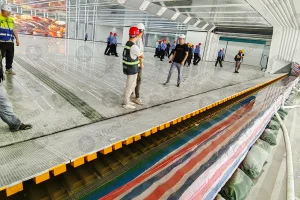
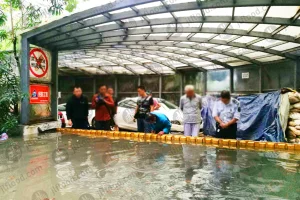
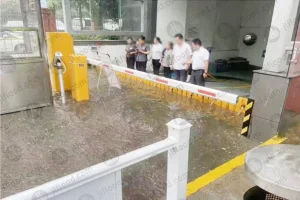
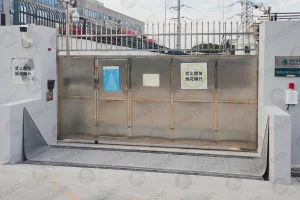
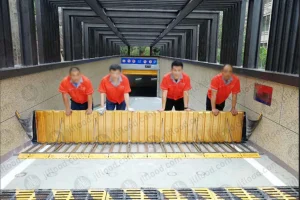
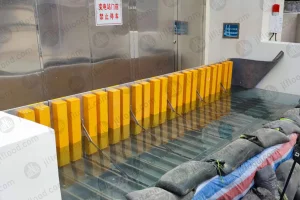
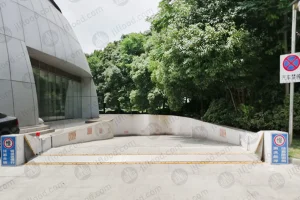
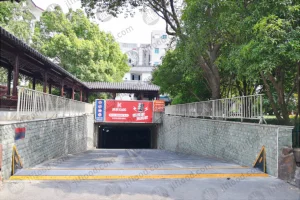
Subway systems are the lifeblood of modern megacities, yet their subterranean design makes them acutely vulnerable to sudden cloudbursts, urban river overflows, and extreme meteorological events. This technical manual details the design, procurement, and deployment of passive automatic flood barrier devices engineered specifically for underground infrastructure.
Operates strictly on continuous hydrostatic pressure and buoyant force ($F_b = \rho V g$). Requires 0kW electricity, ensuring 100% operation during severe grid blackouts when municipal flood risks peak.
Initial passive deployment activates within 0.1 to 0.5 seconds of surface water ingress into the embedding basin. Full dam height is achieved automatically as water levels rise.
Constructed with marine-grade 6063-T6 aluminum structural extrusions and heavy-gauge SUS304/316 stainless steel frame housings built to withstand extreme dynamic loading and vehicular roll-overs.
Unlike electromechanical flood gates that rely on water level sensors, PLC controllers, backup diesel generators, and motorized actuators—all of which present single-point electrical failure vectors during inundation—the Hydrodynamic Automatic Flood Baffle utilizes the potential energy of the floodwater itself.
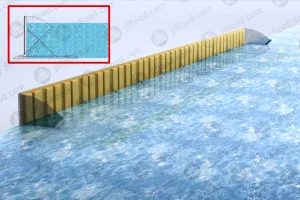
When heavy runoff breaches the station threshold, water enters the pre-embedded floor channel through modular stainless steel intake grilles. The water accumulates inside the sealed basin, generating immediate positive buoyancy under the counterweighted hollow aluminum barrier blade. As the liquid level within the basin rises, hydraulic pressure forces the gate leaf to rotate smoothly upward around its stainless steel pivot axis. Dual high-density EPDM compression gaskets automatically seal against the side jambs and bottom recess, forming an impermeable, self-tightening water barrier.
Mathematically, the dynamic equilibrium equation governing the barrier opening moment ($M_o$) is expressed as:
M_o = \int_{0}^{H} \rho_w g (H - z) \cdot w \cdot L_b \cos(\theta) dz - W_b \cdot r_{cg} \cos(\theta) > 0
Where $\rho_w$ is fluid density, $H$ is instantaneous water head, $w$ is clear width span, $W_b$ is barrier structural mass, and $\theta$ is the dynamic rotation angle. This hydro-mechanical advantage guarantees that higher flood head directly increases seal compression force, eliminating human error during emergency events.
Empirical data from urban transit authority installations across 30+ metro networks nationwide.
Procuring subway automatic flood barriers directly from top-tier Chinese manufacturers (such as Nanjing Junli Technology) offers global infrastructure contractors unparalleled economies of scale, stringent ISO-certified quality assurance, and modular customization.
Nanjing's advanced manufacturing cluster combines precision CNC laser profiling, automated robot TIG welding, continuous aluminum anodizing, and full-scale hydrostatic testing pools in a single location.
Optimized raw material procurement (domestic 6063-T6 alloy billets) combined with high-volume automated manufacturing yields premium barrier devices at a fraction of European or North American fabrication costs.
Fully customizable clear spans (from 1.5m pedestrian passages up to 24m wide multi-leaf vehicular station plazas) designed to match specific civil drawings and local rainfall return period standards.
Note: Pricing varies based on clear width, dynamic load requirements (pedestrian vs. heavy maintenance trucks), seal material (EPDM vs Fluororubber), and embedded concrete casing depth. The following reference table outlines typical factory pricing tiers:
| Model / Product Code | Target Application | Standard Retaining Height | Structural Material | Estimated Price Tier (USD / Meter) |
|---|---|---|---|---|
| HM4D-0006A (Standard) | Subway Pedestrian Entrance / Concourse Steps | 600 mm – 900 mm | 6063-T6 Anodized Aluminum | $450 – $680 / m |
| HM4D-0006C (Heavy-Duty) | Metro Logistics Ramps / Service Depots | 1,000 mm – 1,500 mm | SUS304 Casing + Reinforced Alloy | $850 – $1,250 / m |
| HM4D-0006E (Surface-Mount) | Existing Retrofit Stations (No Deep Excavation) | 500 mm – 800 mm | Marine-grade Aluminum Alloy | $520 – $790 / m |
| Substation-Spec Gate | Transformer Vault Doorways & Cable Trenches | 600 mm – 1,200 mm | Dielectric Stainless / Aluminum Composite | $600 – $950 / m |
| Multi-Leaf Interlocked Array | Wide Subway Station Entrances (>10m Width) | 1,200 mm – 2,000 mm | SUS316 Casing + Dual Hydraulic Dampers | $1,100 – $1,800 / m |
* Complete wholesale quotation spreadsheets, volume discount schedules for municipal subway contracts, and engineering CIF shipping calculations can be requested directly from our commercial division.
Exporting heavy urban resilience equipment demands strict adherence to international building codes, civil engineering interfaces, and local site conditions. Junli Technology provides end-to-end technical documentation for global EPC contractors.
Our subway automatic flood baffles comply with international flood barrier standards, including FM 2510 (American National Standard for Flood Abatement Equipment), BS EN 124 (Gully tops and manhole tops), and ISO 9001:2015 / ISO 14001:2015 quality and environmental management protocols.
We supply full 3D CAD, Revit, and BIM Level 2 structural families for immediate integration into station architectural design models. Embedded bottom frame structural steel rebars are designed to match local concrete reinforcement grid specifications (e.g., Eurocode 2, ACI 318).
To ensure flawless installation, overseas project teams receive comprehensive English installation manuals, step-by-step video tutorials, rebar tie-in templates, and remote engineering oversight. On-site engineer dispatch is available for major transit network installations.
Subterranean rail networks feature diverse structural openings. Modern flood protection requires specialized baffle configurations tailored to each ingress point.
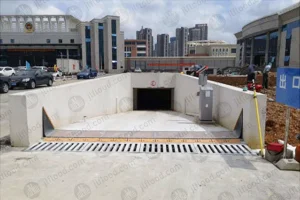
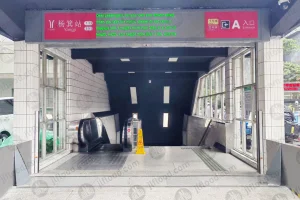
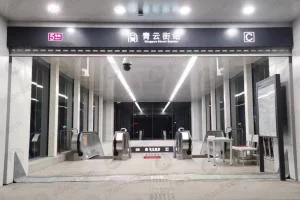
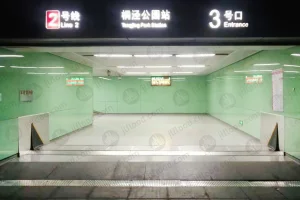
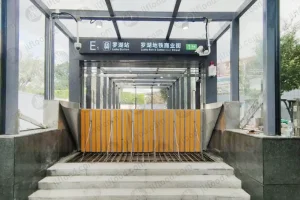
Located at pedestrian station stairs and escalator landings. Units are embedded completely flush with the floor, featuring anti-slip diamond treads on the top face. Passengers walk across without tripping hazards during normal transit operations.
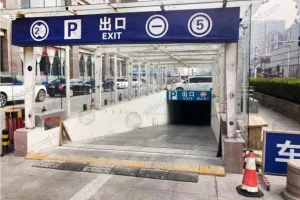
Heavy-duty reinforced models (HM4D-0006C tier) engineered to endure frequent passage of heavy service trucks, emergency vehicles, and forklifts up to 40 tons without distorting the underlying water basin or sealing tracks.
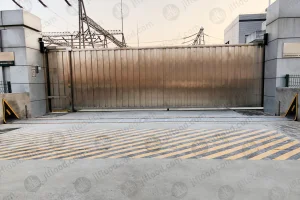
Crucial electrical distribution vaults supply power to third-rail or overhead catenary lines. Flood baffles at substation gates prevent catastrophically expensive electrical short-circuits during extreme urban flash floods.
As IPCC climate models predict higher frequencies of 100-year storm events, municipal subway authorities are shifting from manual emergency sandbagging to autonomous smart urban flood protection systems.
While the mechanical lifting mechanism remains 100% passive and power-free, modern automatic flood baffles are equipped with wireless NB-IoT / LoRaWAN limit switches. When floodwater triggers the gate, an automated alert signal is dispatched to the subway Centralized Control Center (OCC).
Advanced hydrodynamic designs incorporate sloped internal basin bottoms and non-stick hydro-phobic coatings that prevent urban silt, leaf litter, and trash accumulation from blocking the dynamic buoyancy chamber mechanism.
Passive flood control systems eliminate energy consumption during standby modes, contributing directly to municipal zero-carbon transit operational goals while reducing life-cycle insurance premiums for transit authorities.
Detailed answers to technical questions commonly raised by transit consultants, structural engineers, and government procurement officers.