Explore our primary certified automatic flood mitigation products manufactured for commercial buildings, subterranean garages, and municipal transit networks.
In an era characterized by accelerated climate volatility, severe precipitation events, flash urban flooding, and rapid municipal concrete expansion, urban infrastructure faces unprecedented hydrological threats. Commercial real estate developers, municipal transit authorities, power grid operators, and industrial facility managers can no longer rely on reactive or manual flood defense systems. Traditional barrier technologies—such as manual sandbagging, modular aluminum insertion stoplogs, or electro-mechanically driven flood gates—present critical single points of failure during extreme weather events.
The fundamental flaw of electrical flood gates lies in grid vulnerability. Extreme storms and cloudburst floods are frequently accompanied by district-level power outages, electrical short-circuits, sensor failures, and physical grid disruptions. Conversely, manual removable barriers require early weather warnings, operational personnel on-site, transport logistics, and physical labor under hazardous conditions. When floodwaters inundate building perimeters within minutes, manual deployment fails.
Manual systems rely on human intervention and advanced warning times. Power-dependent systems fail when local substations flood or backup generators drown, leaving underground garages and critical equipment exposed.
Hydrodynamic automatic flood barriers operate on pure physics: hydrostatic pressure and Archimedes' buoyancy principle. As water levels rise, the gate deploys automatically without electricity or human command.
Modern commercial building insurance, ESG operational mandates, and urban civil defense regulations increasingly mandate zero-power automatic flood protection barriers for subterranean access control.
As a premier China Automatic Flood Barrier For Building Manufacturer, our engineering framework prioritizes passive safety, structural load-bearing strength, continuous operational reliability, and sub-millimeter sealing integrity. The self-closing flood barrier operates on dynamic fluid buoyancy. Below is the precise mechanical execution roadmap of our systems:
| Engineering Parameter | Surface-Type Hydrodynamic Barrier | Embedded Flush-Type Hydrodynamic Gate | Heavy-Duty Substation / Rail Gate |
|---|---|---|---|
| Operating Principle | Water Buoyancy & Hydrostatic Pressure | Recessed Buoyancy Chamber + Auto-Locking | Dual Hydro-Mechanical & Manual Override |
| Power Requirement | 0 kW (100% Passive Hydro-Power) | 0 kW (100% Passive Hydro-Power) | 0 kW (Optional IoT Telemetry) |
| Material Matrix | 6063-T6 Extruded Aluminum / SUS304 | Structural Stainless Steel SUS304 / SUS316 | High-Yield Structural Steel / Composite Armor |
| Load Rating Standard | EN124 Class C250 (25 Tons) | EN124 Class D400 to E600 (40–60 Tons) | EN124 Class F900 (90 Tons Heavy Cargo) |
| Sealing Architecture | Continuous EPDM Double-Lip Gaskets | Vulcanized EPDM + Dynamic Pressure Seals | Multi-Layer Hydro-Expansion Sealing Strip |
| Retaining Height Range | 300 mm – 1200 mm | 500 mm – 2000 mm (Modular Leaf) | 600 mm – 3000 mm (Custom Engineered) |
| Trigger Water Depth | ≤ 50 mm at Inlet Frame | ≤ 30 mm at Sub-Base Basin | ≤ 50 mm Custom Sensitivity |
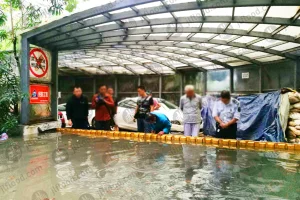
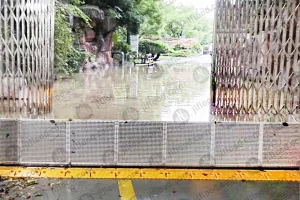
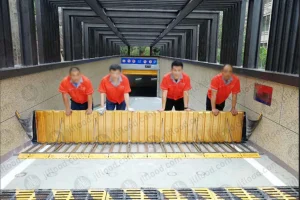
When torrential surface runoff exceeds local threshold drainage capacity, surface floodwater enters the recessed bottom frame through specialized debris-filtering intake grates. As water fills the sealed lower basin chamber, integrated high-density hollow panel modules experience hydrostatic uplift force exceeding their net downward weight vector.
The front lip of the barrier lifts, rotating smoothly along stainless steel hinge pins. As the water head increases, the hydrostatic lateral pressure pushes the rising panel tightly against the vertical side frame sealing strips, forming an impermeable, self-tightening water barrier.
When lying flat during dry operational periods, embedded automatic flood barriers form an even, flush road surface. Sub-surface structural ribs are FEA-tested (Finite Element Analysis) to withstand extreme rolling vehicle axle loads, such as double-trailer fire engines, delivery trucks, and heavy buses (D400-F900 loading ratings).
Anti-slip surface tread plates, noise-damping rubber buffers, and self-cleaning bottom silt flushes ensure seamless daily vehicular traffic without mechanical degradation or noise pollution.
Automatic flood protection gates are customized to accommodate specific architectural geometries, slope angles, foundation depths, and water flow profiles. Our manufacturing engineering team in China designs site-specific solutions for primary structural typologies:
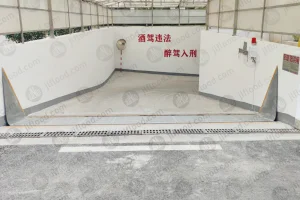
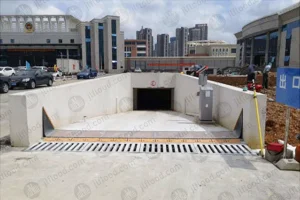
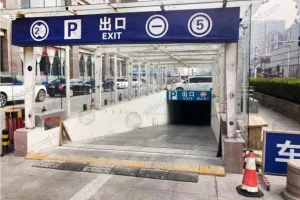
Subterranean parking ramps represent the most vulnerable entry points for flash urban floods. When storm sewers surcharge, surface water cascades down ramps, causing catastrophic property destruction to luxury vehicles, electrical distribution panels, and building mechanical rooms.
Engineering Implementation: Modular embedded barriers (such as the HM4E Series) installed directly at the threshold top of the ramp or mid-slope curb transition. Flush integration allows unrestricted daily vehicle ingress/egress. In flood conditions, the panel rises automatically to intercept runoff before it reaches the ramp slope.
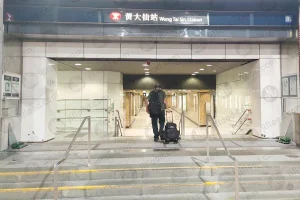
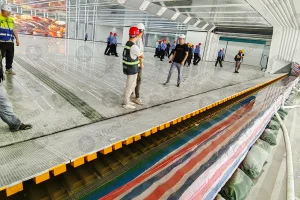
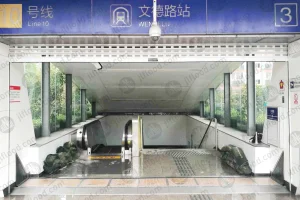
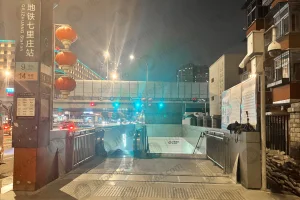
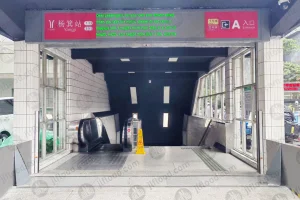
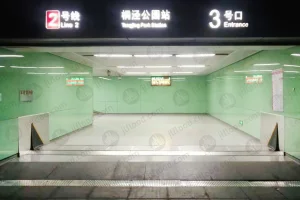
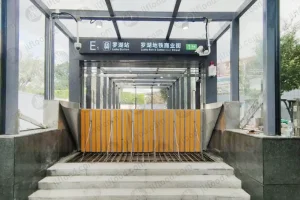
Metro networks present extreme life-safety risks during extreme climate events. Inundation of station entrances, ventilation shafts, or underground connection channels can submerge entire rail networks, causing severe service disruption and multi-billion-dollar infrastructure damages.
Engineering Implementation: Surface-mounted or semi-embedded automatic flood gates configured with wide clear spans (up to 10+ meters wide without intermediate support posts). Field-tested across high-density transit hubs including Guangzhou Metro, Dalian Metro, Suzhou Rail Transit, and Beijing Subway systems.
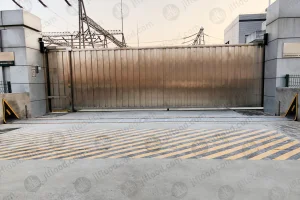
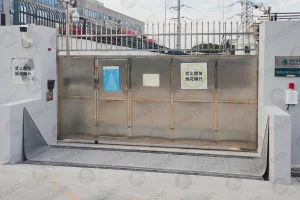
Critical energy infrastructure, transformer stations, and hyperscale data centers require zero-tolerance perimeter flood protection. Water intrusion into high-voltage switchgear rooms leads to instantaneous explosion risks, regional electrical blackouts, and critical communication failures.
Engineering Implementation: Heavy-duty, high-retaining automatic flood gates fitted with stainless steel SUS316 anti-corrosion frames, integrated telemetry output sensors for remote SCADA monitoring, and tamper-proof perimeter seal designs.
Hospitals, municipal civic centers, and commercial skyscrapers contain critical basement-level infrastructure—such as backup diesel generators, medical gas supplies, chiller units, and main telecom distribution frames.
Engineering Implementation: Architectural flip-up automatic barriers and aesthetic self-opening/closing flood doors that blend seamlessly into building facades, pedestrian walkways, and glass curtain wall entrances.
As a worldwide leading exporter of automatic flood barriers for building protection, China’s industrial ecosystem offers unmatched advantages in precision engineering, raw material sourcing, scalability, and cost competitiveness. Sourcing directly from top-tier Chinese manufacturers yields clear strategic benefits for global EPC contractors, engineering consultants, and importers:
Our manufacturing facilities in Nanjing, Jiangsu incorporate fiber laser cutting, multi-axis CNC machining, automated robotic welding, dynamic surface anodization, and specialized rubber extrusion lines under one unified quality management system (ISO 9001:2015).
Unlike regional fabrication shops, our facilities feature a full-scale hydraulic testing pool. Every batch of custom flood gates undergoes mandatory hydrostatic head pressure validation, structural deflection verification, and zero-leakage seal audits prior to global packing.
Direct access to primary Chinese aluminum and stainless steel mills eliminates intermediary material markups. Standard orders ship within 14–21 days, providing overseas procurement managers with an exceptional ratio of performance, durability, and cost efficiency.
The future of urban flood defense lies at the intersection of passive mechanical reliability and digital intelligence. As smart cities develop, automatic flood barrier systems are evolving beyond standalone physical gates into interconnected nodes of urban resilience platforms.
While mechanical deployment remains 100% power-free and hydrodynamic, future-ready barriers incorporate micro-power IoT telemetry modules (solar or long-life lithium battery powered). When the gate initiates lifting, optical sensor arrays immediately send real-time alerts to the building’s BMS (Building Management System) and municipal storm emergency control rooms.
Next-generation seal chemistry features self-healing fluoropolymer coatings and ultra-durable EPDM compounds resistant to chemical spills, hydrocarbon runoff, UV degradation, and saline conditions in coastal areas. Lightweight carbon-composite panels are also being developed for extreme-width spans without intermediate pillars.
Successfully integrating automatic flood protection gates into international building tenders requires full compliance with global structural and hydraulic standards, along with seamless civil engineering coordination.
Our automatic flood barrier product series strictly conforms to international regulatory codes including BS EN 13564 (Anti-flooding devices for buildings), FM 2510 (Flood Abatement Equipment), ISO 9001/14001, and European CE marking requirements.
We supply overseas civil engineering teams, structural consultants, and architects with complete 2D CAD details, 3D Revit BIM modules, concrete trench excavation templates, dynamic structural loading specs, and drainage tie-in guidelines.
Every order includes standardized English installation manuals, step-by-step video commissioning guides, spare gasket maintenance kits, and direct remote engineering support to ensure seamless field installation by local contractors.
Comprehensive answers to critical technical questions asked by structural engineers, buyers, and project managers.
Browse our extended portfolio of field-proven flood protection systems engineered for metro stations, connection channels, and utility substations.