
In an era marked by increasing meteorological volatility, traditional active flood protection barriers—dependent on human labor, electrical grid continuity, and manual deployment—represent critical points of failure for civil infrastructure. When extreme rainfall induces rapid surface runoff, power grids frequently experience catastrophic trips, and emergency personnel are often blocked by paralyzed traffic networks. The China automatic flood device without personnel on duty factory ecosystem has engineered a fundamental technological leap: Hydrodynamic Self-Rising Flood Barriers that operate purely on passive hydraulic physical principles.
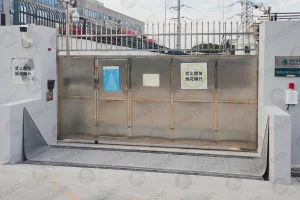
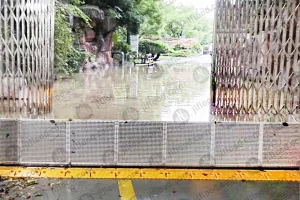
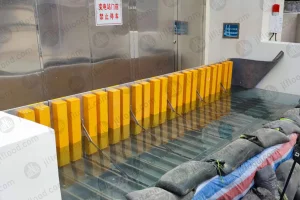
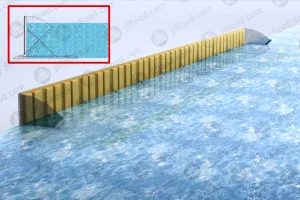
Developed by specialist engineering entities such as Nanjing Junli Technology Co., Ltd., these autonomous system gates remain flush embedded within driveways, subway portals, and utility access points. By utilizing the buoyancy force of incoming floodwaters combined with hydrostatic pressure differentials, the barrier panel automatically rotates upward to establish an absolute water-retaining seal within seconds—demanding zero human intervention, zero electrical power, and zero sensor triggers.
The structural design of an unstaffed hydrodynamic automatic flood barrier requires an intricate equilibrium between structural mass, hydraulic buoyancy, dynamic friction, and elastic sealing compression. The system comprises three principal engineering components: an embedded bottom frame chamber, a high-strength aluminum alloy structural door leaf, and a dual-layer EPDM/silicone sealing composite.
As floodwater breaches kerb height, it flows through intake grates into the recessed foundation basin. Air chambers positioned inside the structural door leaf displace water, creating an upward buoyant moment ($M_b = F_b \times d$) that overrides mechanical holding latches. The door begins its continuous upward angular rotation automatically.
Once rotated to its critical angle (typically 75° to 90°), the horizontal hydrostatic force exerted by the impounded water volume pushes the panel directly against the structural side columns. The greater the flood depth, the tighter the compression against the vertical sealing frame—creating a self-tightening hydraulic lock.
To maintain zero leakage under variable water heads, Junli engineers utilize marine-grade EPDM gaskets co-extruded with memory-core silicone inserts. These seals withstand continuous vehicular drive-over loads up to 30 tons when resting flat, instantly recovering their elastic seal profile upon barrier activation.
| Performance Parameter | Junli Hydrodynamic Unmanned Device | Motorized / Hydraulic Gate | Manual Aluminum Slot-In Logs |
|---|---|---|---|
| Operating Energy Source | 0 kWh (Pure Hydrodynamic Buoyancy) | Grid Electricity / Backup GenSet | Human Physical Labor |
| Personnel On Duty Required | NO (100% Unstaffed Passive Deployment) | YES (Operator for Control Console) | YES (Emergency Response Team) |
| Deployment Speed | < 30 Seconds (Water Driven) | 2 - 5 Minutes (Motor Driven) | 30 - 120 Minutes (Assembly) |
| Blackout Reliability | 100% Functional (Immune to Grid Outage) | High Failure Risk (Battery/Gen Failure) | N/A (Manual Operation) |
| Surface Drive-Over Rating | Heavy Duty (AASHTO HS20 / 30-Ton Axle) | Light to Medium Duty | Non-Driveable (Barrier Frame Blocks) |
| Maintenance Cycle | Annual Debris Flush & Visual Check | Quarterly Electrical/Hydraulic Service | Storage Inspection & Seal Check |
Securing critical infrastructure against 100-year flood events demands uncompromising manufacturing precision, rapid production scaling, and stringent quality control. China's industrial manufacturing ecosystem—centered around advanced metal extrusion, robotic laser cutting, automated submerged-arc welding, and full-scale hydraulic testing labs—gives top-tier facilities like Nanjing Junli Technology Co., Ltd. a unmatched global competitive edge.
Leveraging China's world-leading aluminum extrusion sector, our barrier panels utilize 6063-T6 multi-hollow extruded profile structures. This offers maximum bending resistance against high dynamic hydro-impact while minimizing structural deadweight to ensure frictionless buoyancy flotation.
Unlike trading companies or regional assembly shops, our factory facility features a high-volume water-testing chamber capable of simulating up to 2.0-meter static water heads and hydrodynamic wave surges. Every design specification is verified for zero-leakage threshold before crate packing.
Urban architecture varies wildly. Our China factory maintains fully customizable production lines—enabling precise adjustment of embedded casing depths, clear span dimensions (up to 6000mm single span or infinite multi-leaf arrays), kerb interface geometry, and surface finishes (anodized, powder-coated, stainless steel cladding).
For international EPC contractors, civil engineers, municipal authorities, and commercial REITs, procuring flood barriers from China requires strict alignment with localized building codes, structural safety margins, and international shipping protocols. Junli Technology provides complete engineering documentation packages to streamline project approval.
Every barrier project is supported by FEA structural stress modeling. We calculate deflection limits, shear pin forces, and anchor bolt tensile stresses under maximum design head ($H_{max}$) plus impact loads from floating debris according to FM 2510, BS EN 1991, and Chinese National Civil Defense Standards.
We supply localized installation toolkits: DWG/BIM structural block models, precise rebar tie-in layouts, concrete pouring sequence guidelines, and drainage pit connection specs. Our embedded frames integrate seamlessly into new concrete pours or retrofitted trench cuts on existing driveways.
Barrier assemblies undergo multi-layer anti-corrosion protection, sea-worthy fumigated timber framing, and shrink-wrapped waterproof protection. Standardized module designs fit directly into standard 20GP/40HQ shipping containers for global delivery.
Urban flood mitigation strategy is experiencing a global paradigm shift. Municipal planning frameworks worldwide—including China's "Sponge City" mandate, Europe's Climate Adaptation Directives, and North America's FEMA Urban Resilience guidelines—are abandoning manual flood control logs in favor of permanent passive flood defense systems.
Insurance providers are increasingly refusing to write coverage for underground commercial spaces that rely on manually assembled aluminum stop logs. The human error factor during midnight flash floods is too high. Passive, unmanned automatic devices guarantee 24/7/365 asset protection.
While Junli barriers rise using 100% passive water mechanics, modern installations feature non-contact magnetic position sensors connected directly to building automation systems. When the gate floats up, it triggers automated alerts to property managers, activates basement drainage pumps, and closes motorized fire/smoke shutters automatically.
Zero operational energy consumption perfectly aligns with corporate ESG (Environmental, Social, and Governance) mandates. By utilizing recyclable marine aluminum and long-life EPDM seals engineered for 20+ year service life, our automatic flood barriers drastically lower the lifecycle carbon footprint of real estate assets.
Different underground openings present distinct structural, traffic, and hydraulic challenges. Our unmanned automatic flood control devices are optimized across five core asset sectors:
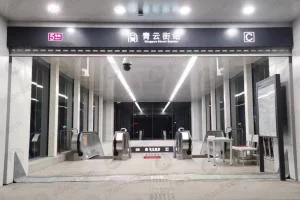
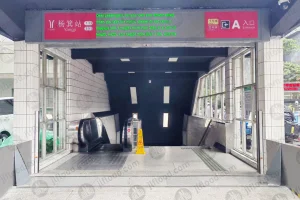
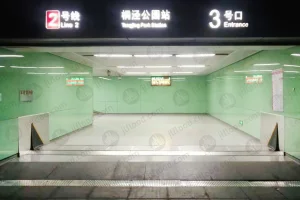
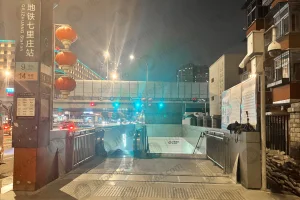
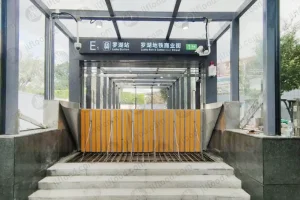
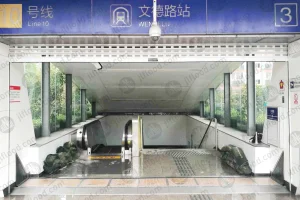
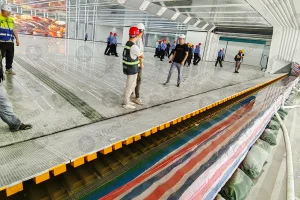
Station portals represent massive entry vectors for surface water inundation. Junli metro-type barriers sit totally flush with pedestrian granite tiles. Thousands of daily commuters walk directly over the embedded casing without a trip hazard. Upon water entry, the panel pops up, blocking water from cascading down escalators into train tunnels—as proven on Guangzhou, Beijing, Suzhou, and Dalian metro networks.
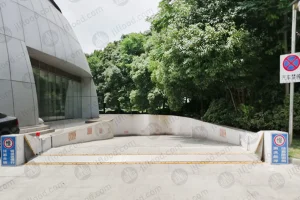
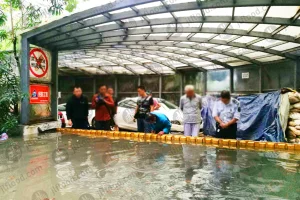
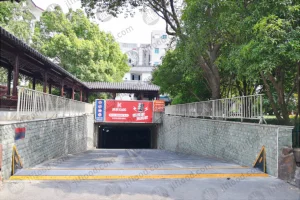
Parking ramps are vulnerable to rapid surface runoff pooling from surrounding streets. Mounted at the top or foot of the ramp, our drive-over flood barrier panels withstand heavy SUV and delivery truck wheel loads (30-ton static load), popping up automatically to save multi-million dollar vehicle fleets in basement garages.
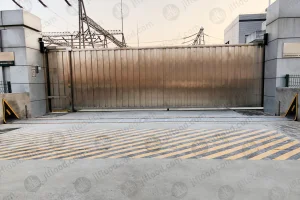
Substation failure during flood events causes widespread municipal blackouts. Installed at perimeter access gates and transformer room doorways, unstaffed barriers prevent water intrusion into cable trenches and switchgear vaults, maintaining regional power grid continuity throughout severe typhoons.
Underground pedestrian street crossings and civil defense shelters feature wide spans and high pedestrian traffic. Modular interlocking automatic flood panels form multi-span continuous flood walls that lock automatically as water levels swell, securing subterranean public safety spaces.
Combines heavy tidal storm surges with corrosive salt-spray environments. Stainless steel 304/316 encasements coupled with marine-anodized panel assemblies ensure zero operational degradation in harsh chemical and coastal industrial sites.
A: The system operates on fundamental Archimedes buoyancy and hydrostatic fluid principles. The barrier panel is housed flush within a recessed foundation casing embedded in the ground. When floodwaters reach the entrance, water enters the casing bottom through inlet slots. Hydrodynamic air chambers within the sealed aluminum panel generate powerful vertical buoyancy force ($F = \rho \cdot V \cdot g$). This force lifts the panel, turning it on its heavy-duty bottom axle. As water rises higher, horizontal water pressure locks the door tightly against the frame gaskets, maintaining a water-tight seal without needing pumps, electricity, sensors, or staff on site.
A: Yes. In its recessed horizontal position, the top cover plate sits flush with the road or ramp surface. Engineered with high-strength 6063-T6 aluminum extrusions or reinforced stainless structural steel, the surface panel is tested to meet AASHTO HS20 / HS25 wheel loading standards (handling axle loads up to 30 tons). Vehicles, fire trucks, and heavy delivery vans drive over it smoothly without damaging the internal mechanical linkage or sealing gaskets.
A: Because there are zero motor gearboxes, hydraulic pumps, or electrical circuits, maintenance demands are extremely minimal. We recommend a semi-annual visual inspection and flushing out silt, leaves, or road debris that may have collected in the bottom frame basin using a high-pressure hose. The EPDM rubber sealing strips should be inspected annually for wear. The entire passive mechanical pivot system is self-lubricating or fitted with stainless steel bearings for long-term corrosion resistance.
A: Single-leaf hydrodynamic barrier modules are manufactured in clear spans from 1.0 meter up to 6.0 meters, with retaining heights ranging from 0.5 meters to 2.0 meters. For wide driveway entrances or subway station concourses exceeding 6 meters, multiple barrier leaves are joined using removable or permanent intermediate mullions, providing continuous passive protection across spans of 20 meters, 50 meters, or wider.
A: For embedded installations, the civil contractor needs to cut a shallow concrete trench across the entrance opening according to our provided installation drawings. A dedicated drainage connection pipe must be routed from the bottom embedded casing to the nearest sump pit or gravity drain. The frame is then set, leveled, tied into ambient rebar, and poured with high-strength non-shrink concrete.

Send us your opening dimensions, clear width spans, and project location. Our hydraulic engineering team will generate customized CAD drawings, FEA structural reports, and a direct factory quotation within 24 hours.
Request Engineering Proposal & Catalog

