Direct factory-supplied passive hydrodynamic flood barriers certified for critical municipal, commercial, and utility applications.
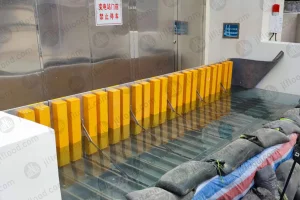
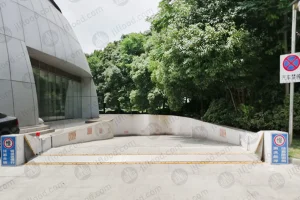
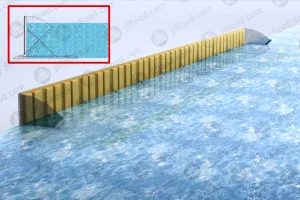
An technical overview on structural protection, zero-energy reliability, and municipal infrastructure resilience.
In an era defined by intensifying global climate volatility, extreme precipitation events, and urban flash flooding, protecting sub-surface municipal and commercial assets has become a paramount priority for civil engineers, asset managers, and municipal planners. Underground garages, metro transit portals, high-voltage electrical substations, and commercial basements represent high-density capital investments. Traditional manual flood barriers—such as aluminum stop-logs or sandbags—suffer from catastrophic failure modes stemming from human error, delayed deployment, and logistical bottlenecks during sudden cloudbursts.
Simultaneously, electrically powered automatic gates introduce inherent points of failure: urban severe weather routinely coincides with regional power outages, short-circuits, sensor glitches, or mechanical motor lockups. Automatic passive hydrodynamic flood barriers represent a fundamental shift in disaster mitigation engineering. By eliminating external power grids, sensors, microprocessors, and manual labor from the activation equation, passive systems rely solely on fundamental hydraulic principles—specifically hydrostatic pressure and fluid buoyancy—to self-deploy automatically when floodwaters approach.
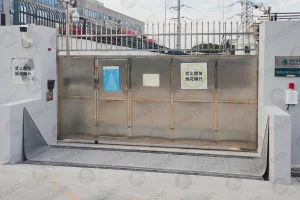
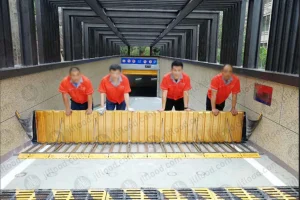
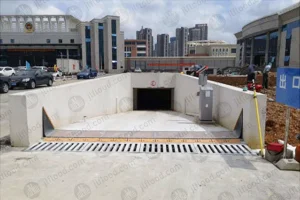
The foundational advantage of China-manufactured passive flood gates lies in their continuous operational readiness. Embedded seamlessly into driveways or pedestrian portals flush with ground elevation, these barriers allow normal vehicular and foot traffic during dry conditions. The instant floodwater reaches a predefined trigger depth, the water flows into the subterranean catchment basin, activating the buoyant door panel to rise automatically.
Understanding the structural, mechanical, and material science that drives zero-power self-closing flood gates.
The gate panel is constructed as a hollow structural buoyant chamber using lightweight, high-tensile 6063-T6 aluminum alloy or 304/316 stainless steel. As floodwater flows into the ground embedded box, hydrostatic displacement forces the panel upward along precision stainless pivot hinges without mechanical gearboxes.
Watertight integrity is achieved through multi-stage EPDM (Ethylene Propylene Diene Monomer) gasket profiles. As water depth increases against the deployed panel, the resulting hydrostatic head pressure pushes the panel tighter against the lateral side frames, creating a self-energizing seal that prevents water ingress.
Designed to withstand heavy vehicular traffic, including fire engines, fully loaded delivery trucks, and public transit buses (up to 60-ton gross vehicle weight). Top covers feature anti-skid surface patterns engineered to meet municipal slip-resistance standards.
| Evaluation Parameter | Hydrodynamic Passive Barrier (Junli Standard) | Electric Motor-Driven Barrier | Manual Aluminum Stop-Logs |
|---|---|---|---|
| Deployment Trigger | Automatic (Water Hydrodynamics) | Electrical Sensor / Manual Switch | Manual Labor Required |
| Power Supply Dependency | Zero (100% Mechanical) | High (Mains + Generator Backup) | None |
| Response Time | Instantaneous (0.1 to 3 seconds) | 15 to 45 seconds | 30 to 120 minutes |
| Blackout Reliability | 100% Unaffected | Vulnerable to system trips/blackouts | 100% Unaffected |
| Maintenance Overhead | Low (Visual Inspection & Debris Clearance) | High (Motors, Sensors, Wiring, UPS) | Medium (Storage, Component Checks) |
| Life-Cycle Operating Cost | Near Zero Standby Cost | Ongoing Electrical & Testing Costs | High Labor & Logistics Costs |
Customized installations across critical urban infrastructure and commercial real estate.
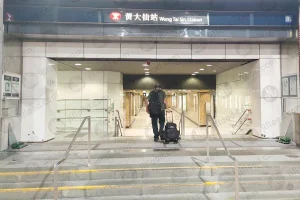
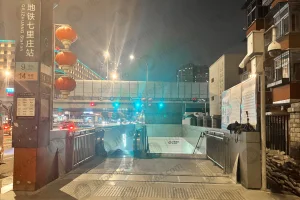
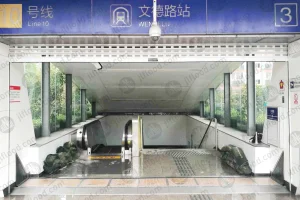
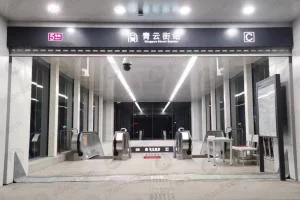
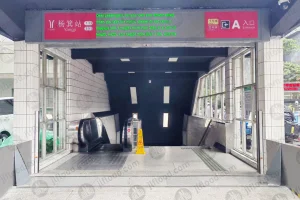
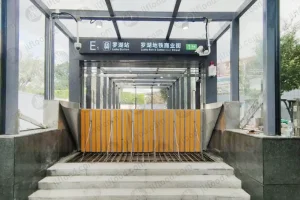
Underground metro networks represent high-risk zones where water ingress can lead to catastrophic damage and life safety hazards. Embedded passive barriers installed at station portal thresholds remain flush with passenger walkways. During intense rainfall, surface runoff triggers instant vertical closure, forming a flood defense up to 2.0 meters high without impeding emergency exit pathways.
Field-proven installations: Guangzhou Metro Line, Beijing Metro Interchanges, Suzhou Rail Transit, Dalian Metro Stations, and Hong Kong MTR connecting channels.
Substation yards, cable trench passages, and transformer room doors demand absolute dry-state security. A flood-induced short circuit at a regional transmission hub can paralyze power grids across entire metropolitan areas. Surface-mounted and embedded hydrodynamic barriers act as autonomous defensive perimeters around sensitive electrical equipment enclosures.
Configured with specialized non-conductive sealing mounts and stainless structural frames to meet strict high-voltage safety codes.
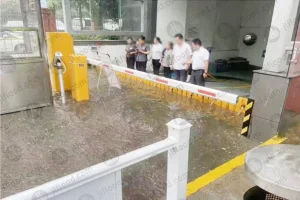
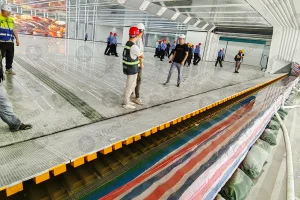
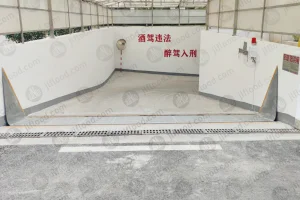
Ramp entrances to basement car parks in shopping malls, residential complexes, and office towers are primary funnels for urban storm runoff. Modern flush-mounted passive ramp barriers accommodate continuous heavy traffic. The modular leaf structure allows clear spans exceeding 20 meters, utilizing interlocking middle support pillars for ultra-wide driveways.
Equipped with integrated warning lights, audible alarms, and mechanical lock-up toggles for manual override during routine maintenance.
Hospitals, emergency response centers, municipal archives, and underground pedestrian street crossings require seamless barrier integration. Junli’s slimline flip-up and embedded barrier series offer minimal civil work impact during retrofits, ensuring compliance with local architectural heritage aesthetics and ADA access guidelines.
Why global contractors and EPC firms partner with Nanjing Junli Technology Co., Ltd. for large-scale flood defense orders.
Located in the manufacturing heartland of Jiangsu Province, Junli Technology leverages China's advanced metallurgical, tooling, and precision engineering supply ecosystem. We maintain complete control over raw material sourcing, extrusion, laser cutting, welding, and final assembly under ISO 9001 quality management.
Unlike trading vendors or local fabricators, our factory facility houses a full-scale hydraulic testing basin. Every custom barrier design undergoes stringent Factory Acceptance Testing (FAT), verifying panel rising speed, structural deflection, and seal zero-leakage rates under static and dynamic water heads prior to packing.
We provide global clients with end-to-end engineering deliverables: structural FEA (Finite Element Analysis) calculation reports, CAD embedment structural shop drawings, 3D BIM models for Revit integration, and comprehensive English installation manuals.
Meeting rigorous international flood control benchmarks while pushing the boundaries of smart city integration.
Navigating global building codes and civil protection standards requires strict compliance with international structural and hydraulic testing protocols. Junli's automatic passive flood barriers are designed and tested to meet or exceed key global benchmarks, including standard guidelines for structural flood barriers (such as principles under EN 1990/1991 structural eurocodes and ASTM flood testing standards).
While the mechanical core of our hydrodynamic barrier remains 100% passive and independent of power, the future of urban flood defense lies in hybrid smart monitoring. Junli's next-generation product roadmap incorporates low-power IoT telemetry modules into the passive barrier housing.
These ultra-low-power, solar/battery-assisted wireless sensors transmit real-time telemetry—including deployment status, water level elevation, and maintenance alerts—directly to municipal SCADA systems and building management networks (BMS), providing site managers with instant situational awareness during major storm events.
Direct engineering answers to common procurement, technical, and installation queries.
The system operates entirely on fluid dynamics (buoyancy and hydrostatic pressure). The barrier panel is housed inside a recessed ground frame chamber flush with the road level. When surface water enters the embedded chamber during a flood, the buoyant door panel naturally rises. As the water level rises, the hydrostatic pressure forces the panel firmly against the frame gaskets, creating a watertight seal without requiring electrical power, sensors, or manual labor.
Yes. The structural top surface of the embedded ground frame and resting panel is engineered from heavy-duty structural steel or reinforced aluminum alloy profiles designed to sustain high wheel loads (up to 60 tons GVW). It handles continuous daily vehicular traffic—such as cars, buses, and heavy trucks—without deformation or damage to the underlying hydrodynamic mechanism.
Because there are no electrical motors, hydraulic pumps, or complex electronic control units, maintenance requirements are minimal. We recommend quarterly visual inspections to clear leaves, silt, or debris from the embedded bottom trough and drainage outlets. Seals should be inspected annually, and simple water flushing of the bottom box ensures the hinge pivot mechanism moves freely.
Standard modular retaining heights range from 300 mm to 2000 mm (0.3m to 2.0m). Single clear spans can extend up to 6 meters. For wider entrances—such as multi-lane underground garage ramps or wide metro portals exceeding 20 meters—multiple barrier panels are connected using removable or automatic intermediate support stanchions to create continuous, seamless flood walls.
Nanjing Junli Technology Co., Ltd. offers comprehensive engineering support for international buyers, including customized CAD/BIM drawings based on site survey data, civil foundation work structural guides, custom material selection (e.g., 316L stainless steel for coastal/saline environments), sea-worthy export packing, and remote or on-site installation supervision.
Explore our full line of surface-mounted, embedded, and flip-up self-closing flood gates.