In an era defined by intensifying hydrological volatility, rapid urbanization, and acute flash-flooding risks, the demand for passive, unpowered automated flood protection infrastructure has escalated from a localized municipal concern to a global commercial imperative. Municipal planning authorities, commercial real estate developers, industrial facility managers, and civil defense engineers across North America, Europe, East Asia, and the Middle East are re-evaluating traditional flood mitigation protocols. Legacy solutions—such as manual sandbagging, modular aluminum stop logs, and electrically driven flood gates—are increasingly recognized as single-point failure hazards due to human operational latency, grid power failure during extreme storms, and component fatigue.
The industrial evolution has prioritized Hydrodynamic Automatic Water Baffles (AWBs)—also known as powerless self-rising flood barriers or hydrodynamic self-opening flood gates. These advanced mechanical assemblies leverage basic physical principles, specifically hydrostatic pressure and fluid buoyancy, to autonomously activate without requiring human intervention, electrical supply, sensors, or external hydraulic pumps.
China has emerged as the premier global hub for the design, prototyping, structural testing, and high-volume manufacturing of automatic water baffles. Leading Chinese manufacturers, such as Nanjing Junli Technology Co., Ltd. (headquartered in Qinhuai District, Nanjing), combine advanced structural engineering, alloy metallurgy, elastomeric seal physics, and full-scale hydraulic testing facilities to supply certified flood control products worldwide. By maintaining complete vertically integrated supply chains—from 6063-T6 marine-grade aluminum extrusion to automated TIG welding, FEA stress simulation, and real-water pool testing—China automatic water baffle factories offer unprecedented structural integrity, compliance with global standards (such as FM 2510 and EN 13564), and competitive cost structures for major infrastructure tenders.
The core technological advantage of Junli automatic water baffles lies in their passive buoyancy-driven kinematics. Unlike electromechanical systems that rely on water level sensors, PLC controllers, emergency backup batteries, or hydraulic actuators (all of which are vulnerable to power grid collapse, lightning strikes, or electrical short circuits during severe typhoons), the hydrodynamic flood barrier operates purely on fluid force dynamics.
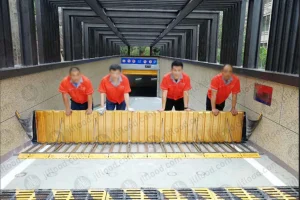
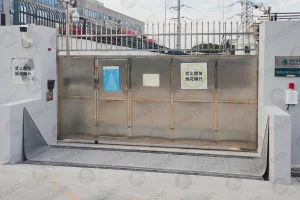
The system consists of a flush-mounted recessed foundation frame installed into the driveway or doorway threshold, an engineered water-collection trough, a structural barrier leaf (constructed from high-strength extruded aluminum alloy profile matrix), and high-durability elastomeric seals. The operating cycle follows three distinct kinematic phases:
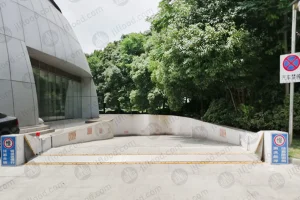
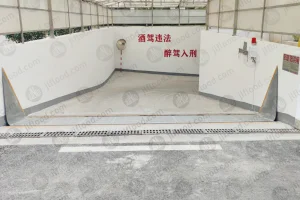
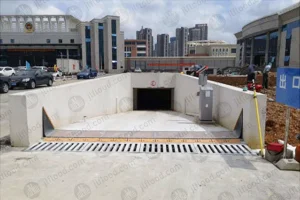
Under normal dry conditions, the barrier panel rests completely flat inside the ground-embedded chamber, flush with the adjacent road surface. High-load structural internal ribbing allows heavy vehicular traffic—including double-articulated buses, fire engines, and 60-ton heavy freight trucks—to pass over the door frame without causing structural deflection or frame distortion.
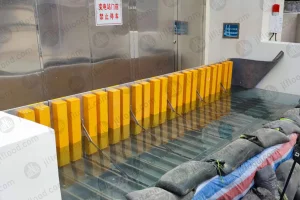
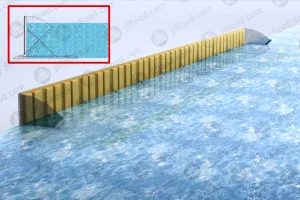
During intense rainfall or urban flood events, initial surface runoff flows over the top threshold grate into the underground collection chamber. As water fills the basin, the buoyant structural density of the hollow aluminum matrix panel generates immediate upward vertical force ($F_{buoyant} > W_{panel}$). The panel pivots smoothly around its stainless-steel bottom hinge, ascending automatically as the water level rises.
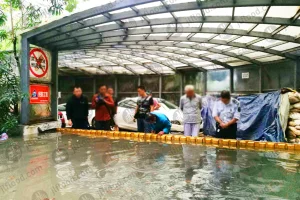
As the water level continues to rise outside the protected asset, incoming hydrostatic head pressure pushes directly against the exterior face of the erect barrier leaf. This pressure compresses the dual-lip EPDM / fluororubber side seals and bottom sealing gaskets against the embedded wall frames, forming an impermeable, hermetic water seal. The higher the floodwater rises, the tighter the hydrostatic seal locks.
Once external floodwaters recede and the internal chamber drains through integrated automatic weep holes or sump connections, hydrostatic pressure drops to zero. Gravity gently lowers the barrier panel back into its recessed housing box, returning the entrance to normal traffic access without manual reset.
| Model Code | Installation Type | Standard Height ($H$) | Max Span Width | Structural Load Rating | Primary Application |
|---|---|---|---|---|---|
| Hm4e-006C | Embedded Flush Mount | 500mm – 1200mm | 6.0m per leaf (Modular) | Heavy Duty (40 Tons) | Underground Garage Ramps, Commercial Basements |
| Hm4d-0006C | Heavy-Duty Embedded | 600mm – 1500mm | 6.0m per leaf | Extra Heavy Duty (60 Tons) | Metro Station Entrances, Substation Gates |
| Hm4d-0006E | Surface Retrofit Mount | 400mm – 900mm | 4.5m per leaf | Medium Duty (15 Tons) | Existing Buildings, Historic Structure Retrofits |
| Hm4d-0006D | Self-Closing Flip-Up | 300mm – 800mm | 3.0m clear span | Pedestrian Load (3.5 kPa) | Cable Trenches, Walkways, Substation Doors |
The international flood defense industry is undergoing a structural paradigm shift driven by three macro trends: global climate adaptation legislation, the expansion of Sponge City municipal directives, and cyber-physical Smart Infrastructure integration.
Global commercial property insurers (such as FM Global and Swiss Re) are mandating physical flood barriers certified to rigorous water-head leakage standards for baseline policy underwriting. Property developers who install certified hydrodynamic water baffles benefit from reduced commercial property insurance premiums and protection against operational disruption liability.
Modern mega-cities are expanding underground. Multi-level subterranean parking, underground mass transit networks, deep electrical transformer vaults, and automated logistics tunnels create severe vulnerabilities. A single point of water ingress at a surface ramp can cause billions of dollars in equipment damage; hydrodynamic automatic water baffles form a critical perimeter defense line.
While activation remains 100% passive and unpowered, contemporary water baffles are equipped with micro-power IoT telemetry sensors. Optical position switches, water immersion sensors, and NB-IoT transmitter modules send real-time gate deployment status alerts directly to city SCADA dashboards and building automation systems (BAS) without compromising mechanical autonomy.
Junli Technology’s automatic water baffles are engineered for specialized civil protection environments. Standard barrier designs are customized based on structural width, design flood elevation, vehicle axle weight, and site foundation civil engineering constraints.
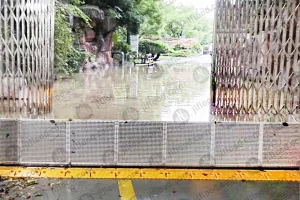
Challenge: Steep driveway ramps funnel surface rainwater straight into subterranean parking garages during short-duration, high-intensity cloudbursts. Manual barrier installation requires security personnel on site—often during non-business hours when facilities are unmanned.
Engineered Solution: Installation of model Hm4e-006C embedded flush barriers across the top threshold or mid-ramp transition of the garage entrance. Integrated steel grates allow smooth vehicle passage daily. When flash water runoff exceeds kerb height, the hydrodynamic panel lifts in seconds, preventing garage inundation and protecting high-value vehicle assets.
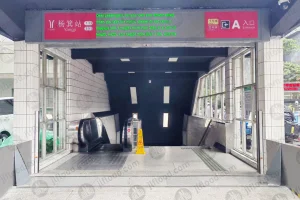
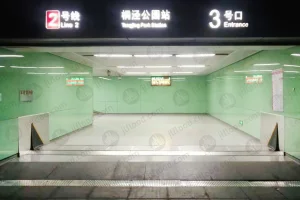
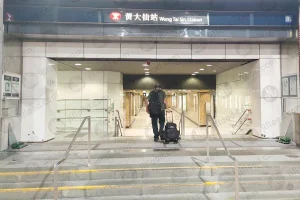
Challenge: Subway pedestrian entrances, emergency exits, ventilation shafts, and connection channels link directly to underground train tunnels. Water ingress can cause multi-million-dollar signal system short circuits and severe urban transportation blockades.
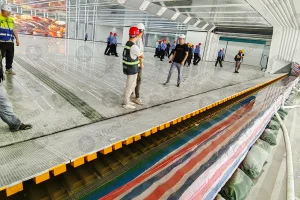
Engineered Solution: Deployment of customized Metro Type Hm4d-0006C / Hm4d-0006E automatic flood gates across wide station plazas (as deployed in Guangzhou Metro Yangji Station, Beijing Metro, and Dalian Metro network projects). Designed with anti-tripping rubber footings and warning illumination LED strips for public safety.
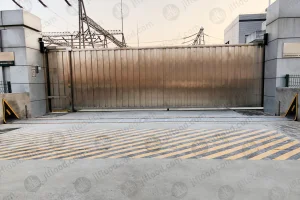
Challenge: High-voltage substations, transformer rooms, and mission-critical cloud data centers require 24/7 operational continuity. Water entering low-lying cable trenches or switchgear rooms triggers grid collapse and catastrophic fires.
Engineered Solution: Barrier units installed at perimeter security gates and individual equipment room doorways. Corrosion-resistant anodized 6063-T6 aluminum frames resist industrial atmosphere corrosion, providing a maintenance-free 20-year operational life window.
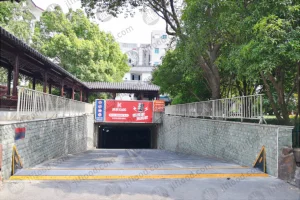
Challenge: Civil defense underground pedestrian shopping corridors, railway station concourses, and river-crossing pedestrian underpasses present extremely wide clear spans that are difficult to seal manually.
Engineered Solution: Multi-leaf modular hydrodynamic automatic flood barrier arrays featuring intermediate interlocking seal columns, installed in cities such as Jinan, Guilin, and Suzhou.
As a premier China automatic water baffle manufacturer, Nanjing Junli Technology maintains stringent quality management standards across all production phases. A flood gate is a life-safety defense mechanism—failure during a major storm is unacceptable.
Every barrier leaf design undergoes thorough structural stress validation using Finite Element Analysis (FEA) software to calculate deflection under dynamic hydrostatic pressure heads ranging from 0.5m to 2.0m. Structural deflection limits are strictly enforced at under $L/250$ to guarantee zero frame binding during deployment.
The future of urban flood mitigation lies in the convergence of passive mechanical reliability with intelligent digital monitoring. Junli Technology’s R&D directorate has established a three-phase technology roadmap for next-generation automatic water baffles:
Integrating fail-safe magnetorheological latches into passive hydrodynamic gates. Under standard flood events, gates rise purely via hydrodynamic buoyancy. In early-warning emergency scenarios (e.g., dam break or sudden storm surge alerts), central municipal SCADA systems can remotely release magnetic retainers, deploying barriers prior to water arrival.
Incorporating microencapsulating hydrophobic polymers within EPDM seal matrix structures. Minor surface abrasions, sand scratches, or debris grit trapped during emergency deployments automatically trigger polymer expansion upon contact with water, eliminating micro-leakage channels.
Transitioning to 100% recycled structural aluminum alloys, eco-certified powder coatings, and zero-waste manufacturing processes across all Chinese production facilities to meet EU Carbon Border Adjustment Mechanism (CBAM) compliance for international tenders.
When global engineering consultancies, general contractors, or municipal procurement teams source automatic water baffles from Chinese suppliers, thorough technical evaluation guarantees long-term project success. Use the following five criteria during factory auditing and bidding evaluation:
Ensure the factory provides documented real-world flood retention proof—such as field performance during major typhoons (e.g., Typhoon Bebinca)—rather than relying solely on 3D CAD renders.
Require certified calculation sheets verifying section modulus ($Z$), stress distribution, and full-scale hydrostatic water pool test reports for your exact clear span width.
Select a manufacturer that provides complete CAD rebar clearance drawings, embedded frame templates, drainage connection notes, and English installation manuals.