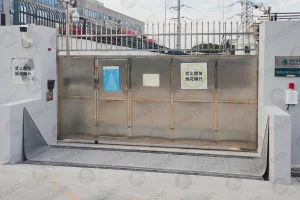
Explore our core hydrodynamic self-closing flood barrier product lines, manufactured in high-capacity Chinese facilities engineered for municipal transit, power distribution nodes, and subterranean commercial complexes.
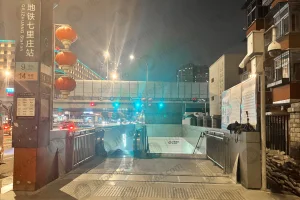
Urban microclimates are undergoing severe disruption worldwide. The accelerating frequency of cloudburst events, severe typhoons, and storm surges has forced civil engineers, municipal authorities, and commercial property asset managers to drastically re-evaluate traditional flood defense mechanics. Historically, facilities relied upon manual deployment of sandbags, modular aluminum louvers, or electromechanical vertical gates. However, historical data reveals that over 78% of catastrophic subterranean flooding events occur during municipal grid blackouts or when human personnel fail to reach flood gates due to extreme localized transit paralysis.
This technical white paper establishes the engineering baseline for Hydrodynamic Automatic Self-Rising Flood Barrier Systems produced by advanced manufacturing clusters in China. By eliminating reliance on electricity, external sensors, manual labor, and electromechanical motors, passive automatic floodgates harness the kinetic energy and hydrostatic pressure of incoming floodwater itself to trigger automated retention panels. As leading China automatic floodgate suppliers scale up production, these power-free systems represent the optimal synergy of thermodynamic reliability, high structural load capacities, and minimal lifetime operational expenditure (OpEx).
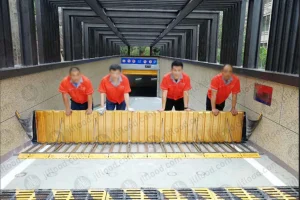
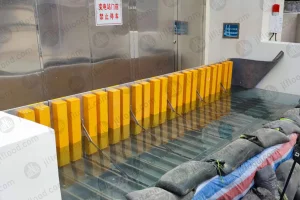
The floodgate sits completely flush inside a subterranean stainless-steel foundation frame during dry conditions. As surface runoff or torrential flash water surges into the floor intake basin, the internal fluid chamber rapidly fills. High-density, closed-cell architectural foam structures embedded within the structural aluminum door leaf generate instantaneous positive buoyancy force ($\Delta F_b = \rho_w \cdot V_{disp} \cdot g$), lifting the panel upward without requiring electrical actuators.
As the ambient water level outside the structure elevates, the hydrostatic horizontal force vector ($P_h = \frac{1}{2} \rho g h^2$) presses the door leaf firmly against the vertical side frames. The system converts hydrostatic pressure into mechanical sealing tension. The higher the flood head rises, the stronger the compression force exerted against the primary elastomeric gaskets, virtually eliminating perimeter water leakage.
Sealing failure is the primary vulnerability in lower-grade barriers. Chinese engineering standards specify continuous extrusion EPDM (Ethylene Propylene Diene Monomer) or marine-grade fluorosilicone seals along all interface boundaries. Rated for continuous submersion, chemical resistance to road salts, and UV degradation, these seals ensure standard leak rates well below the stringent 0.05 L/hr per meter of seal threshold established by international civil defense codes.
| Evaluation Parameter | Hydrodynamic Automatic Barrier (China) | Electromechanical Vertical Gate | Manual Aluminum Stop Logs |
|---|---|---|---|
| Power Dependence | Zero Power Required (Passive) | Requires AC Power / Backups | Zero Power Required |
| Response Latency | Instantaneous (< 0.5s fluid fill) | 30 seconds to 3 minutes | 30 minutes to 2 hours (Human bottleneck) |
| Operational Reliability | 99.99% (No electrical failure mode) | Medium (Motor/Sensor burnout risks) | Low (Subject to staff delay or absence) |
| Traffic Drive-Over Load | Heavy Axle Load (Up to 60T / AASHTO HS-20) | Varies (Surface rail obstructions) | None (Must be manually inserted) |
| Maintenance Overhead | Ultra-Low (Annual seal check & clearing) | High (Quarterly motor, gear & wiring audit) | Low (Storage & frame cleaning) |
The global dominance of China automatic floodgate suppliers is not merely a matter of unit-cost efficiency; it is driven by unmatched industrial clustering, vertical supply chain integration, and rapid OEM/ODM prototyping capabilities. Centers of excellence such as the Jiangsu manufacturing corridor (including specialized production complexes in Nanjing) leverage complete localized access to raw materials, high-precision extrusion tooling, automated robotic welding setups, and full-scale hydraulic testing pools.
Chinese manufacturers utilize heavy-gauge 6063-T6 architectural aluminum extrusions for flood barrier leaves and hot-dip galvanized SS304/SS316 stainless steel for structural ground embedment troughs. Advanced laser cutting and robotic TIG welding yield seamless structural frames capable of enduring dynamic hydrodynamic wave impacts and high vehicle traffic loads without structural warping.
Unlike regional assembling vendors, major Chinese floodgate factories house full-scale hydrostatic testing basins. Every custom-engineered gate unit undergoes wet validation prior to global containerized packing—measuring real-time deflection under design water head pressure, verifying seal compression, and certifying fluid balance parameters before issuance of factory test reports.
From custom clear spans exceeding 10 meters to multi-leaf interconnected subterranean ramp arrays, Chinese manufacturers provide comprehensive CAD/BIM drawing sets, structural FEA (Finite Element Analysis) stress simulations, and modular export packing. Procurement lead times are reduced by 40-60% compared to European or North American fabricators.
Automatic hydrodynamic flood barriers are engineered for versatile deployment across diverse municipal, commercial, and critical utility environments. Below are the standard localized integration patterns for infrastructure vulnerability points:
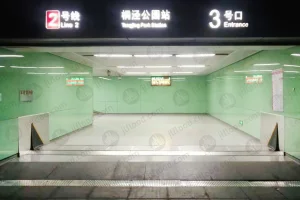
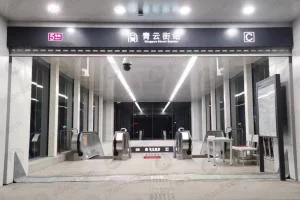
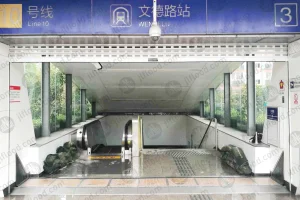
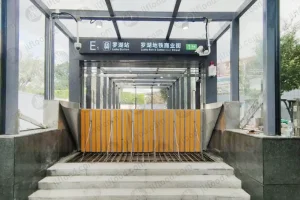
Subway pedestrian entrance portals, connection channels, and vent shafts represent extreme flooding risks. Surface-mounted and embedded hydrodynamic gates sit flush with floor tiles, allowing millions of daily commuters to pass unhindered, while instantly sealing the tunnel network when torrential rain overflows street curb capacities.
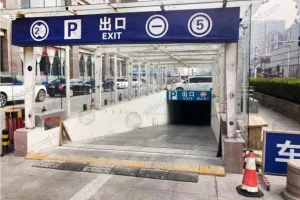
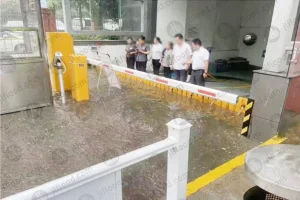
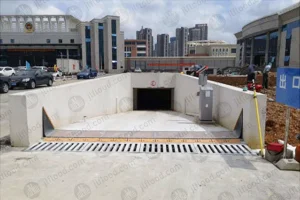
Basement ramps at commercial malls, residential towers, and hospitals are natural collection basins during cloudburst events. Heavy-duty automatic garage flood gates accommodate daily continuous vehicular traffic (axle loads from 15T to 60T) while preventing vehicle destruction and basement structural drowning.
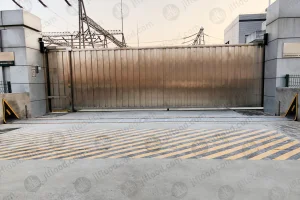
Transformer rooms, cable trenches, and main utility gates require zero-fail protection. A flooded substation can cause regional power grid collapse. Compact, self-closing flood gates prevent water ingress into critical electrical rooms, ensuring continuous power distribution during extreme weather.
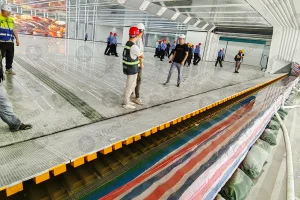
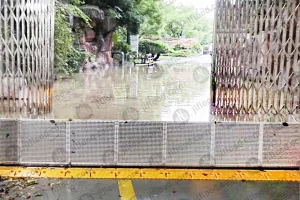
Municipal civil defense passages, subterranean retail venues, and logistics centers utilize modular interconnected surface flood barriers. These systems allow retrofitting onto existing concrete slabs without requiring extensive excavation of active operational facilities.
The evolution of flood protection is moving toward the convergence of passive mechanical reliability and active IoT monitoring telemetry. Future research and development roadmaps across premier Chinese manufacturing facilities focus on three core innovations:
While the mechanical deployment of the barrier remains 100% power-free and hydrodynamic, next-generation units integrate self-powered LoRaWAN or NB-IoT micro-sensors. These transmit real-time gate status (angle of deployment, water retention height, maintenance alerts) directly to municipal smart city central dashboards and facility manager smartphones.
To further minimize door leaf weight while maximizing structural modulus, hybrid carbon-fiber and graphene-infused alloy extrusions are entering advanced prototyping. Reduced panel inertia accelerates passive deployment times while providing enhanced corrosion protection against saltwater and aggressive urban runoff.
Next-gen frame designs focus on ultra-shallow embedment depths (< 100 mm), allowing existing built environments to install heavy-duty automatic flood gates with minimal slab trenching, eliminating the risk of cutting underlying post-tension cables or utility lines.
Review our extended portfolio of surface-mounted, embedded, power-free, and custom-span flood protection barriers engineered for global infrastructure tenders.
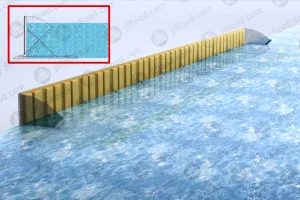
Specifying civil defense products requires strict adherence to international quality management and structural safety frameworks. Direct procurement from Chinese tier-1 suppliers ensures seamless compliance verification across standard international codes:
Barriers are designed and manufactured in accordance with ISO 9001 (Quality Management), ISO 14001 (Environmental Management), and ISO 45001 (Occupational Health & Safety). Hydrostatic testing protocols align with FM 2510 (American National Standard for Flood Abatement Equipment) and European CE safety norms.
Every shipment is accompanied by bilingual technical packages: detailed civil construction excavation templates, structural anchor layout drawings, FEA load calculation reports, material origin certificates (MTCs), and step-by-step English installation and maintenance operational manuals.
Leading Chinese exporters support overseas installation through dedicated project engineering teams. Support includes remote video commissioning supervision, BIM structural model integration for consulting engineers, and spare-seal maintenance kits backed by long-term warranty guarantees.
Answers to common technical, structural, and procurement questions raised by civil engineering consultants, EPC contractors, and overseas buyers.
The floodgate relies on natural hydrodynamics. The door panel rests flush inside a embedded foundation trough under dry conditions. When water enters the chamber, high-density internal flotation units generate positive buoyancy forces, causing the panel to float upward. As the water head rises, horizontal hydrostatic pressure compresses continuous EPDM side and bottom seals against the housing frame, creating a watertight barrier without motors, sensors, pumps, or manual control.
Yes. Heavy-duty garage and driveway flood barriers are constructed using high-tensile 6063-T6 aluminum extrusion panels and reinforced stainless steel foundation frames. Standard models support continuous axle loading from 15 to 30 tons, while customized heavy industrial models easily accommodate up to 60-ton semi-trailers (equivalent to AASHTO HS-20/HS-25 standards).
Standard retaining heights range from 500 mm to 2,000 mm (0.5 m to 2.0 m). Single clear spans are available up to 6.0 meters per leaf. For wide openings such as double-lane garage ramps or metro plazas, modular interconnected multi-leaf arrays can span across 20+ meters using removable intermediate support posts or synchronized hinges.
For embedded floodgate models, a recessed concrete trough must be cast according to our civil engineering drawing set, complete with bottom drainage connection pipes to prevent silt build-up. For surface-mounted units (suitable for retrofit projects), a smooth, level concrete curb floor is required, and the barrier housing is secured using high-strength chemical anchor bolts.
Quality factories conduct hydrostatic pressure validation in full-scale testing pools prior to dispatch. Every order includes a factory water-retaining test certificate. Furthermore, continuous compression EPDM perimeter gaskets maintain sealing elasticity over a 15 to 20-year service life under standard outdoor temperature swings (-40°C to +90°C).