Direct supply from Nanjing Junli Technology — China's premier hydro-mechanical flood gate manufacturer.
Understanding why leading civil engineering contractors are shifting from manual demountable dams to power-free embedded automatic flood protection systems.
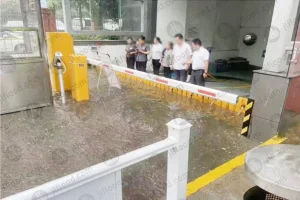
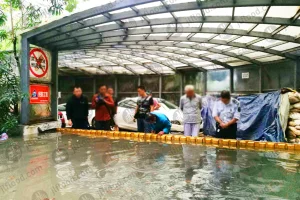
Underground mass transit systems are subterranean bottlenecks prone to flash flooding, urban surface runoff, and cloudburst events. Traditional flood boards require human intervention, manual deployment, and electrical power—all of which frequently fail during extreme typhoons or sudden utility grid blackouts.
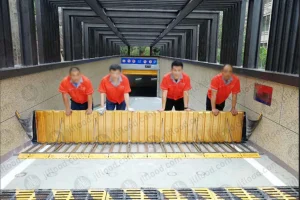
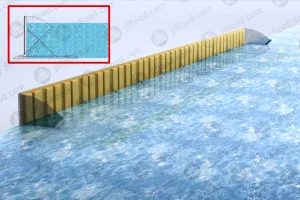
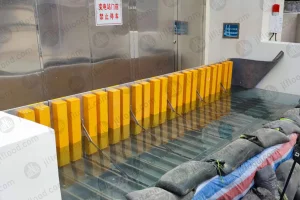
An Embedded Hydrodynamic Flood Control System operates without sensors, motors, or emergency power backups. Installed flush with the finished floor level, incoming floodwaters naturally enter the recessed frame chamber, driving high-buoyancy panels upward in under 30 seconds via pure hydrostatic pressure.
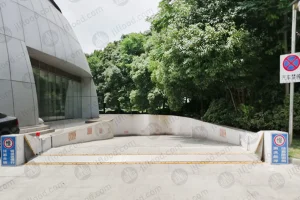
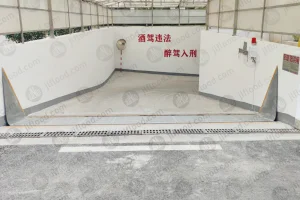
By recessing the entire assembly into the concrete substrate of station entrances, pedestrian walkways, or logistics ramps, daily transit operations remain unobstructed. Heavy-duty structural modules withstand vehicular axle loads up to T60 (60 Metric Tons) while maintaining active readiness for 20+ years.
| Performance Metric | Embedded Hydrodynamic Barrier (Junli) | Manual Aluminum Flashboards | Electric / Hydraulic Rising Gates |
|---|---|---|---|
| Activation Principle | Automatic Water Buoyancy & Hydrostatic Lift | Manual Transport & Manual Stacking | Electric Motor / Hydraulic Cylinder Drive |
| Power Dependence | 0% (100% Power-Free Operational Integrity) | 0% Power (Requires Physical Labor) | 100% (High risk of failure during storm power cuts) |
| Response Time | < 30 Seconds Passive Deployment | 30 – 120 Minutes (Requires early warning) | 2 – 5 Minutes (Requires sensor signal) |
| Pedestrian & Vehicle Impact | Flush Embedded (Zero tripping hazard) | Stored off-site (Obstruction during setup) | Surface threshold protrusion (Minor bump) |
| Sealing Efficiency | Continuous EPDM Dynamic Compression Seal | Inter-panel gap leakage risk | Mechanical linkage seal wear |
| Maintenance Overhead | Minimal (Semi-annual silt wash & inspection) | High (Storage inspection, manual drills) | High (Motor, fluid, sensor calibration) |
Combining heavy industrial infrastructure, specialized metallurgy, and advanced robotic manufacturing to supply global engineering projects.
Access to China's premier aluminum alloy and stainless steel ecosystems allows production of ultra-high strength 6063-T6 extrusions and SUS304/SUS316 structural casings at competitive cost structures.
Nanjing Junli utilizes automated laser cutting, multi-axis robotic welding, and automated continuous seal pressing, maintaining sub-millimeter tolerances across 6-meter single-span gate leaves.
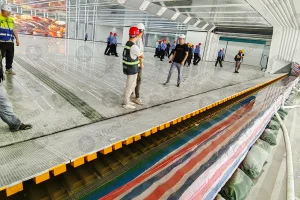
Every batch undergo hydrostatic head pressure validation in our full-scale testing pool, measuring zero-leakage rates and panel deflection dynamics prior to international shipping.
High-volume manufacturing facilities enable turnaround times of 15 to 25 days for custom project orders, serving major infrastructure developers across Southeast Asia, the Middle East, and Europe.
Designed to fit seamlessly into municipal underground entrance profiles, concrete foundation recesses, and civil engineering drawings.
Constructed from Q355B heavy gauge carbon steel or 304 stainless steel. The chamber features embedded rebar ties that integrate into the second-stage concrete pour during metro station entrance construction.
Featuring a multi-chamber honeycomb structural core enclosed in high-grade marine alloy. Designed for maximum stiffness-to-weight ratio to prevent twist under uneven hydrostatic head pressure.
Utilizes aging-resistant EPDM rubber gaskets along bottom and side channels. As water rises, hydrostatic backpressure compresses seals further against side jambs, guaranteeing near-zero leakage (<0.1L/h/m).
Ensuring smooth approval from EPC contractors, municipal transit authorities, and structural consultants.
We supply complete engineering packages for structural sign-off: BIM 3D Revit models, 2D AutoCAD civil embedment detail drawings, Finite Element Analysis (FEA) stress reports, and material mill test certificates (MTC).
Designed to comply with international flood barrier performance benchmarks, including FM 2510, BS 851188 structural resilience requirements, and ISO 9001 quality management framework.
Dedicated export engineering team offering remote video commissioning, multilingual installation manuals, custom-fit frame adapters, and fast-track spare part logistics worldwide.
Tailored structural configurations for diverse urban underground entryways and critical infrastructure.
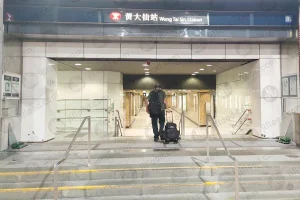
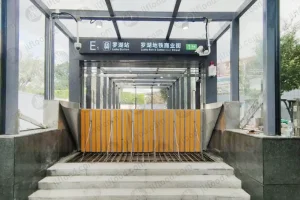
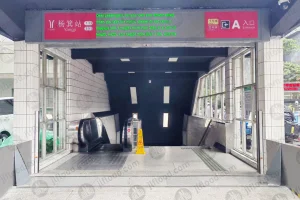
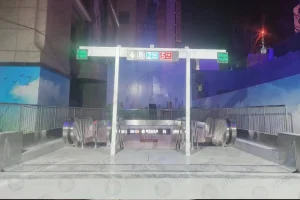
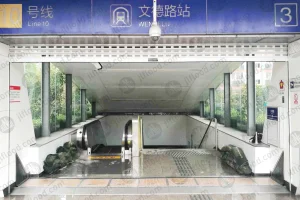
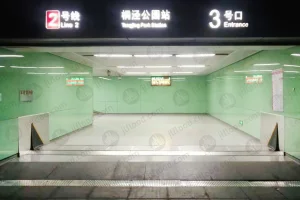
Flush ground installation at subway steps and concourse portals prevents severe surface storm run-off from entering deep station shafts without hindering high-volume passenger traffic.
Ideal for underground ped-ways and commercial connection corridors linking transit hubs to shopping malls, office towers, and adjacent high-density buildings.
Protects electrical transformer rooms, control rooms, and cable vault access points within traction substations from devastating flood-induced grid outages.
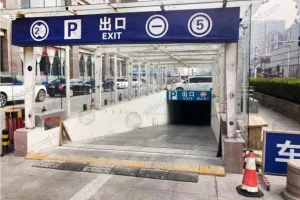
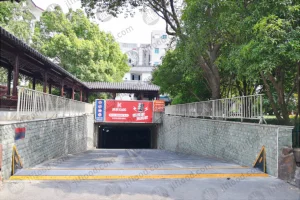
Heavy-duty reinforced embedded gates installed across subway park-and-ride parking garage entry ramps, allowing daily vehicle movement with automatic storm protection.
The convergence of hydro-mechanical reliability and real-time smart monitoring networks.
Modern embedded flood gates are equipped with optional RS485 / Modbus position sensors, sending instant wireless notifications to the Metro Operation Control Center (OCC) when a panel deploys.
Part of holistic urban resilience designs, embedded barriers work alongside underground retention basins and sustainable drainage systems (SuDS) to handle extreme 100-year rainfall events.
Integrated LED warning lights and auditory alarms activate automatically via micro-hydro generators as the gate rises, alerting pedestrians in high-density concourses.
Clear engineering answers for specification writers, procurement officers, and structural engineers.
The system operates on pure physical fluid dynamics. When floodwater reaches the ground threshold, water flows into the bottom recessed frame through intake grates. The intrinsic buoyancy of the hollow multi-chamber panel causes it to float and rise automatically. As water pressure increases, hydrostatic head forces the barrier firmly against its compression seals. Zero electricity, pumps, or human intervention are required.
Standard heavy-duty models (such as our HM4D and HM4E series) are engineered with reinforced internal structural ribbing. When fully retracted in the floor recess, the top cover plate sits flush with the pavement and supports heavy vehicle axle loads up to T60 (60 Metric Tons), suitable for fire trucks, service vehicles, and high-frequency transit traffic.
The bottom foundation frame includes built-in slope drainage channels and integrated silt discharge ports that connect directly to the station's municipal stormwater or sump pump system. Routine semi-annual maintenance simply involves flushing the frame recess with a high-pressure water hose to remove accumulated silt.
Yes. We manufacture both shallow-depth embedded systems (requiring minimal civil excavation depth) and surface-mounted modular flip-up barriers. For retrofit projects, our engineering team provides custom steel frame transition plates that anchor directly to existing reinforced concrete slabs without compromising structural integrity.
Standard single-leaf span lengths range from 1.5 meters to 6.0 meters, with retaining heights from 0.5 meters to 2.0 meters. For wide metro station plazas or multi-lane entrances exceeding 6 meters, modular intermediate support pillars or synchronized multi-leaf barrier arrays are utilized to cover unlimited width spans.
Every order undergoes factory hydrostatic testing in our dedicated water testing basin. We simulate real-world design head conditions, measure seal compression tightness, and verify that dynamic leakage is well under strict international limits (<0.1 L/h/m). Factory acceptance test (FAT) video documentation and official inspection reports are issued with every shipment.
Factory-direct ordering, custom dimensional engineering, and technical OEM supply.