
Explore high-capacity hydrodynamic automatic flood barriers engineered by leading Chinese suppliers. Built for severe weather resilience and certified under rigorous hydrostatic head pressure testing.
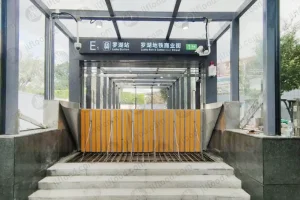
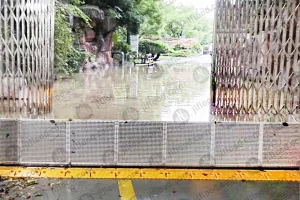
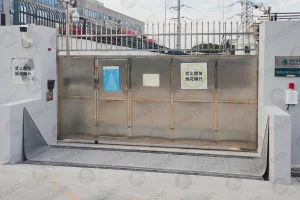
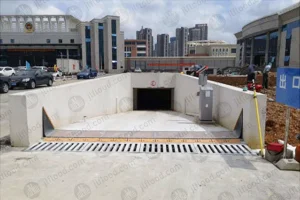
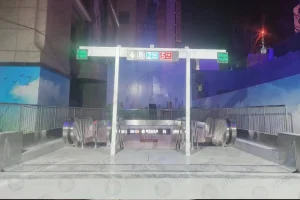
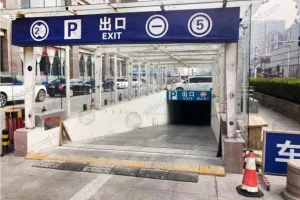
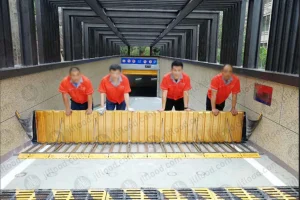
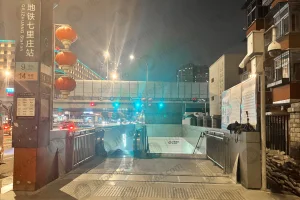
Climate volatility, hyper-urbanization, and the increasing frequency of short-duration extreme precipitation (cloudburst events) have placed unprecedented stress on global municipal storm drainage networks. In modern metropolises, underground spaces—such as subway networks, electrical substations, commercial parking structures, and civil defence passages—represent high-density capital concentration areas that are acutely vulnerable to sudden water ingress.
Historically, civil engineering projects relied upon manual sandbags, detachable aluminum stop logs, or electromechanical motorized flood gates. However, extensive field analysis of recent urban inundation disasters reveals critical structural vulnerabilities in these legacy approaches:
Manual barriers require physical deployment by site personnel. Extreme rainfall events frequently occur during non-business hours or trigger rapid flash flooding within 15–30 minutes, leaving maintenance crews zero buffer time to manually slide stop logs or build sandbag dikes.
Motorized gates depend on electrical power grids, standby generators, or electronic sensor arrays. Severe rainstorms regularly cause local power outages, electrical short circuits, or sensor failures, causing motorized gates to freeze in their lowered default states precisely when protection is required.
Standard modular gates lack integrated bottom frame sealing mechanisms. Under continuous hydrostatic head pressure, unanchored bottom seals experience elastic deformation, leading to high-volume seepage rates that bypass subsurface drainage pumps.
Leading China flood defence system suppliers & factories have fundamentally disrupted this paradigm through the engineering of hydrodynamic automatic flood barriers. Operating entirely on physical hydraulic buoyancy and hydrostatic pressure differentials, these self-closing flood gates require zero electricity, zero manual intervention, and zero sensor triggers. The incoming floodwater itself becomes the physical actuation force that raises and locks the protective barrier panel in place within seconds.
China has emerged as the global epicenter for advanced hydraulic gate manufacturing, smart structural alloy fabrication, and large-scale urban infrastructure protection. The integration of advanced metallurgical supply chains with rigorous municipal testing standards gives Chinese manufacturers a decisive edge in engineering depth, structural integrity, and cost efficiency.
Chinese production facilities in key industrial clusters like Nanjing and Jiangsu leverage complete local supply chains for 304/316 marine-grade stainless steel extrusion, high-tensile 6063-T6 architectural aluminum alloys, and custom EPDM/silicone vulcanized seals. Advanced multi-axis CNC laser cutting and robotic seam welding ensure dimensional tolerances within ±0.5 mm on spans exceeding 6 meters.
Unlike theoretical lab designs, flood defense systems built in China undergo real-world combat validation across massive municipal transit networks (including Guangzhou Metro, Dalian Metro, Beijing Subway, and Hong Kong MTR). They are engineered to survive extreme vehicle drive-over loads (up to 60-ton axle loads) without structural frame deformation.
From narrow pedestrian cable trench doorways to wide multi-lane underground garage ramps spanning over 20 meters, Chinese factories offer modular engineering designs. Technical support includes full CAD/BIM embedment drawings, structural Finite Element Analysis (FEA), and tailored installation templates for international EPC contractors.
The core technological innovation of the hydrodynamic automatic flood barrier lies in its passive mechanical mechanism that harnesses fluid dynamics to convert incoming water volume into upward rotational vector forces.
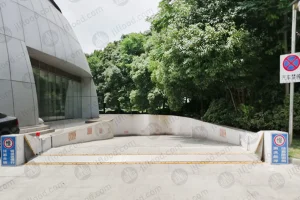
Under dry conditions, the barrier panel lies completely flat flush within a stainless-steel ground recessed foundation frame. The top plate is engineered with non-slip diamond treads or high-strength anti-friction coating, allowing heavy vehicular and pedestrian traffic to pass seamlessly without obstruction.
When torrential rain causes surface runoff to accumulate past the threshold kerb level, water enters the front inlet grates of the recessed ground chamber. As the water level inside the chamber fills, Archimedes' principle activates: buoyancy chambers under the main panel generate positive upward lift.
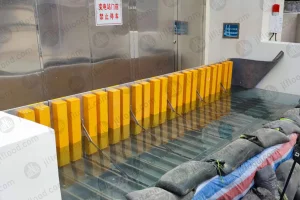
As the water level continues rising, hydrostatic differential pressure forces the panel upward to a 45°–90° retaining position. Heavy-duty rubber side seals compressed against side jambs form an airtight, watertight seal. Once floodwaters recede, water inside the chamber drains out naturally, allowing the panel to return to floor level smoothly via counterweight dampening.
| Performance Parameter | Traditional Aluminum Stop Logs | Motorized Electric Flood Gates | China Hydrodynamic Automatic Barrier |
|---|---|---|---|
| Power Requirement | None (Manual Assembly) | 220V/380V Main Electric Line | 0 Watt (100% Power-Free Passive) |
| Deployment Speed | 30 – 60 Minutes (Human Dependent) | 1 – 3 Minutes (Sensor Dependent) | Instantaneous (< 30 Seconds Auto Buoyancy) |
| Maintenance Overhead | High (Storage, Regular Drills) | High (Motor Inspection, Battery Check) | Low (Visual Inspection & Chamber Flush) |
| Blackout Vulnerability | Not Applicable | High (Requires UPS / Generator) | Zero Impact (Operates via Water Dynamics) |
| Ground Surface Flushness | Posts remain or require installation | Surface threshold protrusion | 100% Flush Ground Recessed Fit |
| Structural Lifespan | 5–10 Years (Seal Degradation) | 8–12 Years (Mechanical Wear) | 20+ Years (Marine Grade 304/316 Steel) |
Different urban structural openings face distinct hydraulic heads, structural load stresses, and architectural space constraints. Leading Chinese suppliers configure specialized physical barrier variations tailored to specific application environments.
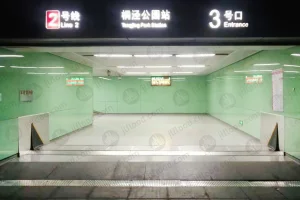
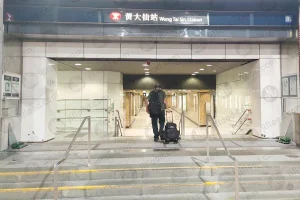
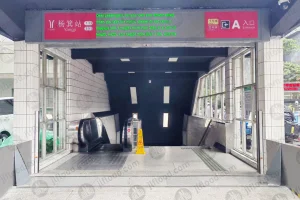
Subway station entrances, connection passages, and ventilation shafts represent critical flow channels during flash floods. Embedded automatic flood barriers installed at station portals (such as installations at Guangzhou Metro Yangji Station and Dalian Metro lines) remain flat for high-density passenger movement, rising automatically to block water ingress before runoff enters escalator shafts.
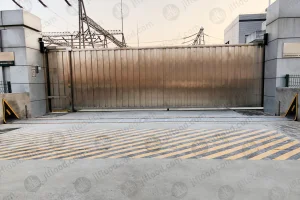
Electrical substations and transformer vaults require strict zero-water tolerance. Infiltration can cause catastrophic short-circuit blackouts across municipal grids. Compact flip-up and modular self-closing flood gates installed at substation gates and cable trench doors provide continuous unpowered boundary protection against sudden surface water logging.
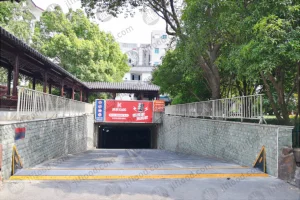
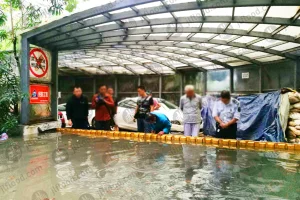
Commercial and residential underground garages are prime targets for storm runoff damage. Heavy-duty embedded hydrodynamic barriers placed at driveway ramps are engineered to withstand continuous 30-to-60 ton vehicle passage without fatigue failure, rising instantly when rainstorm volume exceeds gutter drainage capacity.
Underground pedestrian street crossings, civil defense shelters, and utility tunnels require wide-span flood control systems. Modular hydrodynamic gate arrays connect multiple leaves seamlessly to cover entrance clear spans from 5 meters to over 25 meters, providing cohesive structural protection across public spaces.
International airports feature large underground baggage logistics tunnels and service basements. Heavy-duty automatic flood gates protect critical operational basements from surface overflow during severe monsoons, supporting uninterrupted aviation ground operations.
Chemical plants and hazardous material storage yards require secondary containment perimeter gates to prevent toxic runoff spillover into municipal waterways during storm inundation. Stainless steel self-closing barriers provide corrosion-resistant containment.
International engineering contractors, architectural specifiers, and municipal procurement directors require full documentation transparency, certified hydraulic performance, and seamless BIM/CAD structural integration. Top Chinese suppliers provide end-to-end global project support.
Every opening profile is matched with detailed civil concrete recess templates, rebar clearance notes, embedded frame anchor positioning, and subsurface drainage collection piping schematics to ensure flawless site concrete pouring.
Before export dispatch, barrier assemblies undergo 100% full-scale water retaining tests in specialized factory pools. Verification includes panel lifting response speed, seal deflection limits, and seal leakage rate measurement under maximum hydrostatic head pressure.
All units are packaged in heavy-duty export wooden crates with anti-corrosion VCI wrapping. Complete English operational manuals, maintenance inspection logs, spare EPDM seal kits, and third-party inspection certificates (SGS, TUV, CE) are provided.
The international flood protection market is undergoing a structural transition driven by urban resilience mandates, ESG sustainability criteria, and smart city infrastructure integration.
While physical gate lifting remains 100% power-free and passive, modern hydrodynamic flood gates are increasingly fitted with wireless IoT position sensors and solar-powered micro-transmitters. These feed real-time gate angle status (Standby, Rising, Fully Locked) back to municipal SCADA control rooms without creating electrical dependency.
Next-generation flood defence systems align with "Sponge City" concepts by interfacing with subsurface retention vaults and permeable pavement designs. Recessed barrier frames integrate silt traps and cleanable debris filtration screens to protect municipal storm drains from clogging during heavy rainfall.
Global commercial property insurers and asset management funds are progressively mandating certified automatic flood barriers for basement real estate protection. Installing field-tested passive barriers directly lowers property casualty insurance premiums and satisfies corporate ESG climate risk mitigation metrics.
Select from our specialized line of power substation gates, garage flip-up barriers, and modular hydrodynamic flood gates engineered by certified Chinese manufacturing facilities.
Detailed technical and commercial answers compiled by senior flood protection engineers for project tender preparation and specification reviews.


