
Explore factory-direct quotes and specifications for high-performance flood control solutions engineered in China.
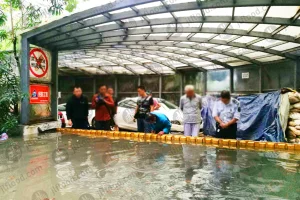
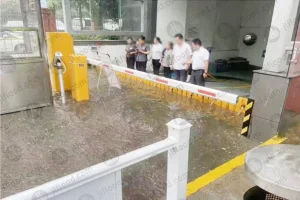
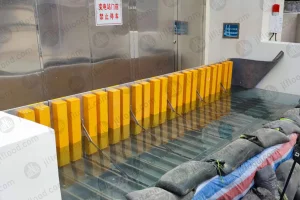
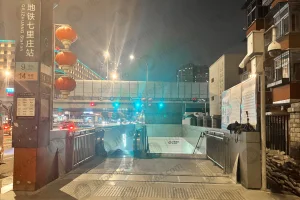
Global climate volatility has dramatically reshaped civil engineering standards for residential properties, multi-family housing developments, and critical urban infrastructure. Municipal flash floods and sudden cloudbursts pose catastrophic risks to underground garages, living quarters, electrical equipment rooms, and subway interconnections.
Traditional flood defense strategies reliant on manual sandbag deployment or electromechanical barriers suffer from critical vulnerability windows. Sandbags require intensive physical labor and advance warning, while motorized barriers frequently fail during extreme storms when local power grids collapse.
This technical procurement guide explores the paradigm shift toward unpowered hydrodynamic automatic flood gates manufactured in China. By harnessing hydrostatic pressure and Archimedes' principle of buoyancy, modern self-closing flood gates offer zero-human-intervention deployment, guaranteeing asset protection even during total power grid blackouts.
Understanding the fluid mechanics and structural physics behind power-free automatic deployment.
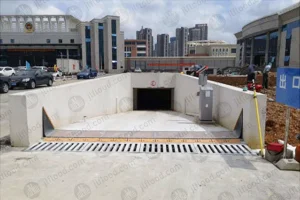
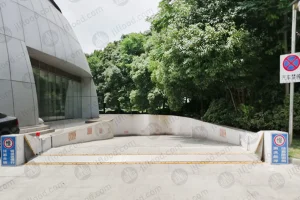
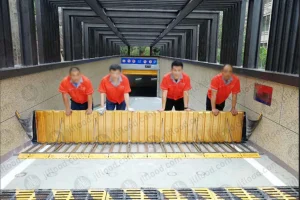
In dry conditions, the heavy-duty aluminum panel remains recessed completely flush inside a stainless steel ground casing embedded within the driveway surface. Vehicles, pedestrians, and emergency service trucks drive over the top plate without structural deflection or operational interference.
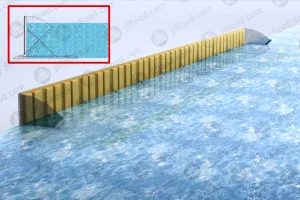
As surface floodwater approaches the barrier perimeter, water naturally flows into the inlet grates of the recessed foundation chamber. The incoming water level creates positive hydrostatic buoyancy beneath the hollow, sealed aluminum door leaf, initiating automatic upward rotation.
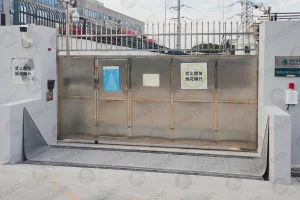
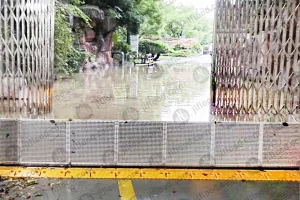
Once the panel reaches its maximum vertical angle (typically 75° to 90°), the rising floodwater pushes firmly against the exterior face. The higher the water level, the stronger the hydraulic force pressing the high-density EPDM rubber seals against the frame, creating an impenetrable water barrier.
The convergence of advanced metallurgical clusters, automated robotics, and direct factory pricing gives global procurement teams unmatched competitive edges.
Chinese factories leverage top-grade T6-treated 6063 aviation aluminum alloy profiles combined with 304 or 316 stainless steel hardware. This guarantees high tensile strength, extreme resistance to salt-spray coastal corrosion, and zero structural degradation over decades of outdoor exposure.
Leading Nanjing and Guangdong manufacturing facilities maintain dedicated full-scale hydraulic testing basins. Every order undergoes real-water hydrostatic head testing to measure deflection rates and verify zero seal leakage before packing into export-ready wooden crates.
By cutting out intermediate distributors and sourcing directly from established OEM/ODM manufacturers, foreign contractors, property developers, and municipal agencies achieve cost reductions between 30% to 55% while maintaining superior build quality.
| Engineering Parameter | Standard Home / Residential Specification | Heavy-Duty Commercial / Metro Specification |
|---|---|---|
| Primary Panel Material | Aviation Grade 6063-T6 Aluminum Alloy | Reinforced Multi-Cellular 6063-T6 Aluminum / Stainless Steel 316 |
| Standard Retaining Heights | 500 mm / 600 mm / 900 mm / 1200 mm | 1000 mm / 1500 mm / 1800 mm / 2000 mm+ |
| Single Span Width | Up to 4.5 Meters (Modularly extendable) | Up to 6.0 Meters (Unlimited with intermediate pillars) |
| Vehicular Load Capacity | 5 Tons – 10 Tons (Passenger Cars & SUVs) | 30 Tons – 60 Tons (Fire Engines, Heavy Trucks, Buses) |
| Deployment Mechanism | Hydrodynamic Buoyancy (Passive, No Electricity) | Dual Hydrodynamic + Dual Hydraulic Override (Hybrid) |
| Sealing Gasket Type | Vulcanized EPDM Co-extruded Triple Seal | Heavy-Duty Oil-Resistant Fluororubber / EPDM Compound |
How foreign engineering consultants, distributors, and buyers navigate ordering, customization, and freight shipping.
Measure the clear width of the entrance ramp or doorway. Determine the maximum expected flood water level based on local historical rainfall intensity data.
Submit civil site plans to the manufacturer. Chinese factory engineering teams issue 2D/3D CAD embedded foundation layout drawings for approval within 24 hours.
Upon completion of automated CNC cutting and welding, full-scale hydrostatic water retaining testing is performed. HD video proof and QA test reports are provided.
Panels and ground frames are wrapped in protective film and sealed in fumigated steel-reinforced plywood cases suitable for FCL or LCL ocean freight shipping worldwide.
As smart cities expand globally, flood barriers are no longer isolated mechanical doors. Modern flood control systems manufactured in China are increasingly integrated into centralized Building Management Systems (BMS) and IoT urban drainage telemetry platforms.
While the fundamental lifting action remains 100% passive and hydrodynamic (ensuring fail-safe operation during power losses), hybrid models now incorporate wireless status sensors. These sensors send real-time telemetry alerts to property managers' mobile devices the instant a gate begins rising, verifying structural engagement and water level readings.
Power substations and transformer stations represent high-consequence flood zones. A single flooded electrical cable trench can cause regional blackout cascades, incurring millions in economic losses.
China heavy-duty substation flood barriers feature specialized non-conductive boundary seals, fire-retardant internal composite cores, and ultra-low threshold profiles that allow heavy transformer transport vehicles to enter the perimeter without damaging the sealing frame.
"Over 1,200 power substations across Asia and Europe have transitioned to passive hydrodynamic flood gates, reducing urban flood risk downtime to absolute zero."
Engineered solutions adapted to residential, municipal, commercial, and transit projects.
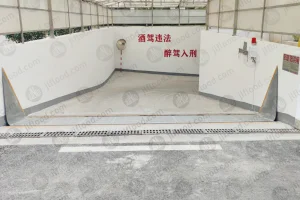
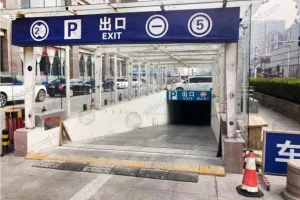
Designed to protect underground residential parking spaces and basement entrances. Surface-mounted or shallow embedded profiles allow seamless installation in private homes without extensive civil excavation.
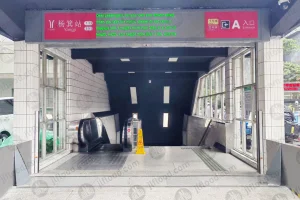
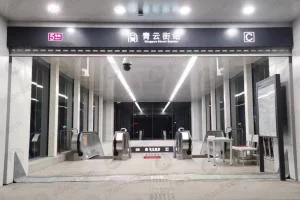
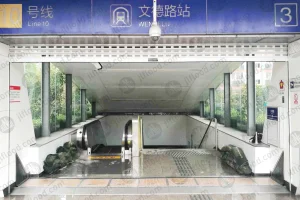
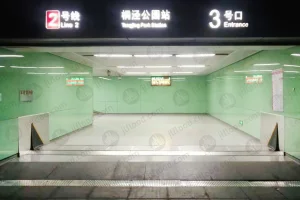
Tested on high-density rail transit networks such as Guangzhou, Beijing, and Hong Kong subways. Handles extreme pedestrian foot traffic and prevents water inundation down escalator shafts during severe typhoons.
Wide clear-span modular barriers installed at shopping mall underground parking ramps. Aesthetics are preserved with flush stainless steel cover plates that complement architectural facade designs.
How Chinese factories support overseas installers with local building codes and rigorous QA standards.
To clear municipal building control inspections in North America, Europe, the Middle East, and Australia, manufacturers provide full structural calculation packages. These include Finite Element Analysis (FEA) reports verifying panel deflection under hydrostatic head pressures up to 2.0 meters of standing water.
All products come accompanied by English installation manuals, step-by-step video tutorials, anchor bolt torque charts, and recommended rebar placement details for civil concrete contractor teams.
Flood barriers installed in freezing northern climates or corrosive coastal environments require tailored material science. Chinese export manufacturers offer specialized anodized coatings, fluorocarbon (PVDF) spray finishes, and 316-grade marine stainless steel casings.
EPDM seals undergo accelerated thermal aging tests (-40°C to +120°C) and continuous salt-spray exposure testing (ASTM B117 standard) exceeding 1,000 hours without material embrittlement or degradation.
Technical answers to key engineering, installation, and procurement questions.
The system operates completely mechanically based on Archimedes' principle of buoyancy and hydrostatic pressure. The flood panel rests inside an embedded foundation chamber flush with the road. When floodwater flows into the chamber, positive buoyancy forces the hollow aluminum panel to float and pivot upward. As water continues rising, hydrostatic pressure pushes the panel against vertical frame seals, locking it tightly in place without requiring motors, sensors, batteries, or manual labor.
Yes. Heavy-duty commercial models (such as the Hm4d-0006C series) are structurally reinforced with internal honeycombed structural ribbing engineered to sustain axle loads ranging from 30 to 60 tons. They easily accommodate passenger cars, delivery vehicles, garbage trucks, and heavy fire engines without panel deformation.
Standard dimensional units (e.g., 3m to 6m wide garage driveways) take approximately 7 to 14 days for precision automated CNC manufacturing and factory water testing. Custom infrastructure project arrays take 15 to 25 days. Ocean freight transport from Shanghai, Ningbo, or Shenzhen ports typically ranges from 12 days (West Coast USA/Southeast Asia) to 30 days (Europe/Latin America).
For existing property retrofits, a shallow trench matching the foundation box depth (typically 180mm to 350mm depending on model height) is saw-cut into the concrete slab. The stainless steel bottom chamber is positioned, leveled, connected to a localized drainage discharge pipe, and encased with high-strength non-shrink concrete grout.
Because the gate relies on passive physical mechanics rather than motors or electrical circuits, maintenance is minimal. Facilities teams should periodically clear leaves, silt, or gravel debris from the bottom chamber inlet grates using a hose spray every 6 to 12 months, and visually inspect the rubber EPDM side seals for physical damage.
Review factory specifications and request bulk pricing quotes for specialized infrastructure applications.
Partner with China's premier engineering team for hydrodynamic flood protection systems. Get expert technical consultation, CAD layout drawings, and transparent pricing tailored to your project.


