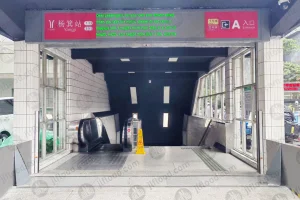
Wholesale Flood Barrier at Guangzhou Metro Yangji Station Suppliers, Factory
View Details & Technical Specifications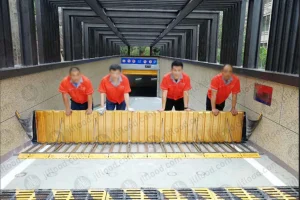
China Heavy duty automatic flood gate Hm4d-0006C Factory, Pricelist
View Details & Technical Specifications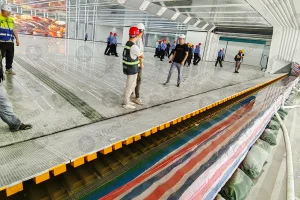
China Self opening & Closing Flood Gate Manufacturers, Suppliers
View Details & Technical Specifications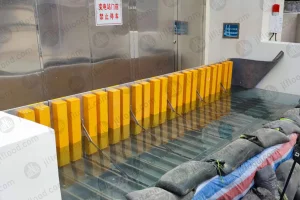
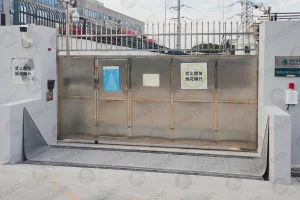
China Flood Barrier at Substation Gate Manufacturer, Supplier
View Details & Technical Specifications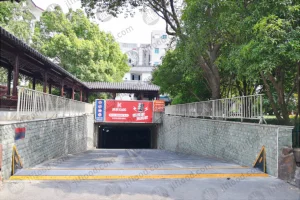
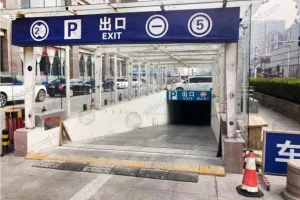
Wholesale Flip-up flood barrier for garages Manufacturer, Factory
View Details & Technical Specifications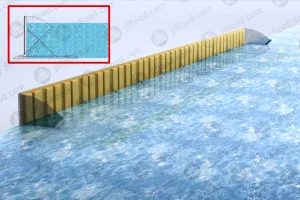
Wholesale Automatic flood barrier, Surface installation metro type: Hm4d-0006E Supplier, Quotes
View Details & Technical Specifications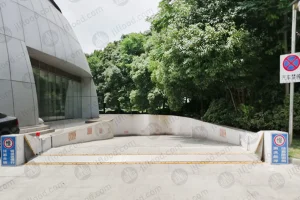
Wholesale Automatic flood barrier, Embedded installation Manufacturer, Suppliers
View Details & Technical SpecificationsAs cloudburst events, rapid urban land development, and global climate anomalies intensify, classical municipal stormwater infrastructure faces unprecedented operational stress. Industrial assets, metropolitan rail transit lines, and subterranean structures require a failure-proof defense posture.
Traditional flood barriers relying on motorized winches, sensors, electric pumps, or manual human deployment carry an unacceptably high point of failure. Severe urban waterlogging is almost universally accompanied by grid blackouts, short-circuits, localized chaos, and emergency response delays. Active electro-mechanical barriers consistently suffer from battery degradation, signal failure, or mechanical jamming during actual flood surges.
Modern global specifications emphasize zero-human-intervention designs. Passive hydrodynamic flood barriers utilize the physics of buoyancy and hydrostatic pressure ($P = \rho g h$) of the incoming floodwater itself to trigger, elevate, and mechanically lock barrier panels into position. By operating completely free of external electricity or human agency, passive barrier systems deliver absolute operational continuity when municipal assets are most vulnerable.
Subterranean flooding in commercial property, metro lines, and power utility stations leads to cataclysmic financial damage, catastrophic business interruption, loss of life, and irreversible reputational harm. Global asset managers, municipal planning boards, and risk underwriters now mandate structural perimeter floodproofing compliant with rigorous global engineering certifications.
How structural metallurgy, hydraulic buoyancy physics, and dual-lip elastomeric sealing technology integrate to form an impenetrable water-retaining barrier.
The system features a flush-recessed ground foundation chamber. As surface stormwater reaches critical accumulation levels, water enters the front intake grates of the foundation box. Buoyancy forces act upon high-density hollow structural panels, causing them to pivot dynamically upwards. As the external water column height ($h$) increases, hydrostatic pressure firmly pushes the barrier panel against structural end-posts and elastomeric seal faces, creating a tighter seal as flood severity rises.
Water-leakage prevention relies heavily on seal integrity. Premium flood solution designs incorporate vulcanized Ethylene Propylene Diene Monomer (EPDM) or Fluorocarbon rubber seals with ultra-high tensile strength, dynamic recovery memory, and outstanding anti-aging, UV-resistant, and chemical corrosion-resistant properties. The dual-lip geometry guarantees continuous zero-leakage performance under low fluid heads and severe turbulent surge heads alike.
Panels and structural frames are constructed from high-tensile 6063-T6 Aviation-Grade Aluminum Alloys or marine-grade SUS304/SUS316 Stainless Steels. The internal structural rib matrix is engineered via Finite Element Analysis (FEA) to withstand severe lateral hydrostatic bending moments, hydrodynamic impact forces from floating debris, and repetitive heavy vehicular traffic loads (up to 40-50 metric tons) when resting in the lowered drive-over state.
| Evaluation Parameter | Passive Hydrodynamic Automatic Gate | Manual Aluminum Demountable Stoplogs | Electromechanical/Hydraulic Flip-Up Gate |
|---|---|---|---|
| Triggering Mechanism | 100% Water Buoyancy (Passive) | 100% Human Deployment Required | Electrical Sensors & Motor Drive |
| Power Grid Dependency | Zero Power Required | Zero Power Required | High (Prone to Blackout Failure) |
| Response Time | Immediate (< 0.1s upon water ingress) | 30 to 180 Minutes (If staff present) | 1 to 5 Minutes (If grid active) |
| Drive-Over Load Capacity | Heavy Duty (AASHTO HS20 / 40 Tons) | N/A (Requires post insertion) | Medium to Heavy Duty |
| Maintenance Requirements | Minimal (Periodic visual & debris check) | Low (Storage & seal checking) | High (Motor, fluid, electrical testing) |
| Life-Cycle Cost (20 Yrs) | Lowest (Zero standby energy / low OPEX) | High Operational Labor Risk | High (Frequent electrical maintenance) |
From raw metal extrusion to precision hydraulic testing, China’s industrial ecosystem provides an unprecedented balance of structural quality, custom engineering agility, and cost efficiency.
China's flood barrier manufacturing sector, centered around key technological hubs like Nanjing, Jiangsu, benefits from a completely integrated supply chain. Aluminum smelting, alloy extrusion, precision laser cutting, CNC machining, automated robotic welding, high-grade EPDM rubber compounding, and surface anodizing take place within tightly concentrated industrial clusters. This reduces component lead times from months to weeks.
No two municipal or commercial entrances share identical dimensions or civil kerb profiles. Chinese manufacturers utilize multi-axis CNC machining centers, automated robotic plasma cutters, and custom extrusion tooling to fabricate tailor-made clear spans up to 6+ meters per single module, and infinite modular combinations for openings exceeding 30 meters. Precise tolerance control (+/- 0.5mm) guarantees absolute sealing integrity upon field assembly.
Leading Chinese factories maintain full-scale hydraulic testing pools where every engineered model undergoes real-world hydrostatic load, dynamic wave impact, deflection rate, and seal leakage verification prior to export. Factory Acceptance Testing (FAT) videos, non-destructive weld testing reports, and material origin certificates are provided as standard tender deliverables.
Detailed civil interface, structural mounting, and functional requirements across primary target deployment environments.
Civil Challenge: High-frequency heavy vehicular traffic (SUVs, trucks, delivery vehicles), sloped driveways, and severe rainwater run-off velocity.
Solution Profile: Embedded hydrodynamic automatic gates installed flush with the finished ramp level. Heavy-duty structural top covers withstand 40-ton vehicle drive-over loads without deflection. Integrated sediment drainage channels prevent debris buildup within the frame chamber.
Civil Challenge: High-density public pedestrian traffic, zero tolerance for tripping hazards, strict civil defense guidelines, extreme risk to life.
Solution Profile: Surface-mounted or flush embedded automatic metro-type flood barriers. Engineered for ultra-fast deployment during sudden urban cloudbursts. Tested on operating rail transit systems in mega-cities like Guangzhou, Beijing, Shenzhen, and Hong Kong.
Civil Challenge: Grid infrastructure assets where water ingress causes short-circuit explosions, region-wide power outages, and tens of millions in transformer damage.
Solution Profile: Perimeter flood barriers and specialized equipment room self-closing flood gates. Provide 24/7 un-manned protection around transformer yards, cable trench entry points, and high-voltage distribution rooms.
Civil Challenge: Aesthetic architectural integration, landscape harmony, non-disruptive installation on existing finished granite or paved flooring.
Solution Profile: Slim-line flip-up and modular hydrodynamic barriers finished with custom anodized or powder-coated colors, matching surrounding building aesthetics while delivering uncompromising flood protection.
A comprehensive engineering review matrix for EPC contractors, commercial developers, and municipal authorities evaluating flood control manufacturers.
Procurement technical submittals must include finite element analysis (FEA) verifying structural panel deflection rates under maximum static water heads ($H_{max}$) and dynamic wave surges. Deflection should not exceed $L/250$ of the clear span length to maintain seal contact pressure.
Ensure mill test certificates (MTC) confirm aluminum alloy composition (EN AW-6063 T6 or EN AW-6082 T6) or stainless steel grade (AISI 304/316). Fluorocarbon/EPDM elastomeric seal components must possess accelerated weather-aging test reports compliant with ASTM D2000 standards.
Embedded barriers require precise civil works coordination. Specifications must require the supply of pre-assembled embedded steel frames, rebar tie-in connection details, concrete pouring sequence guides, and bottom chamber drainage channel discharge calculations ($Q = C \cdot A \cdot \sqrt{2gh}$).
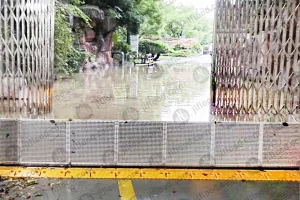
China Automatic Flood Barrier without electric power Pricelist, Quotes
View Details & Technical Specifications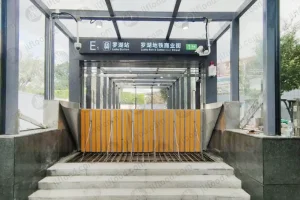
Wholesale Flood Barrier at Metro Stations Manufacturer, Quotes
View Details & Technical Specifications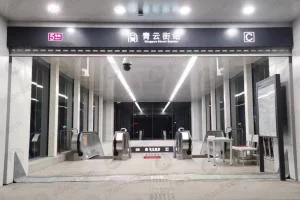
Wholesale Flood Gate at Metro Stations Manufacturer, Suppliers
View Details & Technical Specifications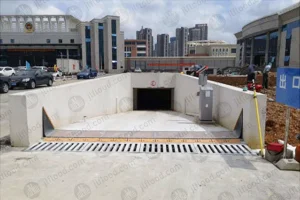
Wholesale Self closing flood barrier Hm4d-0006D Suppliers, Pricelist
View Details & Technical Specifications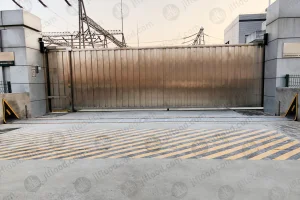
China Automatic Flood Barrier at Substation Gate Factory, Pricelist
View Details & Technical Specifications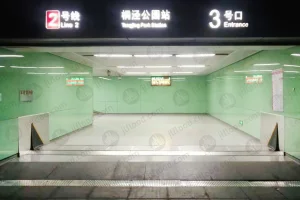
Wholesale Flood Barrier at Metro Connection Channel Manufacturer, Factories
View Details & Technical Specifications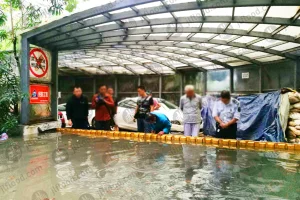
Wholesale Modular hydrodynamic automatic flood gate Supplier, Factories
View Details & Technical SpecificationsHow smart sensor arrays, digital twin simulations, and advanced surface coating dynamics shape the next generation of flood barriers.
While mechanical rising action remains strictly passive and water-driven, next-generation Chinese flood gates integrate low-power IoT telemetry sensors (NB-IoT/LoRaWAN). These sensors instantly notify smart city control centers, facility managers, and mobile apps the exact millisecond a barrier panel begins rising, providing real-time operational visibility without compromising passive mechanical security.
Leading suppliers leverage Computational Fluid Dynamics (CFD) and Digital Twin simulations to analyze localized hydrodynamic turbulence, sediment deposition patterns, and debris impact dynamics for complex custom site geometries before manufacturing begins. This ensures optimized panel buoyancy response times and structural safety margins.
Advanced foundation trough designs incorporate hydrodynamic flushing profiles and anti-accumulation slope geometry. Incoming floodwater scours away silt and urban leaf debris, ensuring unhindered movement of internal floating levers and guaranteeing that the gate closes fully flush after flood waters recede.
In-depth technical answers addressing common inquiries from consultants, specifiers, structural engineers, and import buyers.
The system utilizes purely natural hydro-mechanical principles: buoyancy and hydrostatic pressure. The main floodgate panel is seated flush inside an embedded ground foundation tray at entryways. When surface floodwaters approach, water flows through front inlet grates into the chamber. As the water level rises inside the chamber, the sealed hollow high-buoyancy panel naturally floats upward around a pivot axis. As external water depth increases, hydrostatic pressure ($P = \rho g h$) pushes the panel tightly against vertical frame seals and side wall abutments, forming a robust mechanical seal. Zero motors, zero sensors, zero human labor, and zero electrical power are required.
Yes. Heavy-duty garage and roadway models (such as the Hm4d-0006 series) are specifically structural-engineered for high-frequency vehicular traffic. In their resting flush position, the top panel and frame are supported by internal structural ribs engineered to meet international load ratings, including AASHTO HS20-44, Eurocode EN 1991-2, and Chinese Fleet-40 standards. They easily withstand point-loads from heavy trucks, fire engines, commercial logistics vehicles, and buses up to 40-50 metric tons total gross vehicle weight.
Standard single-leaf retaining heights range from 300 mm to 2000 mm (0.3m to 2.0m). Single modular clear spans can extend up to 6.0 meters. For extra-wide openings such as multi-lane underground garage ramps, logistics hubs, or broad subway entrance plazas exceeding 20-50 meters, multiple barrier modules are interconnected via intermediate removable support posts or synchronized modular hinge linkers to create uninterrupted protection barriers of arbitrary width.
Passive hydrodynamic barriers are engineered for extremely low operational expenditure (OPEX). Routine maintenance involves periodic visual inspections of the embedded foundation chamber to clear silt, sand, leaves, or urban debris collected in the bottom trough. The EPDM elastomeric side and bottom seals should be visually checked and lubricated with silicone grease annually. Because there are no electric motors, hydraulic pumps, or complex electronic control boards, component wear is virtually non-existent under normal operational conditions.
Embedded systems require a concrete trench recessed into the road surface or doorway threshold. Factory submittals provide civil concrete block-out drawings specifying rebar reinforcement layout, trench depth (typically 200mm - 450mm depending on model), channel gradient, and bottom drainage pipe connections (min. DN100) to clear residual rainwater. Once the concrete trench is cast, the pre-assembled embedded steel frame is anchored into place using high-strength chemical anchor bolts and sealed with non-shrink structural grout.
Given the long structural dimensions of barrier panels, export packaging employs reinforced ISPM-15 compliant fumigated wooden crates or steel-framed protective stillages. Panels are wrapped in protective polyethylene foam films and vacuum-sealed anti-corrosion barrier layers to prevent damage, moisture exposure, and surface scratching during ocean freight transport. Complete installation hardware, embedded anchor bolts, spare EPDM seal strips, and English civil assembly manuals are packed alongside the primary equipment modules.