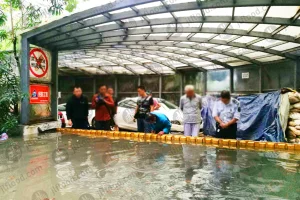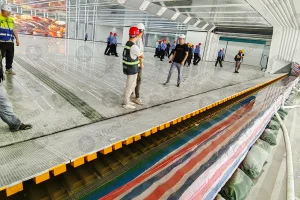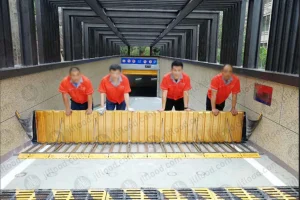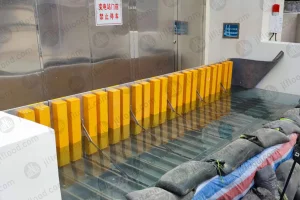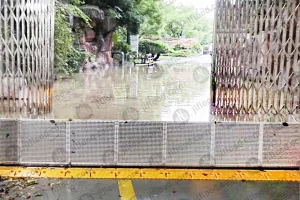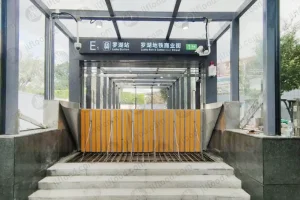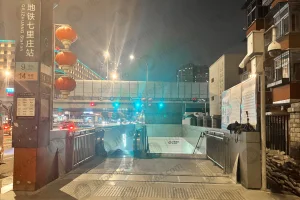
As catastrophic precipitation events and flash flooding frequency increase globally due to urban micro-climate shifts, civil structures with subterranean footprint—specifically commercial and residential underground parking garages—face catastrophic asset exposure. A single flash flood breach into a basement parking garage can result in millions of dollars in vehicle destruction, structural foundation weakening, and electrical distribution hub failure.
Traditional motorized flood gates rely on water sensors, electrical wiring, backup generators, and manual intervention. During severe storm events, municipal grid blackouts coincide exactly with water surges, rendering electric barriers completely inoperable.
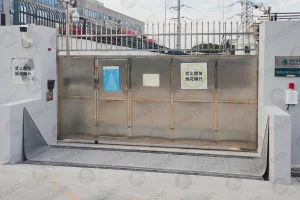
A China Self-Closing Flood Barrier Device operates entirely on passive fluid mechanics. Utilizing water buoyancy ($F_b = \rho V g$) and hydrostatic pressure, incoming surface runoff flows into the embedded basin beneath the barrier panel, automatically pivoting or raising the shield without human input.
Built with structural-grade stainless steel (SUS304/SUS316) or high-strength aviation aluminum profiles, these devices withstand continuous vehicle wheel loads up to 40-60 metric tons while retaining absolute water tightness under design flood heights.
"In subterranean hydrodynamic barrier design, the critical point of engineering failure is not structural bending moment, but baseline chamber debris buildup and seal compression fatigue. Our patented self-flushing bottom pit channels divert silt sediment via low-velocity drainage outlets, ensuring the buoyancy chamber remains free of debris for automatic deployment during emergency inundation."
The global market for subterranean flood defense devices has transitioned from reactive manual sandbag placement to fully automated, structural civil engineering integration. Driven by climate resilience mandates across North America, Western Europe, East Asia, and the Middle East, commercial property owners and municipal infrastructure boards are establishing strict structural requirements for garage entries.
Institutional real estate developers, REITs, and corporate park asset managers are now evaluated under ESG (Environmental, Social, and Governance) climate risk frameworks. Installing self-closing garage flood barriers directly reduces property risk scores, allowing asset managers to secure lower commercial insurance premiums and meet GRESB sustainability benchmarks.
Urban planning authorities in cities like Singapore (PUB regulations), Hong Kong (Buildings Department circulars), London, and coastal Chinese metropolises (Nanjing, Shanghai, Shenzhen) now mandate passive flood control gates at all subterranean ramp entrances whose baseline invert falls below designated 100-year storm flood levels.
The commercial economics are decisive: installing a high-spec hydrodynamic automatic flood barrier costs between $5,000 to $25,000 per ramp depending on span. Conversely, repairing flood damage to a 300-car basement garage, including structural decontamination and electrical transformer replacement, exceeds $1.5 million per incident.
When requesting commercial quotes from Chinese original equipment manufacturers (OEMs), engineering procurement officers must evaluate unit pricing based on clear span width, standard retaining height, load-bearing classification, and installation modularity. Below is an authentic industrial pricing matrix and key cost driver analysis.
| Model Series | Target Application | Standard Height ($H$) | Vehicle Load Rating | Material Spec | Estimated Price Range (USD / Meter) |
|---|---|---|---|---|---|
| HM4D-0006C | Commercial Garage Ramps & Logistics Hubs | 600 mm – 1000 mm | Heavy Duty (40 – 60 Tons) | SUS304 Frame / Aviation Alum Panel | $480 – $750 / m |
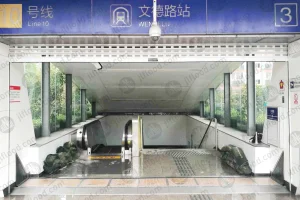
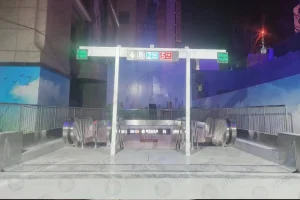
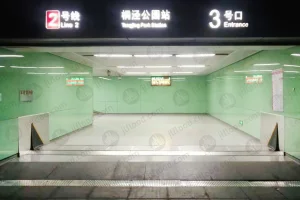
| HM4D-0006D | Subterranean Metro Entrances & Rail Terminals | 500 mm – 1200 mm | Pedestrian + Emergency Vehicle (20T) | SUS316 Marine Grade Stainless Steel | $620 – $980 / m |
| HM4D-0006E | Surface Installation / Retrofit Garage Ramp | 400 mm – 800 mm | Standard Passenger Vehicle (15T) | Extruded Aluminum Alloy 6063-T6 | $350 – $580 / m |
| Flip-Up Series | Pedestrian Doorways & Control Rooms | 300 mm – 600 mm | Pedestrian / Light Cart Load | Anodized Aluminum / EPDM Seals | $280 – $420 / m |
Driveway widths ranging from 3 meters to over 12 meters require modular leaf interlocking arrays with structural reinforcement mullions.
Embedded types require a concrete foundation recess (typically 200mm to 400mm depth), influencing baseline excavation civil costs.
Standard EPDM vs fluorocarbon/silicone gasket materials for sub-zero climates or high-salinity coastal marine environments.
Reinforced internal rib structures designed to absorb continuous heavy bus or freight truck passage without structural fatigue.
Nanjing Junli Technology Co., Ltd. builds self-closing garage flood barriers according to rigorous architectural and mechanical standards. The device consists of three critical sub-assemblies: the structural foundation frame, the floating door leaf panel, and the triple-redundant seal array.
Fabricated from hot-dip galvanized steel or SUS304 stainless steel with a minimum zinc coating thickness of 85 microns. Integrated anchor lugs tie directly into the garage ramp reinforced concrete rebar structure, preventing movement during high hydrostatic load.
Engineered using extruded aviation-grade T6 aluminum hollow chambers filled with closed-cell polyurethane hydrophobic foam. This delivers high structural stiffness-to-weight ratio, enabling immediate buoyancy rise when baseline water exceeds 30-50mm.
Utilizes continuous co-extruded EPDM rubber gasket profiles mounted along bottom, side jam, and panel-to-panel joints. Hydrostatic head pressure acts directly on the active lip seal, increasing seal compression as water level rises.
While garage ramps present the most frequent commercial deployment, China hydrodynamic self-closing barriers are designed for multi-sector asset protection where water ingress causes critical disruption.
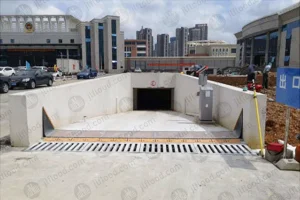
Underground car parks for shopping malls, office towers, residential high-rises, and luxury hotel basements. Protects tenant vehicles and critical utility basements.
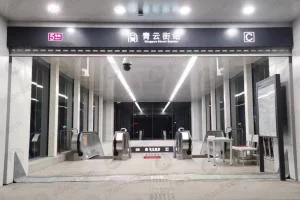
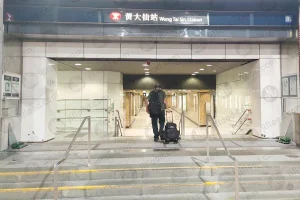
Subway station pedestrian portals, ventilation shafts, and subterranean inter-modal connection corridors. Validated in Guangzhou, Suzhou, and Dalian metro networks.
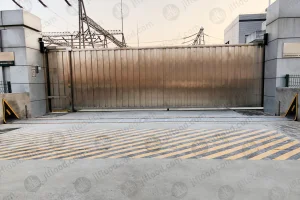
Perimeter security gates and cable vault doors for high-voltage transformer stations where water ingress triggers catastrophic regional grid power failure.
Underground vehicular tunnels, pedestrian street crossings, airport landside basements, and municipal underground utility corridors.
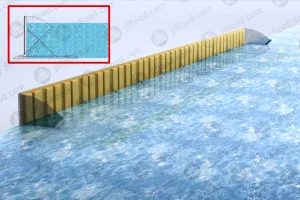
Submit your garage entrance clear width, design flood retaining height, and traffic load requirements. Nanjing Junli Technology’s engineering team will return structural CAD drawings, factory pricelists, and formal quotes within 24 hours.