Precision-engineered hydrodynamic barriers validated across high-density commercial assets and municipal infrastructure.
Analyzing the Technological Migration from Passive Sandbags to Autonomous Hydrodynamic Self-Closing Flood Gates in High-Density Urban Environments.
As rapid urbanization collides with increasing climate volatility, extreme precipitation and urban flash floods pose catastrophic financial and physical risks to commercial real estate, industrial infrastructure, and public transit assets. Globally, municipal building codes are shifting from reactive disaster mitigation to mandatory proactive structural design. In this context, the China self-closing flood gate for building has emerged as the definitive standard for perimeter water-retaining resilience.
Historically, property managers and structural engineers relied upon manual flood barriers—such as modular aluminum stop-logs or sandbags. However, post-disaster forensic investigations consistently reveal that manual systems suffer from high failure rates due to delayed human deployment, unpredicted off-hour cloudbursts, severe labor shortages during emergencies, and loss of grid electricity. Modern smart architecture demands automated, unpowered, and fail-safe flood containment systems that operate independently of human intervention or external power supplies.
Manual aluminum stop-logs require 30–60 minutes of labor-intensive installation. Electric barriers fail during power grid blackouts—the precise moment floodwaters peak. Pneumatic systems rely on pressurized air lines that can rupture under structural strain.
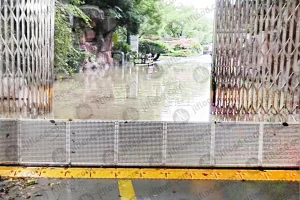
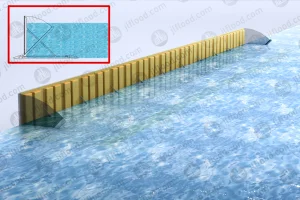
Self-closing flood gates utilize the natural hydrostatic pressure and buoyancy of incoming floodwaters. They embed flush into ground levels, triggering automatically in seconds without sensors, motors, human power, or utility connections.
An in-depth analysis of buoyant lever balance, structural load distribution, and multi-tier EPDM sealing technology engineered by Nanjing Junli Technology.
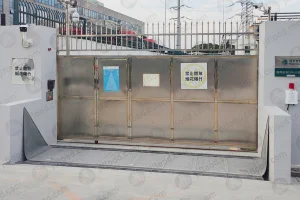
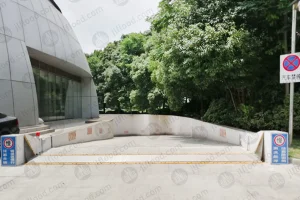
The engineering foundation of the self-closing flood barrier rests on Archimedes' buoyancy principle coupled with hydrostatic moment arm physics. Recessed within a custom-cast concrete foundation trench at entry points—such as underground garage ramps, metro station portals, or power substation doorways—the gate sits completely flush with the finished roadway level during normal conditions, supporting heavy vehicular traffic without disruption.
As surface runoff flows toward the structure, it enters the inlet grille of the embedded frame basin. Water fills the subterranean retention chamber, creating hydrostatic uplift force against the lightweight high-strength marine-grade aluminum door panel.
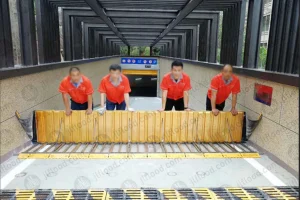
The panel rotates smoothly along a stainless steel hinge axis. As water levels rise, buoyancy drives the panel upward to a 16° to 90° retaining angle, creating an impenetrable wall. Secondary mechanical latches engage under peak hydrostatic load.
Once regional floodwaters recede, the water collected within the subterranean basin drains away naturally via non-return check valves into municipal storm drains. The door panel returns smoothly to its zero-profile flush rest position.
Building longevity requires extreme structural resilience. Nanjing Junli Technology utilizes specialized extruded 6063-T6 marine aluminum profiles paired with 304 or 316 stainless steel structural framework. Sealing integrity is maintained via high-density EPDM (Ethylene Propylene Diene Monomer) composite rubber gaskets engineered to withstand extreme temperature ranges (-40°C to +120°C), UV radiation, chemical runoff, and biological degradation over a 20+ year operational lifespan.
How international architectural specifications, real estate developers, and infrastructure operators deploy self-closing flood gates to secure critical assets.
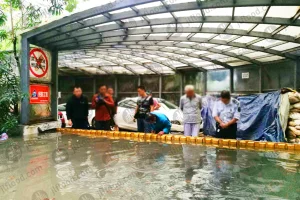
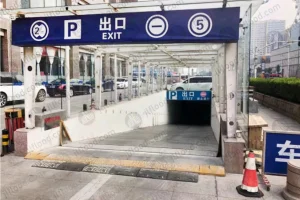
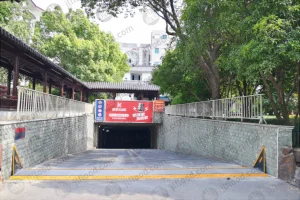
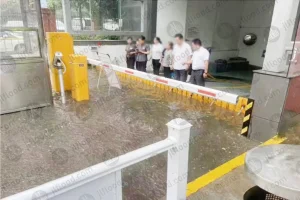
Underground multi-story parking structures are highly vulnerable to flash flood inundation. Standard ramp widths require multi-leaf modular self-closing flood gates capable of holding back up to 2.0 meters of static head water while enduring heavy vehicle passage (up to 40-ton load capacity for fire trucks and delivery vehicles) without structural deformation.
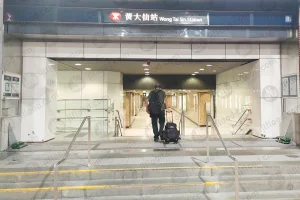
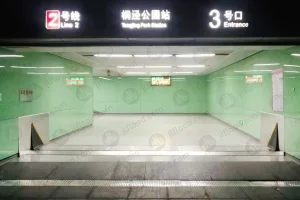
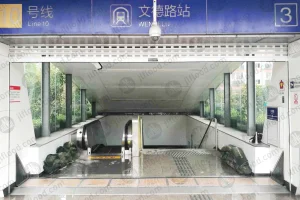
Subway portals, pedestrian connection channels, and ventilation shafts act as direct funnels for floodwaters into subterranean rail networks. Leading metro authorities—including Guangzhou, Suzhou, Nanjing, Beijing, Shenzhen, Dalian, and Hong Kong MTR—have adopted surface-mounted (HM4D-0006E) and embedded automatic flood gates to guarantee 100% water exclusion during severe typhoons.
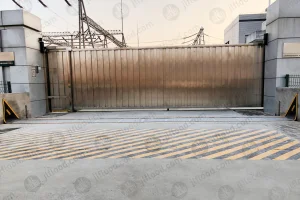
Water intrusion into power transformer vaults or regional electrical substations causes catastrophic multi-million-dollar power grid collapses and citywide blackouts. Self-closing substation gates deliver zero-latency automatic protection, insulating critical transformers, high-voltage switchgear, and cable trenches from water ingress.
Hospitals, emergency response centers, and airport landside passages require 24/7 uninterrupted baseline operational status. Autonomous self-closing flood gates satisfy international ESG (Environmental, Social, and Governance) requirements, enabling seamless asset protection and reduced commercial property insurance premiums.
Why international EPC contractors and architectural specifiers partner with China’s premier specialized flood barrier manufacturer.
Located in the engineering hub of Qinhuai District, Nanjing, Jiangsu Province, Nanjing Junli Technology Co., Ltd. stands at the forefront of intelligent flood control engineering. Integrating smart civil defense, hydrodynamic design, structural bridge mechanics, and power security systems, Junli Technology operates a fully integrated, state-of-the-art Industry 4.0 manufacturing complex.
Our automated CNC extrusion, robotic laser welding, and precision assembly lines ensure millimetric precision. Standardized modular designs enable rapid custom scaling for opening spans from 2 meters up to 30+ meters.
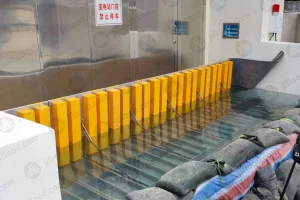
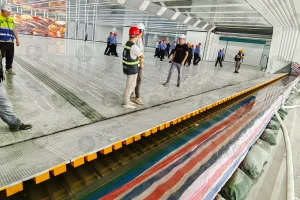
Every gate design undergoes rigorous full-scale hydraulic testing inside Junli’s specialized testing pool. We verify lift initiation speeds, hydrodynamic seal deflection under maximum head pressure, and leakage zero-tolerance prior to international export packing.
From CAD/BIM dimensional drawings to custom embedded frame templates, remote installation commissioning guidance, and complete bilingual engineering documentation, Junli delivers complete end-to-end supply chain confidence.
A direct technical comparison highlighting operational efficiency, life-safety compliance, and long-term Total Cost of Ownership (TCO).
| Technical Criterion | Junli Self-Closing Flood Gate | Electric Motorized Gate | Manual Aluminum Stop-Logs |
|---|---|---|---|
| Power Reliance | 0% (Pure Passive Buoyancy) | 100% (Requires Grid / Backup Gen) | 0% (Manual Labor Required) |
| Activation Latency | Immediate / Autonomous (< 1 sec) | 30 - 120 Seconds (Sensor dependent) | 30 - 90 Minutes (Human deployment) |
| Blackout Reliability | 100% Continuous Protection | High Failure Risk (Battery decay) | Operational (If staff is present) |
| Traffic Profile Integration | Flush Ground Level (Up to 40T load) | Raised Thresholds / Tracks | Ramps require storage racks |
| Operational Expense (OPEX) | Near Zero (Low periodic inspection) | High (Motor/Sensor/UPS service) | High (Ongoing staff drill costs) |
| Expected Service Life | 20+ Years (Marine grade alloy) | 8 - 12 Years (Mechanical wear) | 10 - 15 Years (Gasket deterioration) |
Expert answers to common engineering, procurement, installation, and compliance inquiries from international specifiers.
Discover our specialized line of automatic barriers engineered for substations, metro channels, and high-load industrial entrances.
Contact our technical sales engineering team today to submit site entry dimensions, request detailed CAD templates, or receive a factory-direct OEM quote for your upcoming project.