Engineered for extreme hydrodynamic pressure, zero-power operation, and high-frequency deployment across civil defence projects.
Urban precipitation models have shifted permanently. Extreme weather events, intensified by global climate volatility, present severe operational and structural hazards to civil infrastructure worldwide.
Across Europe, North America, East Asia, and the Middle East, high-density metropolitan zones face unprecedented flash flooding. Traditional emergency measures—such as manual sandbagging, temporary aluminum stop-logs, or electrically actuated pump-dependent barriers—consistently fail during critical stress scenarios. Manual barriers require human intervention, which is frequently blocked by traffic gridlock or rapid inundation rates. Conversely, electromechanical systems rely on external grid power or sensor networks that routinely short-circuit during torrential downpours.
As a result, leading municipal agencies, commercial real estate developers, and utility operators are replacing legacy solutions with passive hydrodynamic automatic flood gates. Sourcing these specialized systems from established **China Water Flood Barrier Manufacturers & Suppliers** provides global procurement managers with an optimal balance of advanced hydraulic engineering, massive production capacity, and field-tested reliability.
How hydrodynamic self-rising flood gates achieve absolute operational reliability without sensors, human labor, or external electricity.
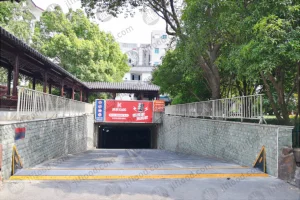
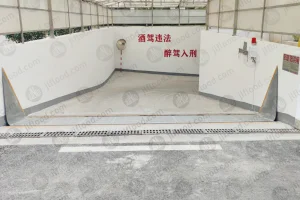
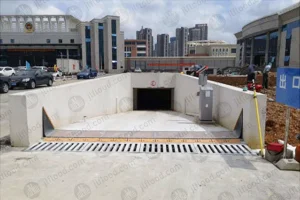
The core technological leap of modern flood barrier manufacturing lies in passive hydrodynamic activation. Standard flood gates sit flush within a recessed foundation casing embedded directly into driveway ramps, subway entrances, or utility access gates. Under dry conditions, heavy vehicles drive over the flush top panel without causing deformation or structural noise.
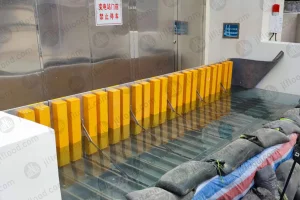
When localized flash flooding occurs, water flows into the ground-level intake basin. As water fills the bottom recess chamber, it exerts hydrostatic pressure and buoyancy forces on the internal hollow aluminum/stainless steel barrier leaf. The dynamic fluid pressure causes the door panel to automatically float, rotate upward, and seal against the vertical frame profiles.
The system remains fully recessed into the concrete slab. High-tensile structural ribbing allows continuous heavy-vehicle pass-through (up to 40+ tons axle load).
Rising surface runoff enters the inlet grid. Internal buoyancy chambers fill rapidly, generating immediate vertical lift torque without electrical triggers.
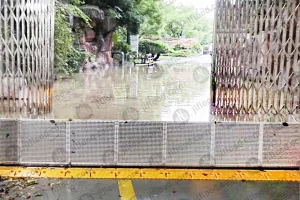
As water levels rise against the barrier wall, head pressure pushes specialized EPDM rubber gaskets tighter against side frames, minimizing leakage to virtually zero.
Once floodwaters recede, water inside the foundation vault drains via integrated gravity sump outlets, allowing the gate to lower back flush smoothly.
| Evaluation Parameter | Hydrodynamic Passive Gate (China OEM) | Active Electric Roll-Up Barrier | Manual Modular Aluminum Stop-Logs |
|---|---|---|---|
| Power Dependence | 0% (Pure Mechanics) | 100% (Grid/Generator Dependent) | 0% (Manual Assembly) |
| Human Activation Time | Instantaneous (Autonomous) | Manual switch / Sensor trigger | 30 – 120 minutes manual labor |
| Power Outage Risk | Zero Risk | High Risk during storm blackouts | N/A |
| Structural Load Capacity | AASHTO HS-20 / Heavy Vehicle Rated | Light to Moderate Pedestrian | Moderate Pressure Limits |
| 20-Year Total Cost of Ownership | Lowest (Minimal Maintenance) | High (Motor/Sensor Servicing) | High (Labor & Storage Expenses) |
Understanding why global engineering procurement managers partner with Chinese flood barrier OEMs to mitigate urban risk at scale.
China's industrial infrastructure sector has achieved world-class capabilities in metallurgical extrusion, precision welding, composite sealing technologies, and full-scale hydraulic testing. Partnering with a specialized Chinese flood control manufacturer gives global buyers distinct structural and financial advantages:
Direct integration with domestic marine-grade 6063-T6 aluminum alloy smelters and 304/316 stainless steel fabricators ensures superior tensile strength and corrosion resistance in saline or polluted stormwaters.
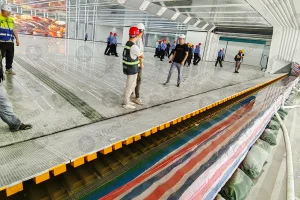
Leading Chinese manufacturers maintain dedicated full-scale hydraulic test pools. Every custom gate configuration is flooded to maximum hydrostatic head pressure before dispatch to verify seal deflection and zero-leakage rates.
Chinese OEM engineering teams deliver rapid parametric CAD drawings, civil embedment clearance notes, and BIM models tailored to international civil engineering standards (BS, EN, ASTM, and AS/NZS).
Tailored hydrodynamic flood defence systems designed for critical entry points across diverse asset landscapes.
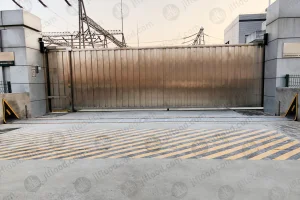
High-voltage power substations require strict perimeter protection. Water ingress into transformer bays or cable trenches leads to catastrophic regional grid failure. Substation flood barriers feature non-conductive sealing options, high chemical resistance, and automatic rising action to maintain grid integrity during unattended storm events.
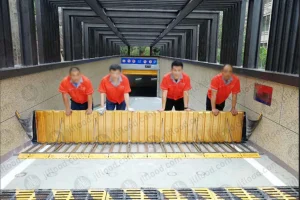
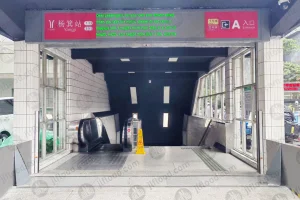
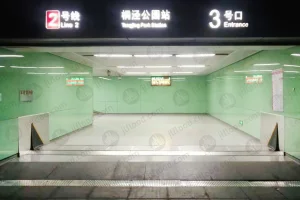
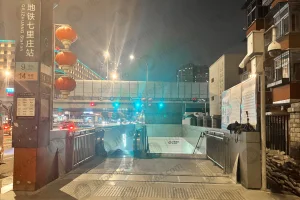
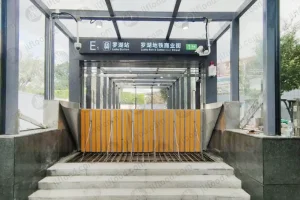
Subway systems are highly vulnerable to urban surface run-off entering passenger stairwells, ventilation shafts, and connection channels. Modular embedded flood barriers provide a seamless, flush threshold for high-volume foot traffic while guaranteeing automatic rising defense during sudden torrential downpours.
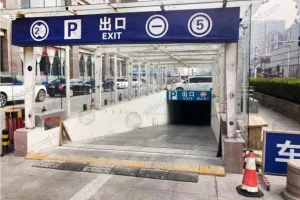
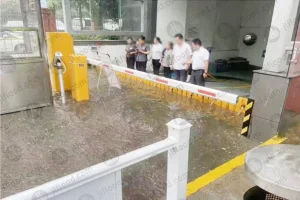
Commercial shopping malls, hospital basements, and residential parkades feature steep entry ramps that channel stormwater straight into lower levels. Embedded ramp flood barriers withstand heavy vehicular traffic (including delivery trucks) while deploying automatically when water approaches kerb thresholds.
Underground pedestrian tunnels, rail concourses, and airport landside passages require ultra-wide span flood barriers. China suppliers fabricate multi-leaf interlocking hydrodynamic gates equipped with central support mullions that withstand severe hydro-dynamic wave loads.
Key engineering parameters global consulting engineers must mandate when issuing RFP tenders for flood barriers.
Integrating passive mechanical reliability with IoT telematics and smart city flood monitoring ecosystems.
While mechanical passive activation remains the gold standard for fail-safe physical protection, the future of flood control lies in **hybrid intelligent monitoring**. Modern Chinese manufacturers are pioneering dual-layer system architectures:
1. Mechanical Passive Physical Barrier: Pure hydrostatic buoyancy operates the physical door leaf autonomously without relying on external power.
2. IoT Wireless Telemetry Layer: Low-power solar/battery-operated sensors transmit real-time barrier deployment status, water level gauge data, and maintenance alerts directly to municipal SCADA or building management systems (BMS).
This hybrid approach eliminates the single point of failure inherent in motorized gates while granting facility managers total remote visibility over their urban resilience assets.
Technical clarification for hydraulic engineers, architectural specifiers, and procurement officers.
Explore our full line of embedded, self-closing, and heavy-duty automatic flood protection products.
Quick baseline values for civil engineers and tender document drafting.
| Specification Parameter | Standard Commercial Grade | Heavy-Duty Industrial / Infrastructure Grade |
|---|---|---|
| Primary Material | High-Strength Aluminum Alloy 6063-T6 | Reinforced 6063-T6 + 304/316 Stainless Steel Framing |
| Retaining Height Range | 500 mm – 1000 mm | 600 mm – 2000 mm (Customizable) |
| Sealing Gasket Type | Co-extruded EPDM Vulcanized Rubber | Dual-Lip Anti-Aging Marine EPDM Gaskets |
| Activation Mechanism | Hydrodynamic Buoyancy / Self-Rising | Hydrodynamic Buoyancy + Manual Override Lockout |
| Vehicular Axle Load | 10 – 20 Tons (Standard Cars & Light Vans) | 40+ Tons (AASHTO HS-20 Heavy Trucks & Fire Engines) |
| Response Activation Time | Immediate upon water entry (< 0.5s) | Immediate upon water entry (< 0.1s) |
| Operational Lifespan | 15+ Years | 25+ Years |