Field-tested hydrodynamic flood protection barriers engineered for seamless automated emergency deployment.
As extreme weather events, flash pluvial flooding, and sea-level surges escalate globally, municipal authorities, commercial real estate developers, and utility operators face unprecedented risk exposures. Traditional flood defense measures—such as manual sandbagging, modular aluminum stop-logs, and electrically powered vertical gates—are rapidly proving inadequate for modern resilience engineering. The structural bottleneck of traditional systems lies in human operational latency and grid disruption. When severe storms strike, municipal power grids frequently suffer catastrophic blackouts, rendering electromechanical flood barriers non-operational exactly when they are required most.
Consequently, international civil engineering specifications are shifting toward passive, hydrodynamic automatic flood gates. Engineered to operate completely independent of human intervention, external sensors, or electrical power, these systems utilize fundamental hydraulic principles to achieve automated deployment. As a premier wholesale manufacturer based in Nanjing, China, our technology represents the pinnacle of hydrodynamic passive flood defense, safeguarding critical subterranean assets across North America, Europe, Southeast Asia, and the Middle East.
Information Gain Insight: According to global infrastructure vulnerability assessments, over 74% of commercial basement flooding damages occur during urban power outages where automated electrical pumps and electric flood doors failed to trigger. Purely mechanical, hydrodynamic buoyancy gates eliminate this single point of failure entirely.
| Evaluation Parameter | Hydrodynamic Automatic Gate | Electromechanical Barrier | Manual Stop-Log Panels |
|---|---|---|---|
| Power Source | 0% (Pure Fluid Buoyancy) | 100% (Grid / Backup Generator) | Manual Labor Required |
| Deployment Latency | Instantaneous (< 30 Seconds) | 1 to 5 Minutes (If Power Active) | 30 to 120 Minutes |
| Human Reliability Risk | Zero (100% Autonomous) | Medium (Requires Sensor/Trigger) | Critical High (Staff Dependency) |
| Driveway Flush Mounting | Seamless In-Ground Trench | Above-Ground Tracks / Posts | Storage Racks Required |
| Maintenance Overhead | Low (Semi-Annual Flushing) | High (Motors, Wiring, Logic) | Moderate (Seal Inspections) |
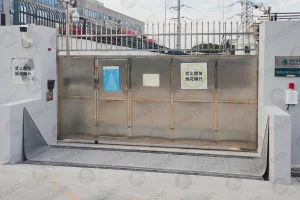
The core physics of our modular hydrodynamic automatic flood gate relies on Archimedes' principle of buoyancy coupled with hydrostatic pressure differentials. The entire assembly consists of three core engineering sub-systems: the structural embedded foundation frame, the dynamic buoyed leaf panel, and the triple-redundant EPDM sealing matrix.
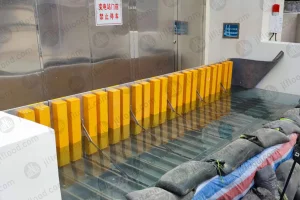
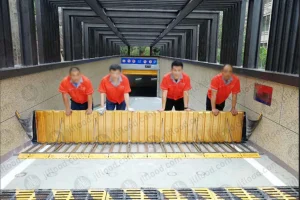
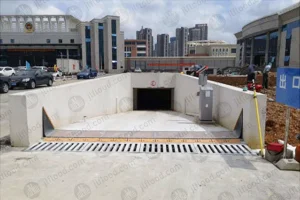
Under dry ambient conditions, the reinforced flood gate panel rests horizontally flat inside a shallow ground trench, fully flush with the surrounding road surface. Heavy-duty vehicles, buses, and freight trucks can pass over the door plate without structural deflection, supported by heavy structural stainless steel internal ribbing.
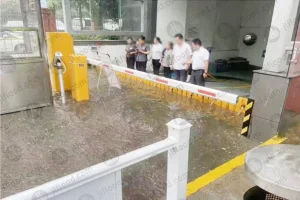
When flash surface runoff reaches the threshold line, floodwaters enter the basin tray through targeted intake grates. As water accumulates within the basin chamber, the hollow stainless-steel or aviation-grade aluminum panel displacement chamber generates massive upward buoyant force, tilting the panel automatically upward.
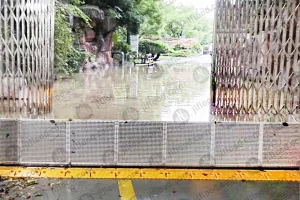
As water depth continues rising outside, incoming hydrostatic pressure pushes the raised gate panel firmly against the vertical rubber seal frame. The higher the external water head rises, the tighter the compression seal becomes against the wall interface, achieving zero leakage performance.
Once floodwaters subside and the internal basin chamber drains via natural gravity or secondary municipal sumps, the panel gently lowers back into its horizontal rest position, restoring unrestricted pedestrian and vehicle access automatically.
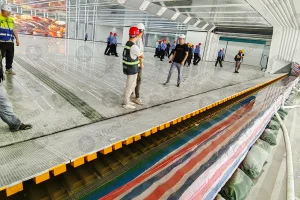
Sourcing large-scale perimeter flood protection barriers for international infrastructure contracts demands strict quality control, verified material metallurgy, and scalable production capacity. Located in Nanjing, Jiangsu Province, Nanjing Junli Technology Co., Ltd. operates an advanced manufacturing facility specializing exclusively in urban flood barriers, civil defense engineering gates, and hydro-mechanical structures.
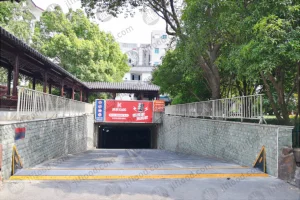
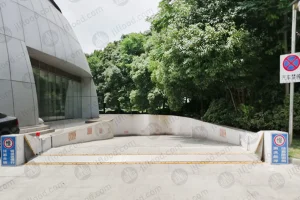
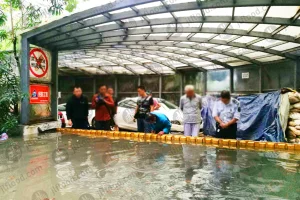
Subterranean commercial and residential car parks are high-risk zones during urban flash flooding. Embedded flush-mounted hydrodynamic gates prevent catastrophic vehicle losses without restricting daily high-frequency traffic ingress and egress.
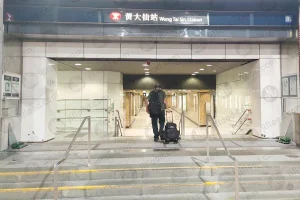
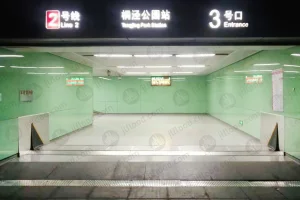
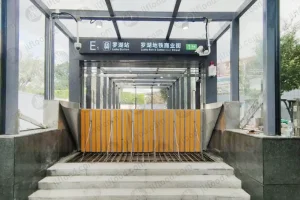
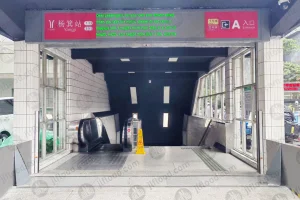
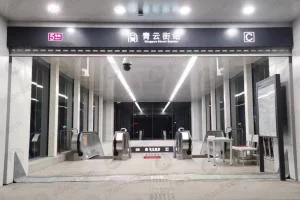
Rapid transit subway networks demand zero-tolerance security against water ingress. Junli flood protection barriers are deployed across metro portals in Guangzhou, Beijing, Suzhou, and Hong Kong to isolate subways from street water inundation.
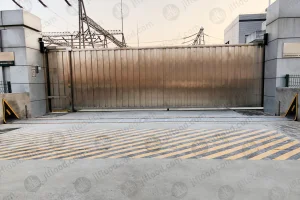
Grid transformers, switchgear rooms, and cable trenches require non-conductive, ultra-reliable water containment. Automatic non-electric flood gates protect critical electrical infrastructure against wide-scale blackouts.
For industrial containment, flood gates act as dual-purpose barriers: preventing external river floodwaters from entering hazardous facilities, while containing accidental toxic chemical spills inside the perimeter boundary.
While mechanical reliability remains the primary foundation of flood safety, modern Smart City paradigms require continuous status monitoring. The latest generation of Junli hydrodynamic gates integrates ultra-low-power IoT (Internet of Things) telemetry modules. These sensors operate via long-life lithium battery packs or solar trickle micro-panels, transmitting real-time operational metrics over LoRaWAN or NB-IoT networks to municipal command centers.
Smart Features Include: Automated SMS/Email alerting when water enters the basin, optical angle encoders verifying panel opening height, silt accumulation diagnostics, and continuous water level telemetries available on desktop and mobile dashboards.
Furthermore, because hydrodynamic passive gates consume zero electricity during standby or operation over their 25+ year lifespan, specifying engineers dramatically reduce embodied and operational carbon footprints compared to powered hydraulic ram systems, directly contributing to LEED and BREEAM sustainability ratings for green buildings.
When drafting Request for Quotations (RFQs) or civil tender documentation for automatic flood gates, architectural specifiers should mandate the following non-negotiable structural and material standards:
Expert answers to common technical, structural, and procurement inquiries regarding automatic flood gates.
Tailored flood mitigation structures for substations, metro channels, and garage access entrances.