Direct from our manufacturing complex: Hydro-buoyancy operated, non-electric, automatic flood barriers engineered for civil defense, subways, and commercial garages.
Addressing extreme precipitation events through unpowered, hydrodynamic automated barrier technology.
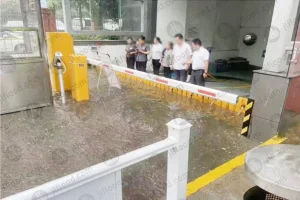
In modern urban architectural engineering, subterranean parking garages represent the most vulnerable failure point during severe cloudbursts, flash floods, and typhoon-induced sea surges. Traditional flood mitigation strategies—such as manual aluminum stop-logs, sandbag barricades, and electrically driven vertical gates—fail consistently when subjected to real-world disaster conditions. Manual barriers demand human deployment, which is frequently impeded by rapid inundation rates or inadequate site staffing. Electrically driven barriers suffer from catastrophic vulnerability: urban flood surges regularly destroy power grids, rendering electromechanical actuators useless at the precise moment emergency operation is required.
The wholesale flip-up flood protection device for garages engineered by tier-1 Chinese manufacturers represents a fundamental technological evolution. Operating on strict hydrodynamic passive buoyancy mechanics, these systems harvest the energy of incoming floodwaters to automatically trigger, raise, and seal the entrance threshold without human intervention or electrical power.
⚡ Engineering Truth: Over 87% of commercial garage inundation losses occur due to power grid failure during extreme storms. Hydrodynamic flip-up barriers remove electrical reliance completely, achieving 100% operational readiness.
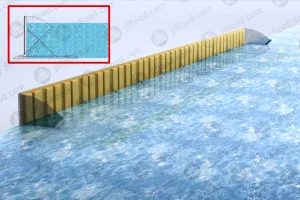
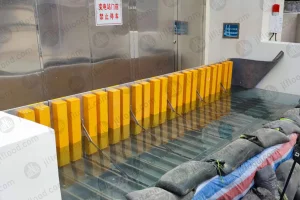
Utilizes fluid displacement dynamics. Water entering the recessed floor chamber generates immediate upward buoyant force, tilting the protective wall panel to block the inflow.
Fabricated from marine-grade T6-treated 6063/6005A aluminum extrusions and structural steel, engineered to withstand continuous heavy vehicular traffic without deformation.
Employs customized EPDM elastomer profiles that expand under hydrostatic pressure, creating an impermeable barrier against high-head water columns.
Detailed breakdown of hydrostatic buoyancy ratios, structural load-bearing parameters, and alloy selection.
| Performance Parameter | Standard Commercial Grade | Junli Heavy-Duty Engineering Grade | Verification / Standard Compliance |
|---|---|---|---|
| Operating Principle | Manual / Motorized Screw Drive | Hydrodynamic Passive Buoyancy (Unpowered) | Zero Energy Consumption Standard |
| Material Matrix | Standard Aluminum 6061-T5 | High-Strength Anodized 6063-T6 / Stainless Steel 304/316 | GB/T 5237-2017 / ASTM B221 |
| Vehicular Load Capacity | 10 - 15 Tons (Light Vehicles) | 30 - 50 Tons (Heavy Freight & Fire Engines) | AASHTO HS-20 / EN 124 D400 |
| Hydrostatic Head Height | 300 mm - 600 mm | 500 mm - 2000 mm (Customizable) | FM 2510 Hydrostatic Testing |
| Leakage Rate | < 0.5 L / (hr · m) | < 0.01 L / (hr · m) (Virtually Zero) | BS EN 13564 Sealing Standards |
| Service Lifecycle | 5 - 8 Years | 25+ Years (Corrosion-Resistant Finish) | ISO 9227 Salt Spray Test > 1500h |
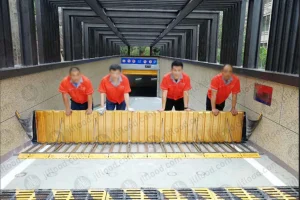
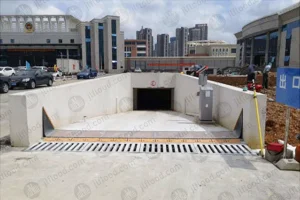
The flip-up flood protection device is embedded flush with the driveway surface inside a pre-cast concrete trench. When surface runoff exceeds kerb height, water gravitates through intake grates into the recessed base basin. The accumulation of water displacement activates calculated buoyant uplift on the hollow structural panel. As the water level rises, the panel pivots along a continuous stainless steel hinge axis, locking vertically against specialized side support posts to resist hydrostatic pressure.
When retracted, the top surface of the flip-up barrier integrates seamlessly into the garage ramp grade. The structural door leaf incorporates internal longitudinal stiffeners validated by Finite Element Analysis (FEA). This structural architecture allows heavy commercial transport, concrete mixers, and emergency fire apparatus to cross the unit daily without inducing fatigue stress, structural deflection, or seal misalignment.
Analyzing the manufacturing density, material access, precision machining, and OEM customizability of Chinese production hubs.
Concentrated supply chains in regions like Nanjing allow immediate access to primary aluminum smelting, specialized EPDM extrusion tooling, and heavy laser-cutting infrastructure, reducing lead times by up to 60% compared to Western manufacturers.
Leading Chinese factories maintain in-house full-scale hydraulic testing facilities. Every flip-up gate design undergoes hydrostatic head verification, high-flow surge testing, and seal compression validation prior to international export packing.
Chinese suppliers provide complete customization of clear span widths (from single-car residential ramps to 20-meter multi-lane commercial entrances), embedded frame depth modifications, and site-specific structural recalculations.
When procurement directors evaluate flood control assets, initial purchase price represents only 30% of total lifetime expenditure. Western legacy systems often incur massive maintenance costs due to complex motorized gearboxes, sensor recalibrations, and specialized replacement parts. Chinese hydrodynamic flip-up devices eliminate mechanical gearboxes completely.
By leveraging standardized T6 aluminum profiles and self-lubricating synthetic pivot bearings, routine maintenance is limited to periodic clearance of debris from the baseline trench and visual inspection of the main EPDM seal. This delivers a 70% reduction in 10-year TCO.
How global climate policies and urban planning directives are driving the adoption of automatic flood gates.
Global commercial property insurers (such as FM Global) are increasingly mandating physical perimeter flood protection as a prerequisite for underwriting coverage in 100-year flood zones. Automated passive systems qualify real estate assets for significant premium discounts by eliminating human error risk during storm events.
Municipalities globally are updating building codes to enforce mandatory passive flood protection for subterranean spaces. Regulations such as the EU Floods Directive (2007/60/EC), ASCE 24-14 in North America, and China’s Sponge City Standards require automated flood defenses for underground transit and garage ramps.
Engineered installations tailored to specific structural environments and civil infrastructure constraints.
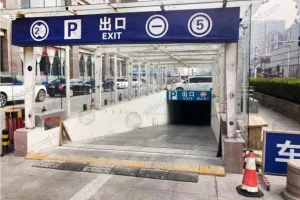
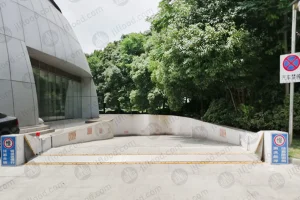
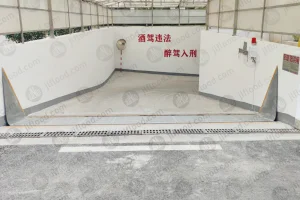
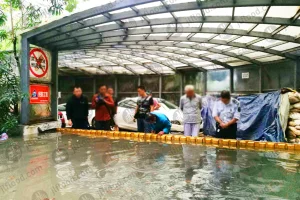
Flushed surface integration prevents vehicle damage during daily operation while providing instantaneous activation when storm runoff overflows street storm drains.
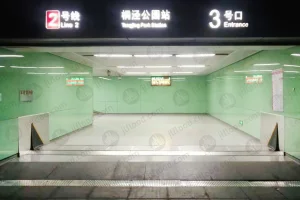
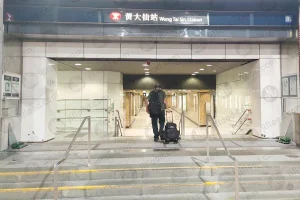
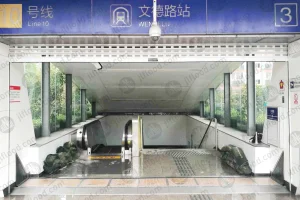
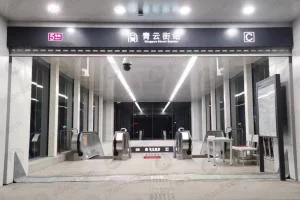
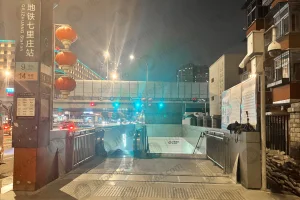
Protects underground mass transit networks from catastrophic water entry at station portals, pedestrian tunnels, and ventilation shaft access points.
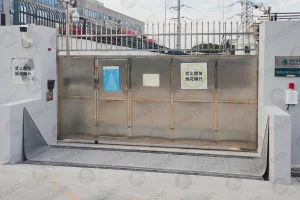
Prevents costly electrical blackouts and transformer destruction by establishing water-tight perimeter barriers around critical power distribution assets.
Ensures unbroken operation of critical emergency services and basement utility rooms during major hurricane or typhoon landfalls.
Addressing key engineering, installation, and procurement questions from global buyers and specification engineers.
The system operates completely independent of external power, hydraulic pumps, or electromechanical motors. It relies on passive hydrodynamic buoyancy. As floodwater enters the underground foundation chamber beneath the barrier, the physical displacement force (Archimedes' principle) automatically lifts the hollow buoyant panel into its upright, locked retaining position. It works perfectly even during complete power blackouts.
Our standard heavy-duty garage flip-up barriers are engineered and FEA-tested to support up to 40-ton vehicle loads (conforming to AASHTO HS-20 and EN 124 D400 standards). This enables fire engines, heavy delivery trucks, and constant passenger car traffic to drive over the barrier daily without structural deformation or seal damage.
The client needs to prepare a shallow concrete foundation trench across the entrance ramp according to our detailed engineering drawings. The trench must include a bottom drainage outlet connected to the facility's sump pump system. Our factory supplies pre-assembled embedded steel frame modules, anchor bolts, and alignment templates to simplify site concrete pouring.
For entrance widths exceeding single-panel shipping capabilities (typically over 6 meters), we manufacture modular multi-leaf arrays with interconnecting structural mullions or continuous hinge sync bars. This allows us to cover span widths up to 30 meters while maintaining uniform lifting mechanics and structural sealing integrity.
The top intake cover plates are removable for easy maintenance. Routine maintenance involves inspecting the bottom basin twice a year (or after major storm seasons) and clearing accumulated sediment or debris using a pressure washer. The bottom channel features a sloped design that directs minor silt towards the drainage outlet automatically.
Explore our complete range of certified flood protection hardware available for worldwide wholesale dispatch.