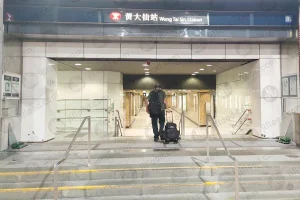
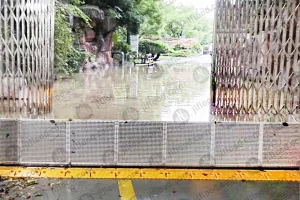
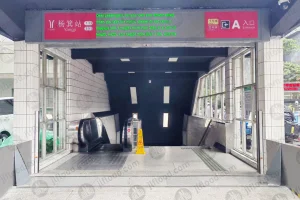
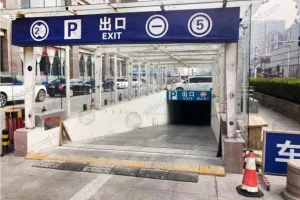
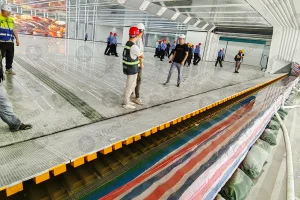
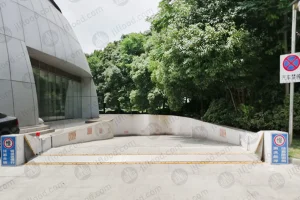
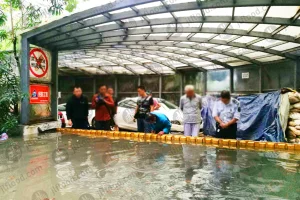
Direct factory procurement models featuring power-free self-rising hydrodynamic mechanics, surface-mounted metro barriers, and subterranean garage gates tested under extreme hydrostatic pressure.
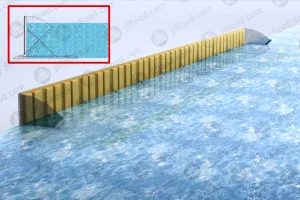
As extreme meteorological events accelerate worldwide due to global climate shift, urban waterlogging and storm surges pose existential financial threats to municipal transit, commercial real estate, and utility networks. Modern B2B procurement strategies are pivoting from reactive sandbag deployment toward engineered, zero-human-intervention automatic flood barrier architectures.
Traditional flood abatement techniques rely heavily on manual labor, early-warning sensors, and grid electricity. During catastrophic typhoons or flash floods, power grids frequently collapse and key personnel are blocked from reaching critical entrances, causing multi-million-dollar structural drownings in subterranean infrastructure.
The modern engineering consensus favors hydrodynamically self-rising gates. Utilizing basic fluid mechanics Archimedes' principle and hydrostatic head pressure—the incoming floodwater itself becomes the actuation force. The system rises dynamically as water rises, eliminating motor failures, sensor latency, and electrical short circuits.
For enterprise procurement officers, the initial capital expenditure (CAPEX) on specialized stainless steel and marine-grade aluminum flood control gates yields an extraordinary return on investment by mitigating operational shutdown costs, severe asset impairment claims, and escalating commercial insurance premiums.
International EPC contractors, municipal authorities, and wholesale buyers require stringent technical parameters prior to issuing RFQs (Request for Quotes). Below is an structural comparison of modern industrial flood barriers across key operational environments.
| Application Sector | Primary Risk Factor | Required Retaining Height | Structural Load Rating | Recommended Barrier Architecture |
|---|---|---|---|---|
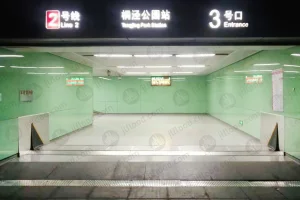
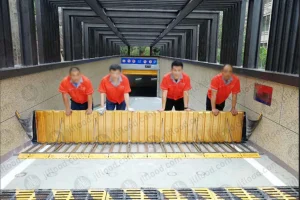
| Subway & Rail Transit Stations | Extreme rapid flash flood ingress via passenger portals & connection channels | 0.6m – 1.6m | Pedestrian + Light Emergency Vehicle (5–10T) | Surface-Mounted or Embedded Hydrodynamic Automatic Barrier (HM4D Series) |
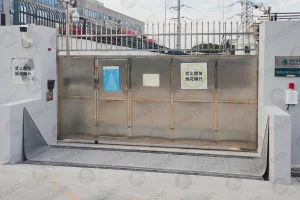
| High-Voltage Power Substations | Water invasion into transformer rooms causing grid blackout & explosive arcs | 0.5m – 1.2m | Perimeter Gate Pedestrian & Heavy Maintenance Truck (20–40T) | Modular Stainless Steel Flip-Up / Automatic Self-Closing Barrier |
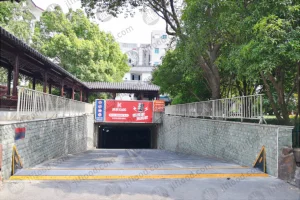
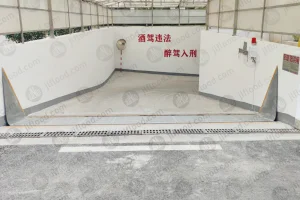
| Commercial & Hospital Garages | Ramp runoff flooding lower parking levels, elevators, and electrical switchgears | 0.6m – 2.0m | Heavy Commercial Vehicles & Buses (30–40T Drive-over) | Embedded Heavy-Duty Hydrodynamic Automatic Gate (HM4E Series) |
| Civil Defense Underground Works | Long-term static water pressure during major urban inundation events | 1.0m – 2.5m | Specialized Military & Civil Defense Load Standard | Reinforced Dual-Lip EPDM Modular Hydrodynamic Barrier Array |
OEM Direct Advantage: Factory custom-engineered embedded frames allow seamless integration into existing asphalt, concrete, or granite surfaces without altering existing clear driveable width or vehicle ground clearance during dry weather.
Understanding how unpowered automatic flood barriers operate under severe hydraulic load requires analyzing the hydrostatics and structural elasticity designed into every factory-produced module.
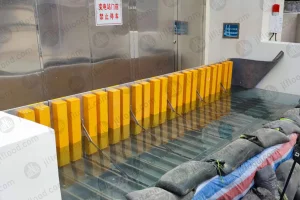
The system utilizes a bottom foundation basin recessed flush into the roadway level. As floodwater flows toward the protected entrance, water flows into the chamber through targeted inlet grates. As water fills the basin, buoyant density forces built into the hollow structural panel trigger horizontal rotation around a high-tensile stainless steel pivot hinge.
The true genius of the hydrodynamic system lies in hydrostatic leverage. As the water head ($h$) increases, the horizontal force vector ($F_h = \frac{1}{2} \rho g h^2 w$) presses the panel tightly against structural wall side-frames. Heavy-duty dual-lip EPDM (Ethylene Propylene Diene Monomer) elastomeric gaskets compress under this natural water load, creating a near-zero leakage seal verified by factory pool testing.
To resist harsh outdoor exposure, coastal salt-air corrosion, and high-impact vehicle drive-over stresses, factory panel structures are extruded from 6063-T6 or 6005A-T6 structural aluminum alloys combined with 304/316 grade stainless steel base chambers. Surfaces undergo anodic oxidation treatments exceeding 25 microns to ensure a 25+ year outdoor service lifespan.
Every municipal project and commercial site presents distinct spatial, architectural, and hydraulic challenges. Modern wholesale manufacturers provide customized modular configurations adapted to specific site constraints.
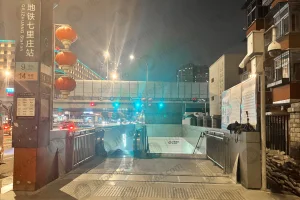
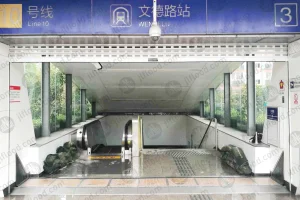
Metro entrance portals represent severe point-vulnerabilities. Custom surface-installation type automatic flood barriers (such as the Hm4d-0006E series) allow retrofit mounting directly on existing concrete plinths without destroying underground utility lines or structural floor slabs. Certified for high-density pedestrian throughput.
Substation perimeters require tight integration between security gates and water barriers. Self-closing flip-up barriers provide daily unobstructed access for heavy maintenance machinery while guaranteeing instant seal activation if surrounding drainage ditches overflow during severe typhoons.
Underground commercial car parks require high vehicle-axle weight resistance. Embedded hydrodynamic models (HM4E series) sit perfectly flush with slope driveways, allowing daily transit of passenger cars, delivery trucks, and fire engines without vibration noise or structural fatigue.
Procuring critical infrastructure protection equipment requires complete verification of quality assurance standards, factory certifications, and rigorous pre-shipment hydro-testing.
Leading flood control factories engineer systems compliant with international building codes and flood proofing standards, including FM 2510 (American National Standard for Flood Mitigation Equipment), EN 12188 (Inundation gates), and ASCE 24 (Flood Resistant Design and Construction).
Every standard design undergoes 100% full-scale water retention testing in specialized hydraulic test pools. Factory inspection documentation includes measured leakage rate curves, structural frame deflection metrics under peak design water height, and rapid actuation timing video recordings.
Wholesale clients receive complete localized support services: CAD structural drawings, BIM (Building Information Modeling) objects for civil engineers, step-by-step embedded frame template guides, remote technical commissioning, and comprehensive English maintenance documentation.
The future of flood defense is evolving at the intersection of passive mechanical reliability and active smart city IoT monitoring networks.
Complete reliance on unpowered mechanical buoyancy. Zero reliance on sensors or electrical grids guarantees failure-proof operation during violent storm surges and city-wide power outages.
Integrating ultra-low-power NB-IoT (Narrowband IoT) liquid sensors into the bottom foundation basin. Sends automated SMS and control room alert signals the millisecond water ingress triggers initial barrier rotation.
Linking thousands of installed flood barriers to city-wide hydraulic AI models. Predicts real-time water accumulation patterns, providing municipal command centers with automated status visibility across all subway and substation gates.
Direct factory procurement offers significant cost benefits for distributors, engineering contractors, and government tenders compared to purchasing through regional trading intermediaries.
Wholesale quotations depend on total linear meters, retaining height requirements (0.5m to 2.0m), panel structural grade (standard vs. ultra-heavy 40T axle load), and surface finishing specifications (anodized vs. fluorocarbon coating).
Factories provide full OEM manufacturing support, including custom dimensional fabrication, specialized embedded frame templates, custom brand laser engraving, and custom export timber packaging designed for container shipping.
All units are packed in ISPM-15 compliant export wooden crates with anti-vibration padding and moisture-proof wrapping. High-volume container loading plans optimize freight costs for international bulk buyers.
Explore our full line of China self-closing, embedded, surface-mounted, and modular hydrodynamic automatic flood gates.
Key engineering, installation, and procurement questions answered by our Senior SEO Growth & Technical Engineering Directorate.
Hydrodynamic automatic flood barriers operate on 100% passive mechanical principles (Archimedes' principle of buoyancy and hydrostatic fluid leverage). As incoming floodwater enters the foundation basin, water buoyancy naturally lifts the barrier panel. As the water head rises, hydrostatic pressure forces the panel firmly against structural side seals. No electricity, sensors, motors, or manual operators are required.
Surface-mounted barriers (Hm4d series) are installed directly on top of existing concrete driveways or plaza entryways, making them ideal for retrofitting operational metro portals without subterranean excavation. Embedded flood barriers (Hm4e series) feature a foundation chamber recessed completely flush with the ground, making them suitable for heavy vehicle drive-over entrances such as commercial garages and power substations.
Standard heavy-duty embedded barrier panels are constructed from structural 6063-T6 or 6005A-T6 aluminum extrusions reinforced with stainless steel internal ribbing. They are engineered and FEA-tested to support heavy commercial vehicle axle loads up to 40 metric tons (equivalent to heavy fire engines, delivery trucks, and maintenance cranes).
Sealing integrity is achieved using marine-grade, aging-resistant dual-lip EPDM (Ethylene Propylene Diene Monomer) elastomeric seals. Under hydrostatic water pressure, the gasket dynamically compresses against the anodized aluminum panel and stainless steel frame, maintaining a sealed water barrier verified through full-scale factory pool testing.
For embedded types, the client's civil contractor constructs a concrete foundation trench based on factory structural templates, including a baseline drainage outlet to discharge residual rainwater. For surface-mounted units, only a flat, level concrete structural threshold with anchor bolt installation is required.
With high-grade anodized aluminum paneling and 304/316 stainless steel foundation components, the system has a design service life exceeding 25 years. Maintenance requires quarterly inspection of the bottom drainage channel to remove leaf debris and annual inspection of the EPDM rubber seals.
Yes. As a direct wholesale manufacturer, every system can be custom-engineered in modular spans up to 6 meters per leaf, or linked in multi-leaf array configurations for wide driveways exceeding 20 meters, with custom retaining heights from 0.5m to 2.0m.
B2B procurement teams, civil consultants, and distributors can request technical specs by clicking any product link on this page or contacting our global engineering service center. Submitting clear entry width, target retaining height, and site photos allows our engineering team to provide a complete proposal packet within 24 hours.