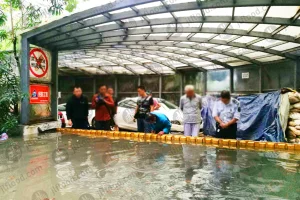
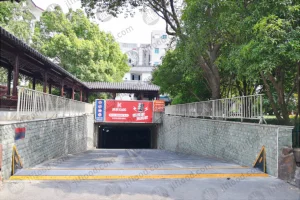
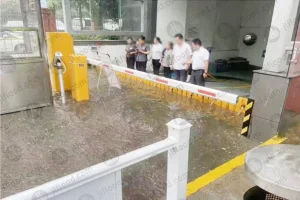
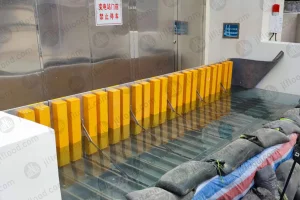
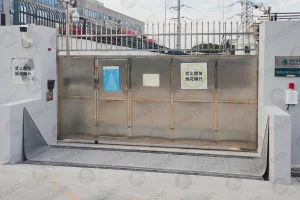
Direct-from-factory hydrodynamic automatic flood gates engineered for municipal subways, commercial garages, and electrical utility substations.
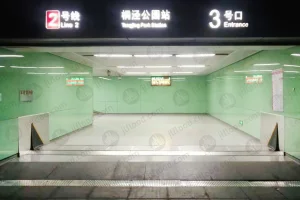

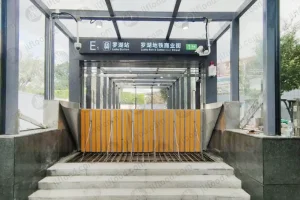
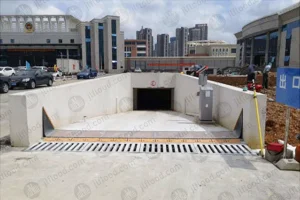
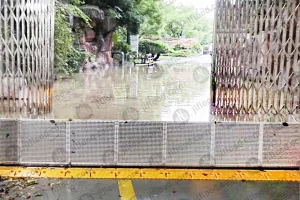
In an era defined by intensifying global climate volatility, urban inundation has emerged as one of the most destructive financial and structural threats facing commercial real estate, municipal infrastructure, and industrial complexes. The underground parking garage—often hosting millions of dollars in vehicle assets, critical mechanical infrastructure, electrical switchgear, and transit connections—represents the single most vulnerable vector for flash flooding. For procurement directors, civil engineers, real estate developers, and municipal authorities, securing a high-capacity, zero-failure wholesale flood gate for garage factory supplier is no longer merely a precautionary measure; it is a fundamental pillar of asset protection and business continuity management.
Historically, commercial facilities relied upon manual flood control mechanisms such as sandbags, deployable aluminum slot-in planks, or electrically driven flood doors. However, real-world disaster records reveal that over 80% of urban flooding events coincide with regional grid failures, severe weather blackouts, or rapid surge events occurring outside standard operating hours. When power fails or personnel are unable to reach the site, manual and electric systems fail completely. Modern civil engineering requires a paradigm shift toward hydrodynamic passive flood barrier technology—systems that leverage the natural physical forces of water buoyancy and hydrostatic head pressure to automatically deploy without electricity, human intervention, or electronic sensor reliance.
The global flood mitigation market has transitioned rapidly from reactionary emergency response tools toward integrated, structural, and automated architectural flood barriers. As urban density increases and underground spaces are utilized for multi-level parking, automated logistics hubs, and subway interchanges, flood gates are evaluated against several key engineering trends:
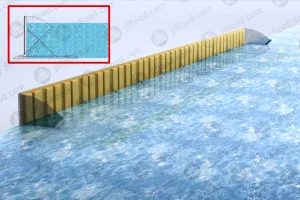
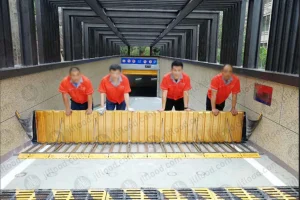
Modern architectural standards favor automatic self-closing and self-rising barriers. Recessed flush into the driveway foundation, hydrodynamic flood gates feature a submerged panel buoyancy chamber. As incoming floodwaters flow into the baseline trough, the panel automatically floats upwards and locks mechanically, forming an immediate watertight barrier against high hydrostatic heads.
By eliminating electric motors, hydraulic pumps, wires, and battery backups, passive hydrodynamic gates eliminate single-point electrical failures. During severe typhoons or municipal grid collapses, the barrier operates with 100% mechanical physics reliability.
Garage ramp entrances demand robust structural integrity. Advanced aluminum extrusion profiles (6063-T6 / 6005A-T6) combined with internal stainless steel load frames allow modern flood gates to sustain continuous daily traffic of heavy commercial vehicles, emergency trucks, and double-decker buses (axle loading up to 40 tons).
Furthermore, leading global engineering specifications now demand multi-stage sealing mechanisms incorporating EPDM (Ethylene Propylene Diene Monomer) synthetic rubber seals. These elastomeric components deliver superior dynamic sealing under continuous water immersion, resisting UV degradation, ozone exposure, chemical runoff, and severe thermal fluctuations across operational ranges from -40°C to +120°C.
When international procurement teams engage with a wholesale flood gate for garage factory, evaluation extends far beyond unit pricing. Enterprise buyers require robust technical compliance, verified test data, structural longevity, and seamless integration into existing civil works. Key procurement drivers include:
| Technology Standard | Hydrodynamic Automatic Flood Gate | Electric / Motorized Barriers | Manual Aluminum Planks |
|---|---|---|---|
| Power Requirement | 0kW (100% Water Buoyancy Driven) | Requires High Power Grid or UPS | Manual Labor Only |
| Response Speed | Immediate (0.1s - 3s passive lift) | Sensor Delay / Motor Drive (30s - 2 min) | 15 - 45 Minutes (Staff Dependent) |
| Blackout Reliability | 100% Operational Guarantee | High Risk of Failure during Grid Outage | Unaffected by Power (Human Dependent) |
| Daily Traffic Interface | Flush Ground Level (Heavy Traffic) | Side Posts or Over-head Rails | Must Be Stored Away Off-Site |
| Maintenance Cost | Extremely Low (Basic Trough Cleaning) | High (Motor, Wiring, Sensor Inspections) | Low (Storage & Component Checks) |
As the worldwide market demands custom-engineered dimensions, rapid deployment, and structural reliability, China’s industrial ecosystem has established itself as the global manufacturing hub for advanced flood protection infrastructure. Specialized facilities, such as Nanjing Junli Technology Co., Ltd., demonstrate how Industry 4.0 integration drives competitive superiority for global B2B procurement:
Advanced Metallurgical & Structural Manufacturing: Utilizing high-precision CNC laser cutting, automated robotic welding arms, and multi-axis extrusion presses, Chinese OEM/ODM factories produce ultra-flat, high-tensile flood panels. The structural frames leverage marine-grade 304/316 stainless steel combined with anodized high-density aluminum extrusions, delivering exceptional corrosion resistance in saline coastal or urban chemical environments.
Full-Scale Hydraulic Testing Pools: Genuine authority in flood engineering (E-E-A-T) stems from verified physical performance. Premier manufacturing factories house dedicated full-scale hydraulic testing tanks. Every product design—ranging from metro station entrance barriers to subterranean garage ramp flood gates—undergoes dynamic water head testing, seal deflection measurement, and continuous flow leakage analysis prior to mass production and global dispatch.
Unlike standard static barriers, hydrodynamic self-rising flood gates manufactured by Junli Technology utilize precise gravity-to-buoyancy ratios. The hollow panel core is calculated using Finite Element Analysis (FEA) to ensure that even low water intake (as minimal as 50mm - 100mm) generates sufficient upward force ($F_{buoyancy} > W_{panel} + F_{friction}$) to unlock and elevate the barrier ahead of rising flood crests.
Supply Chain Agility & OEM Customization: Global infrastructure projects require bespoke civil interface engineering. Whether a garage ramp features an arched threshold, steep incline, wide clear span exceeding 10 meters, or low floor slab depth, Chinese Industry 4.0 factories provide 3D CAD modeling, BIM integration, embedded frame templates, and complete installation drawings within 48 to 72 hours of project intake.
Flood gate specifications vary significantly across real-world commercial, industrial, and municipal installations. Selecting the optimal configuration requires understanding localized hydrodynamic stress and architectural constraints:
Challenge: High vehicle traffic flow, sloping ramp geometry, aesthetic integration.
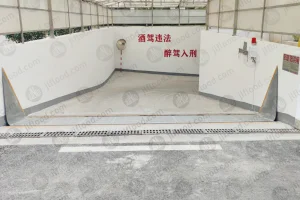
Solution: Embedded subterranean hydrodynamic flood gates. Installed completely flush with the finished driveway paving. Vehicles drive over stainless steel cover plates smoothly during normal conditions. Upon water accumulation, the panel rises automatically to create a continuous water barrier up to 2.0 meters high.
Challenge: Rapid passenger foot traffic, underground connection channels, zero threshold tolerance.
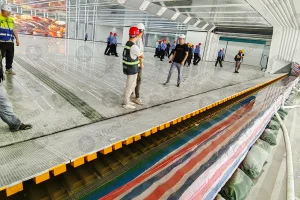
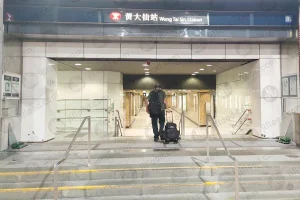
Solution: Metro-type modular surface-installed or embedded self-closing flood gates (such as the Hm4d-0006E series). Validated across major rail lines in Beijing, Guangzhou, Dalian, and Hong Kong to safeguard subterranean passenger concourses against flash river overflow.
Challenge: High risk of catastrophic electrical fires or blackout if transformers submerge; perimeter security requirements.
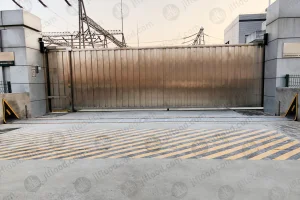
Solution: Heavy-duty perimeter flood gates and substation doorway flip-up barriers (e.g., Hm4d-0006C models). Provides continuous 24/7 un-staffed water defense around power infrastructure, ensuring regional grid stability during extreme storm events.
In-depth technical responses to common inquiries regarding wholesale garage flood gates, structural performance, maintenance, and factory customization.
The hydrodynamic flood gate operates purely on fundamental hydraulic principles—specifically Archimedes' principle of buoyancy and hydrostatic pressure. The panel rests flat inside a recessed foundation chamber installed flush with the garage ramp surface. When surface water or flood runoff enters the chamber through drainage grates, water accumulates in the basin underneath the panel. As the water level rises inside the chamber, the buoyant panel automatically floats upwards. As the external flood level increases, the water pressure forces the panel firmly against vertical side frame seals, creating a watertight barrier. The entire process requires zero power, zero electronic sensors, zero hydraulic oil, and no human intervention.
Standard commercial garage flood barriers manufactured by top Chinese factories are engineered for heavy-duty vehicular access. Constructed with high-strength structural 6063-T6 aluminum extrusions and reinforced steel supporting structures, standard panels sustain wheel loads from passenger cars, SUVs, and delivery vans. Heavy-duty industrial configurations (e.g., Hm4d-0006C series) support concentrated axle loads up to 40 tons (H20 / HS20 traffic loading standards), allowing fire trucks, heavy logistics trailers, and emergency vehicles to drive across the baseline frame without structural deformation.
Because hydrodynamic flood gates feature zero mechanical motors, electrical wiring, or hydraulic fluids, maintenance requirements are minimal. Routine maintenance consists of periodic visual inspections and clearing leaves, silt, or road debris from the baseline foundation chamber using built-in wash-out ports or removable cover plates (typically performed once or twice a year). The primary sealing strips are made of high-durability EPDM synthetic rubber, designed for a 10 to 15-year service life before replacement. The structural aluminum alloy and stainless steel frame are rated for an operational lifespan exceeding 25 years.
Yes. Modern manufacturing facilities excel in custom engineering. For wide garage entrances (e.g., multi-lane driveways exceeding 6 to 20 meters), modular inter-connectable barrier leaves with intermediate removable posts or dynamic multi-panel arrays are utilized. For sloped driveways, factory engineers calculate ramp angles and customize the embedded concrete foundation box to ensure the top panel deploys perfectly horizontal to match design flood elevations while maintaining smooth vehicle transitions.
Reputable Chinese manufacturers provide full factory quality assurance dossiers. This includes ISO9001 quality management system certification, ISO14001 environmental compliance, raw material mill test certificates (MTC for stainless steel and aluminum alloys), finite element structural calculation reports, third-party water leakage test reports, and factory hydrostatic testing video documentation for each manufactured serial number prior to export packaging.
Wholesale flood barriers are exported using heavy-duty, fumigation-free wooden crates reinforced with steel strapping. Embedded structural frames and barrier panels are wrapped in protective polyethylene anti-scratch films and moisture-proof vapor barriers. All associated hardware components, anchor bolts, EPDM seal kits, embedded templates, and step-by-step English installation and maintenance manuals are clearly labeled for immediate on-site handling.
Explore our full line of factory-direct automatic flood barriers for garage driveways, subways, and municipal utilities.