High-performance hydrodynamic automatic flood gates engineered for subway stations, electrical substations, commercial underground garages, and municipal waterlogged zones.
Navigating urban waterlogging challenges through unpowered automatic flood barrier engineering and marine-grade aluminum metallurgy.
In the contemporary landscape of global municipal engineering and commercial asset protection, extreme hydrometeorological events pose an escalating threat to subterranean civil infrastructure. Rapid urbanization combined with micro-climate shifts has rendered legacy flood prevention tools—such as manually deployed sandbags, modular plastic dams, and motorized sluice gates—fundamentally obsolete. The structural vulnerability of traditional manual systems stems from their reliance on human intervention, early warning delay periods, and electrical grid availability during severe typhoons or flash flood surges.
This technical white paper delivers an exhaustive authoritative review of wholesale prevention control flood barrier aluminum gate manufacturing standards, engineering principles, structural load calculations, custom OEM supplier capabilities in China, and commercial pricelist structures. Designed for procurement managers, civil engineering consultants, structural architects, and municipal authorities, this document provides the necessary Information Gain (IG) required to evaluate high-reliability flood defence installations for critical assets, including rail transit metro networks, high-voltage power substations, underground commercial parking garages, and urban utility tunnels.
How unpowered self-closing aluminum gates utilize fluid dynamics and mechanical leverage to form an impermeable structural barrier.
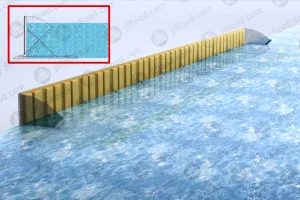
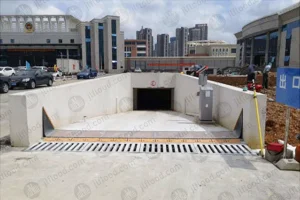
When surface water runoff breaches kerb thresholds, water flows through intake grates into a sub-grade stainless steel embedding chamber. The internal density differential generates buoyant forces beneath the hollow, sealed aluminum alloy panel, triggering an immediate upward rotation.
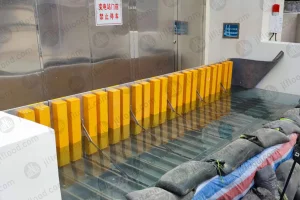
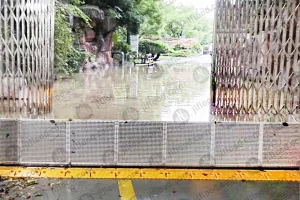
As the external flood height rises, lateral hydrostatic water pressure pushes the upright aluminum gate panel against the sidewall frames. The greater the external water head, the tighter the continuous EPDM rubber sealing gasket compresses, guaranteeing a zero-leakage barrier seal.
Upon the receding of floodwaters, internal drainage channels discharge accumulated fluid back into the municipal storm sewer network. As buoyancy dissipates, gravitational weight returns the aluminum panel smoothly flush into its ground frame casing, restoring normal vehicular access.
The structural load-bearing capacity of an automatic aluminum flood barrier gate is directly dictated by its alloy chemistry, profile moment of inertia (I), and frame assembly geometry. Premium manufacturing facilities in China utilize heavy-duty extruded 6063-T6 or 6005-T6 aluminum alloys, subjected to precision artificial aging treatments to achieve yield strengths exceeding 240 MPa.
| Engineering Property | 6063-T6 Aluminum Alloy | 6005-T6 Aluminum Alloy | 304 Stainless Steel Frame | EPDM Sealing Rubber |
|---|---|---|---|---|
| Tensile Strength (MPa) | ≥ 245 MPa | ≥ 260 MPa | ≥ 520 MPa | ≥ 10.5 MPa |
| Yield Strength (MPa) | ≥ 200 MPa | ≥ 240 MPa | ≥ 205 MPa | N/A |
| Corrosion Resistance | Excellent (Anodized >15μm) | Excellent (Fluorocarbon Coated) | Passivated Grade 304/316 | UV & Ozone Resistant |
| Load Class / Rating | A15 - C250 EN124 | D400 Heavy Duty Vehicle | E600 Heavy Infrastructure | Shore A Hardness 65±5 |
| Primary Application | Standard Gate Leaf Profiles | Span Profiles >6 Meters | Embedded Bottom Casing | Perimeter Hydro-Seals |
Why leading global EPC contractors, municipal agencies, and B2B distributors source aluminum flood control barriers from specialized OEM hubs in Nanjing, China.
China accounts for over 50% of the world's primary aluminum output and structural profile extrusion capacity. Advanced manufacturing clusters in Jiangsu Province, led by industry pioneers such as Nanjing Junli Technology Co., Ltd., capitalize on complete vertical integration—from raw ingot casting and heavy extrusion presses (up to 10,000 tons) to automated CNC machining centers, robotic welding, and fluorocarbon surface finishing.
This localized supply chain ecosystem allows Chinese flood gate manufacturers to produce multi-leaf modular aluminum barrier systems with dimensional tolerances within ±0.5 mm, ensuring exact fitment for custom clear opening widths ranging from 1.5 meters up to 30+ meter continuous spans.
Unlike regional trading companies or unverified door fabricators, dedicated Chinese high-tech enterprises operate full-scale hydro-testing basins. Every prototype and production batch undergoes simulated wave action, hydrostatic overload testing, and seal deflection analysis under maximum design water heads (up to 2.0m retaining heights per leaf).
Nanjing Junli Technology's multi-disciplinary engineering team encompasses specialized technology segments: intelligent civil defence, smart flood control, bridge joint mechanics, and energy infrastructure protection. Field data collected from typhoon season deployments in over 30 Chinese metros and global installations directly informs continuous patent innovation.
Tailored height options (0.5m to 2.0m), customizable surface anodization colors, modular multi-gate connection pillars, and custom curb anchor interfaces designed to match localized civil engineering drawings.
By eliminating intermediary distributors and leveraging optimized material sourcing, factory-direct wholesale pricing delivers a 30% to 50% cost advantage over European or American localized suppliers.
Every wholesale procurement package includes structural finite element analysis (FEA) reports, English CAD shop drawings, step-by-step civil embedding templates, and English maintenance schedules.
Macro-level drivers accelerating global adoption of hydrodynamic flood protection gates across public, commercial, and utility sectors.
Urban flooding is no longer regarded as an isolated force majeure event; it is a structural operational risk that dictates commercial insurance premiums, municipal building codes, and critical infrastructure resilience mandates. Global trends driving the mandatory installation of aluminum flood control gates include:
Governments across East Asia, Europe, and the Americas are enacting stringent urban runoff standards. Green building certifications (LEED, BREEAM) reward projects integrating passive climate adaptation hardware that mitigates structural water inundation.
Major commercial property underwriters now require verified flood defense barriers for subterranean asset coverage. Installing field-tested hydrodynamic gates significantly lowers liability insurance premiums for real estate portfolios.
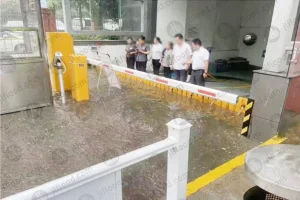
Flash floods invariably cause regional power outages. Motorized gates reliant on emergency generators often fail due to electrical shorts or delayed switching. Unpowered hydrodynamic gates guarantee 100% operational readiness during complete grid failure.
Tailored structural flood gate configurations designed for distinct civil infrastructure entryways and urban flood risks.
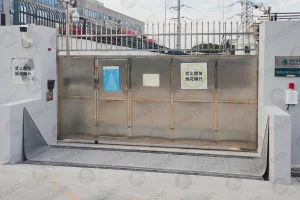
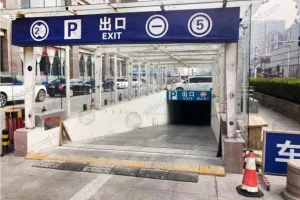
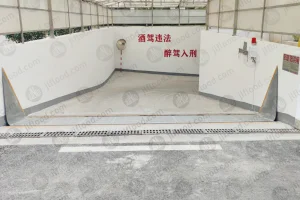
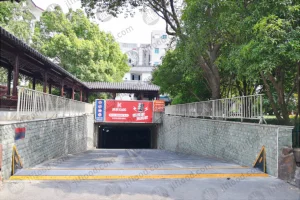
Challenge: Steep vehicular access ramps act as natural water funnels during high-intensity rainfall, submerging parked vehicles, mechanical rooms, and electrical transformers.
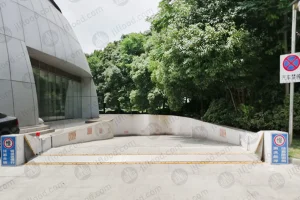
Solution: Flush-embedded hydrodynamic gates (Hm4d-0006 Series). Installed at the top or toe of the ramp, the gate panel remains flat allowing daily drive-over traffic (D400 load rated). When water enters the tray, the gate automatically pivots upward, blocking water ingress into the basement level.
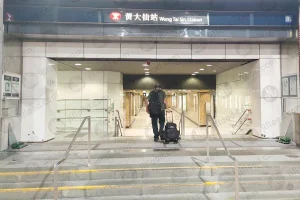
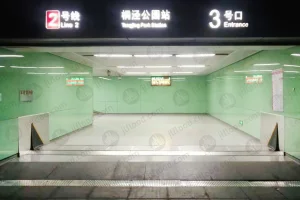
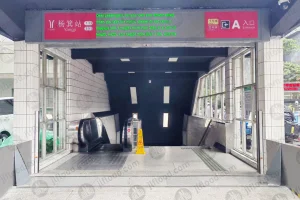
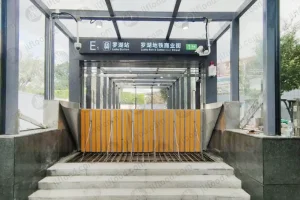
Challenge: Pedestrian station portals, vent shafts, and underground concourses require non-obstructive barriers that comply with fire evacuation routes.
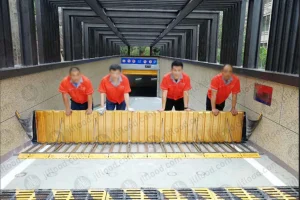
Solution: Low-profile embedded stainless steel frame barriers. Field-proven across rail transit systems in Guangzhou, Beijing, Suzhou, and Hong Kong. Gates remain completely concealed beneath pedestrian foot traffic until water activation occurs.
Challenge: Electrical substations housed in low-lying zones risk catastrophic grid failure, arc flashes, and millions in equipment loss if floodwater enters transformer vaults.
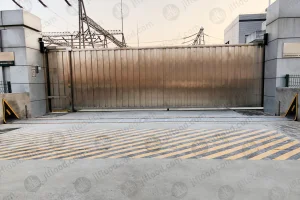
Solution: Perimeter protection automatic flood gates and specialized doorway flip-up barriers equipped with non-conductive grounding seals, guaranteeing continuous isolation of critical electrical switchgear.
Challenge: Secondary containment zones and hazardous chemical storage warehouses require leak-proof barriers to prevent chemical spills from washing into municipal waterways.
Solution: Corrosion-resistant anodized 6065-T6 aluminum barriers fitted with chemical-grade Viton or EPDM composite gaskets, providing dual-way containment against environmental contamination.
Essential technical criteria for project engineers, procurement managers, and tendering committees when evaluating aluminum flood gate suppliers.
To ensure project compliance and prevent site installation failures, procurement documentation for wholesale flood gates should stipulate the following engineering verifications:
Verify that embedded frame depth matches concrete slab thickness. Ensure the bottom casing incorporates dedicated sediment flushing ports and gravity drainage connection spigots (DN50/DN100) to clear silt buildup after flood events.
Demand finite element analysis (FEA) proving that structural panel deflection under full hydro-head design does not exceed L/250 (where L is clear span length). Excessive deflection compromises side wall rubber seal integrity.
For wide openings exceeding 6.0 meters, check if the manufacturer supplies removable intermediate mullions or continuous multi-leaf hinge sync mechanisms to maintain uniform buoyancy lift without panel binding.
Understanding price variables, material cost factors, and bulk procurement tiers for international trade contracts.
Pricing for aluminum prevention control flood barrier gates is determined by structural height, clear span width, vehicle wheel load rating, and mounting configuration (surface embedded vs. wall flip-up). Below is an industrial wholesale pricelist guidance matrix for commercial planning.
| Barrier Model Type | Retaining Height Range | Load Rating (EN124 / AASHTO) | Est. Wholesale Price (USD / Meter Span) | Typical Lead Time |
|---|---|---|---|---|
| Hydrodynamic Automatic Embedded Gate (Standard) | 0.6m - 0.9m | C250 (25 Tonnes) | $450 - $750 / m | 10 - 15 Days | Heavy-Duty Ramp Embedded Flood Barrier (Hm4d-0006C) | 0.9m - 1.2m | D400 (40 Tonnes) | $750 - $1,100 / m | 14 - 20 Days |
| Substation Perimeter Hydro-Gate (Surface Mount) | 0.5m - 1.0m | B125 (12.5 Tonnes) | $380 - $620 / m | 7 - 12 Days |
| Metro Station Portal Barrier Array | 1.0m - 2.0m | E600 Heavy Rail Spec | $1,200 - $1,800 / m | 20 - 30 Days |
| Manual / Flip-Up Doorway Barrier | 0.4m - 0.8m | Pedestrian A15 | $220 - $350 / m | 5 - 10 Days |
Expert responses to critical engineering, installation, and maintenance inquiries regarding aluminum flood barrier systems.
The hydrodynamic flood gate relies entirely on fluid pressure dynamics and buoyant leverage. The gate panel rests flush inside a floor-embedded stainless steel tray during dry conditions. When floodwaters reach the threshold, water flows through intake grates into the bottom casing. The water displaces air within the sealed hollow aluminum alloy panel, creating positive hydrodynamic buoyancy that lifts the gate. As water depth increases, lateral hydrostatic pressure presses the gate against vertical rubber seals, locking it in place until water levels drop.
Yes. Premium aluminum flood gates designed for garage entrances and roadway ramps are engineered to withstand heavy vehicular traffic. Utilizing high-strength extruded 6063-T6 or 6005-T6 structural aluminum reinforced with internal ribs, these panels achieve load ratings conforming to EN124 Class C250 (25 tons) and D400 (40 tons), enabling safe daily passage for fire trucks, delivery vehicles, and passenger cars.
Because hydrodynamic gates contain no motor drives, electrical sensors, or hydraulic pumps, routine maintenance is minimal. Manufacturers recommend bi-annual inspections: clearing leaves, silt, or debris from the floor embedding tray, flushing the internal drainage ports with a water hose, inspecting the elasticity of EPDM side seals, and applying silicone lubricant to pivot hinges.
Civil works require cutting a concrete trench across the entryway corresponding to the dimensions of the barrier embedded bottom casing. A reinforced concrete foundation bed must be poured with integrated drainage pipes (connected to a sump pit or storm drain). The embedded frame is anchored into the trench using expansion bolts, leveled to match the finished driveway grade, and backfilled with high-strength non-shrink grout.
Nanjing Junli Technology provides end-to-end engineering support for global B2B clients. Clients submit site dimension drawings, clear width requirements, and design flood height specs. Junli's engineering department generates custom CAD shop drawings, finite element load reports, bilingual installation manuals, and pre-shipment factory water-test video documentation for project sign-off.
Explore additional specialized automatic, self-closing, flip-up, and metro connection channel aluminum flood gate models.