Direct OEM & ODM supply straight from China’s leading flood protection manufacturing hub. Select standard or custom embedded/surface models.
A comprehensive technical evaluation of zero-energy passive flood protection mechanisms for global infrastructure engineers, municipal architects, and commercial B2B procurement managers.
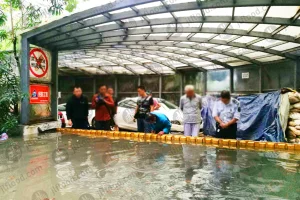
In the era of accelerating climate change, extreme meteorological events—such as short-duration intense rainfall, cloudbursts, and coastal storm surges—have exposed critical vulnerabilities in modern urban infrastructure. Underground garages, mass rapid transit (MRT/metro) networks, high-voltage electrical substations, and civil defense assets represent multi-billion-dollar investments that face catastrophic financial losses during sudden inundation events. Traditional flood control methodologies, including manual aluminum stoplog barriers, sandbags, and motor-driven electric gates, are increasingly deemed unacceptable by risk underwriters and municipal engineering boards. Manual barriers fail when site personnel cannot react in time or are blocked by severe traffic gridlock during flash floods; electrical gates fail precisely when grid power cuts out—the exact moment intense flooding occurs.
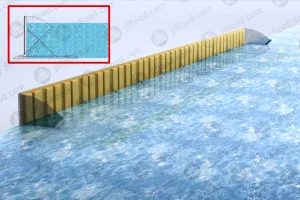
The solution lies in the paradigm of Hydrodynamic Self-Closing Flood Protection Systems. Engineered to operate automatically via buoyancy force and hydrostatic water pressure without requiring any electrical power, human intervention, sensor triggers, or battery backups, these power-free barriers offer absolute operational reliability. Engineered by specialized manufacturers like Nanjing Junli Technology Co., Ltd., self-closing flood gates sit flush within recessed floor channels during fair weather, allowing heavy vehicular and pedestrian traffic to pass uninterrupted. When floodwaters reach a predefined threshold, water automatically flows into the retention basin, triggering the barrier panel to rise, deploy, and self-lock to block water ingress entirely.
| Performance / Feature Parameter | Hydrodynamic Self-Closing Barrier (Junli System) | Electric Motor / Sensor Driven Gates | Manual Demountable Aluminum Barriers |
|---|---|---|---|
| Power Source Requirement | 0 kW (100% Passive Water Buoyancy) | Electricity / Backup UPS Battery Needed | Manual Labor / Human Force Required |
| Activation Speed & Response Time | < 0.1s Trigger Response (Water Inflow) | 30 – 120 Seconds (Sensor Delay Risk) | 30 – 90 Minutes (Labor Deployment) |
| Reliability During Grid Blackout | 100% Immunity to Power Failure | High Failure Risk (Battery Depletion) | N/A (Dependent on Human Availability) |
| Standby Operational Cost | $0 / Year (Zero Electrical Draw) | High (Constant Sensor Maintenance) | Low (Storage & Labor Training Costs) |
| Vehicular Load Passability | 20 – 40 Tons (AASHTO HS20 / Heavy Truck) | Varies (Requires Ground Slot Covers) | Zero (Barriers Block Pathway Entirely) |
| Lifespan & Maintenance Cycle | 20+ Years Design Life (EPDM / Stainless Steel) | 5 – 8 Years (Electrical Motor Wear) | 10+ Years (Gasket Degradation Risk) |
Unmatched structural precision, rigorous hydraulic testing, and scale economies from China's high-tech flood defense manufacturing cluster.
Nanjing Junli Technology owns high-tonnage aluminum alloy extrusion lines, producing aviation-grade 6063-T6 aluminum profiles and 304/316 stainless steel frame chassis capable of resisting extreme hydrostatic head pressures.
Unlike standard sheet metal fabricators, every batch model undergoes 1:1 scale hydraulic pool testing in our factory test basin. We verify lifting speed, seal tightness under dynamic water pressure, and zero-leakage performance prior to export clearance.
By integrating R&D, structural calculation, CNC laser machining, vulcanized EPDM seal molding, and assembly under one roof in Nanjing, Junli reduces production costs by 35% compared to European or US brands, offering global buyers maximum Information Gain and ROI.
How modern sponge cities and climate-resilient municipalities incorporate power-free self-closing flood gates into long-term master planning.
1. Mandatory Resilience Building Codes: Insurance agencies and international building standards (such as ASCE 24 and Eurocodes) are pushing for fail-safe, un-powered emergency flood barriers in all underground commercial garages and public rail systems.
2. Smart City & IoT Telemetry Convergence: While the mechanical rising mechanism of Junli barriers is 100% hydrodynamic and power-free, modern municipal deployments integrate passive signal switches. When the barrier rises by water buoyancy, it triggers an instant signal to the central Smart City SCADA room, alerting authorities without depending on high-voltage grid lines.
3. Modular Span Expansion for Wide Entrances: Commercial developments often feature 15 to 30-meter wide underground parking ramps. Modern self-closing barrier designs utilize modular inter-connecting leaves with hidden center columns, ensuring structural equilibrium and leak-proof lateral joining even across multi-lane driveways.
Custom-engineered embedded and surface flood barrier solutions designed for specialized urban infrastructure assets.
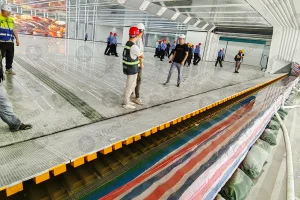
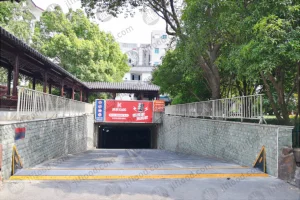
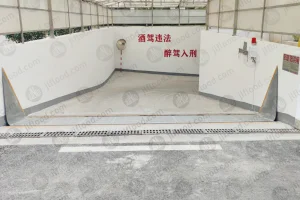
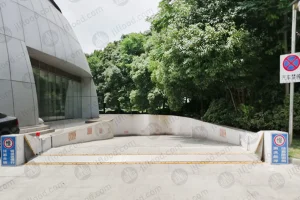
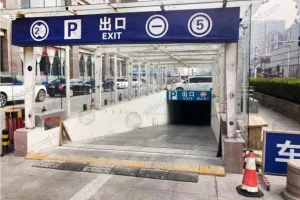
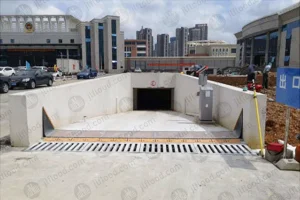
Flush-mounted embedded barriers installed at the crest or foot of parking ramps. Vehicles drive across the stainless steel top cover panel daily without noise or vibration. Water entering the ramp immediately lifts the wall to block basement flooding.
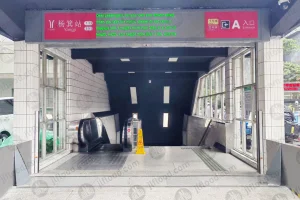
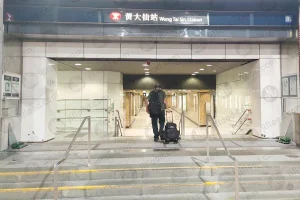
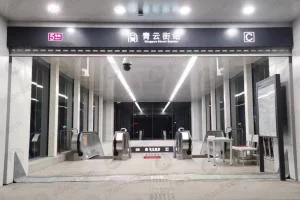
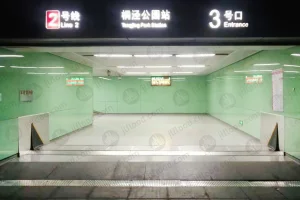
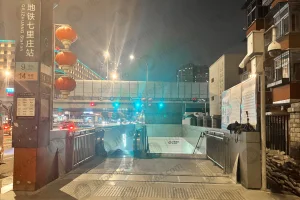
Field-proven at major subway networks including Guangzhou Metro, Beijing Metro, Suzhou Metro, and Hong Kong Transit. Protects pedestrian station intakes, emergency evacuation shafts, and commercial connecting channels against flash river overflows.
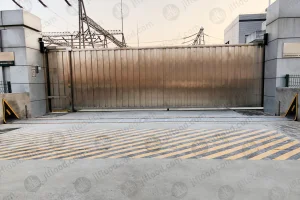
Protects electrical transformer compounds, cable trench gates, and power control buildings. Prevents short circuits, million-dollar equipment destruction, and regional grid blackouts caused by extreme urban waterlogging.
Heavy-duty, long-span barrier arrays deployed across underground street crossings, airport runway drainage gates, and civil defense bunkers requiring high structural yield strength and 40-ton vehicle passability.
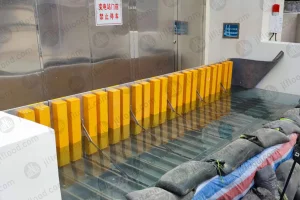
True E-E-A-T requires actual verification. Watch our factory water-testing pool demonstration and field performance records documented during typhoon seasons.
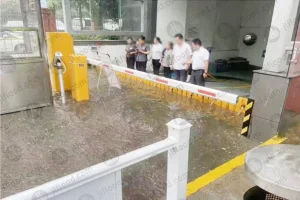
During recent extreme typhoon weather events, installed Junli self-closing flood gates across eastern China blocked incoming floodwaters automatically with zero operators on site and zero available grid power.
Understanding how factory prices are calculated for custom engineering projects, container logistics, and OEM specifications.
When procuring wholesale self-closing flood barriers directly from China manufacturing facilities, purchasing managers must consider several technical variable factors that determine the overall project pricelist:
Standard hydrodynamic models range from 0.5 meters (500mm) to 2.0 meters (2000mm) in retaining height. Higher retaining panels require thicker aluminum alloy structural ribs and heavier counterweight balance systems, affecting linear meter pricing.
Embedded (Flush Foundation): Requires custom steel frame casting boxes built into the floor driveway. Ideal for new construction.
Surface-Mounted: Bolt-on ramp design requiring minimal excavation. Ideal for retrofitting existing facilities.
Selection of 6063-T6 Structural Aluminum vs. SUS304 / SUS316 Stainless Steel frame assemblies depending on environmental salinity (e.g., coastal marine environments vs. inland urban basements) and vehicle passability ratings (20T vs 40T axle load).
Nanjing Junli Technology provides full OEM support, wholesale pricing tiers for EPC contractors and international distributors, as well as complete export packaging (fumigated wooden crates, protective film wrapping, and containerized loading guidance).
Technical and procurement answers provided by senior hydraulic engineers at Nanjing Junli Technology Co., Ltd.
The barrier panel is housed completely flush inside a recessed concrete foundation chamber during normal dry weather. When flash flood surface runoff reaches the entrance, water enters the bottom chamber through intake grates. The accumulating water generates hydro-buoyancy and hydrostatic pressure, which naturally floats and lifts the light, high-strength panel upward. As the water level continues to rise, the panel automatically swivels and mechanical locks engage, pressing high-density EPDM triple-lip seals tightly against the side frame to form a completely watertight barrier. No sensors, motors, human power, or battery backups are required.
Yes. Junli self-closing flood barriers are engineered with structural internal ribbing and heavy-gauge top surface plates. Standard models are rated for 20-ton vehicular axle passage, while reinforced heavy-duty models accommodate up to 40-ton container trucks (AASHTO HS20 loading standard). Vehicles can drive smoothly over the flush cover plate daily without damaging the internal mechanical linkage or causing rattle noise.
For embedded models, civil contractors need to construct a concrete recess trench according to our structural foundation drawings. The trench includes an embedded steel mounting frame, concrete pour-in rebar connections, and a bottom drainage outlet pipe connected to the building's sump pit or municipal storm drain. For surface-mounted retrofits, only a leveled concrete ground surface and expansion bolt anchoring are required.
Standard model orders are manufactured and dispatched from our Nanjing factory within 15 to 25 business days. Custom wide-span or extra-tall barrier projects typically take 30 days. Wholesale pricing is calculated based on linear meters, retaining height, material grade (6063-T6 vs stainless steel), and quantity thresholds. Detailed pricelists, AutoCAD drawing sets, and formal tender quotations can be issued within 24 hours of receiving site dimensions.
Contact the engineering department at Nanjing Junli Technology Co., Ltd. Direct factory support, CAD/BIM embedment templates, and competitive pricelists for global contractors.
Complete product catalog featuring specialized hydrodynamic flip-up gates, substation perimeter barriers, and municipal flood defense modules.