
Industrial-grade automatic self-closing and self-deploying flood barrier configurations for metro systems, electrical substations, and underground facilities.

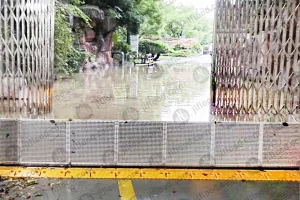
As rapid global climate shifts trigger unprecedented flash floods, extreme precipitation events, and urban waterlogging, conventional flood defenses are failing at critical infrastructure entry points. Traditional manual sandbags, motorized gates, and electrically actuated barriers exhibit single-point failure vulnerabilities—specifically grid collapse, power blackouts, human error, and delayed deployment during violent storms.
Modern civil engineering mandates passive resilience: architectural containment systems that deploy autonomously without human intervention, external power supplies, or sensor electronics. As a specialized wholesale self deploying flood barrier supplier & factory, Nanjing Junli Technology Co., Ltd. leads the engineering transition toward hydrodynamically driven, self-buoyant flood defense arrays.
Information Gain Note: Urban drainage infrastructure design criteria are shifting from 30-year flood return intervals to 100-year storm resistance mandates. Hydrodynamic self-deploying barriers mitigate operational liability by leveraging physics—using incoming floodwater hydrodynamic pressure to automatically deploy the barrier shield.
Electrically driven flood gates fail precisely when storm surges crash local power grids. Self-deploying hydrodynamic gates operate with complete mechanical independence, eliminating electrical failure risks during torrential rains.
Flash floods occur without warning, often during off-peak hours. Hydrodynamic barriers react in sub-second timeframes as water flows into the ground embedded trench, raising the defense leaf before floodwaters reach structural thresholds.
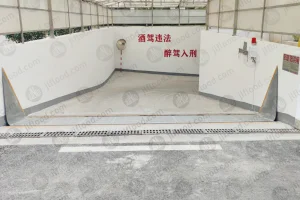
During normal conditions, self-closing flood gates sit embedded completely flush with driveway or station access surfaces, withstanding heavy vehicular axle loads up to 60 tons without restricting pedestrian or traffic flow.
How water hydro-static dynamics transform structural risk into defense force
The baseline architecture of Junli's hydrodynamic automatic flood barriers (such as the Hm4d and Hm4e series) relies on the principles of hydrostatics and Archimedes' buoyancy principle. The system comprises a recessed stainless steel or hot-dip galvanized embedded foundation basin, a high-strength aluminum alloy door leaf, dual-acting seal gaskets, and hydraulic dampening mechanisms.
The structural barrier plate rests flat inside the embedded ground frame. Driveway surface traffic, buses, and heavy machinery pass over the cover plate continuously. Drain ports keep the base trench clear of residual rainwater.
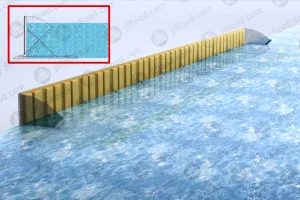
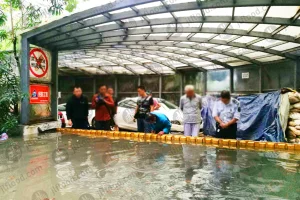
Surface water runoff exceeds drainage capacity and enters the intake grill of the foundation casing. As the water level inside the chamber rises, buoyancy forces act upon the engineered hollow-core aluminum alloy door leaf.
The panel swivels along its pivot axis, self-rising as water fills the basin. Hydrostatic pressure pushes the door panel firmly against the side sealing pillars, compressing EPDM seals to create a water-tight seal.
Once floodwaters recede, the water inside the foundation basin drains away through bottom check-valves. The barrier leaf smoothly lowers back into its sub-surface frame under controlled mechanical dampening.
| Performance Metric | Junli Hydrodynamic Barrier | Electric Motorized Flood Gates | Manual Modular Aluminum Barriers |
|---|---|---|---|
| Power Dependency | Zero (100% Hydro-buoyant) | High (Requires AC power / Battery backup) | None |
| Deployment Time | < 30 seconds (Automatic) | 1 – 5 minutes (If power functional) | 30 – 120 minutes (Manual assembly) |
| Human Intervention | Not required (Unattended operation) | Manual switch or sensor trigger | Required (High personnel risk) |
| Blackout Reliability | 100% Operational Integrity | High Risk of Failure | Operational (If staff available) |
| Maintenance Profile | Minimal (Annual trench debris check) | High (Motor, wiring, sensors, UPS) | Medium (Storage & gasket checks) |
| Service Lifespan | 20+ Years (Marine grade alloy) | 8 – 10 Years (Electronic wear) | 10 – 15 Years |
Nanjing Junli Technology Co., Ltd. operates at the center of China’s advanced manufacturing ecosystem in Jiangsu Province. Sourcing directly from an established China OEM/ODM factory provides global engineering firms and infrastructure contractors with unprecedented structural customization, rigorous quality assurance, and high cost-efficiency.
We utilize marine-grade 6063-T6 extruded aluminum alloy for optimal strength-to-weight ratios, paired with 304 or 316 stainless steel foundation basins. All components undergo high-frequency robotic welding and anodized surface treatments to prevent salt-spray and chemical corrosion.
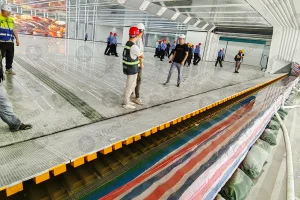
Unlike generic fabricators, Junli conducts full-scale hydrostatic and hydrodynamic testing. Every customized barrier batch is tested in our factory wet pool to verify seal deflection, zero leakage rate under hydrostatic head pressure, and smooth opening/closing cycles prior to global export.
Our manufacturing facility spans automated CNC machining, custom extrusion lines, and heavy-duty assembly floors. We supply wholesale distributors, civil contractors, and municipal authorities with tailored dimensions, structural load specs, and custom branding options.
Field-proven installations across critical infrastructure and commercial assets
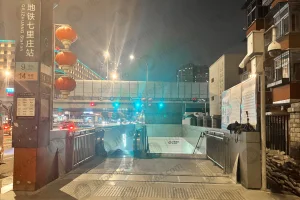
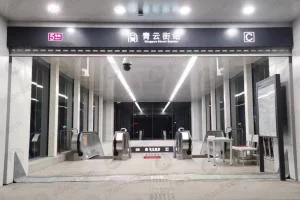
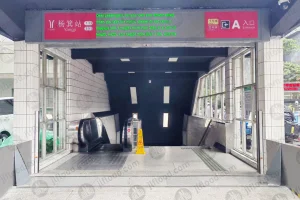
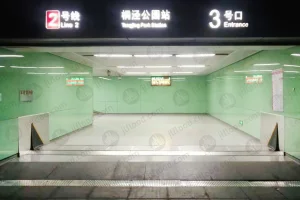
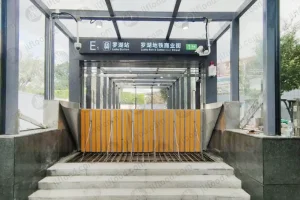
Subsurface metro stations (such as verified projects in Guangzhou Metro, Beijing Metro, Suzhou Metro, Dalian Metro, Shenzhen Metro, and Hong Kong MTR) present high flood risk due to low-elevation station entrances and connection channels.
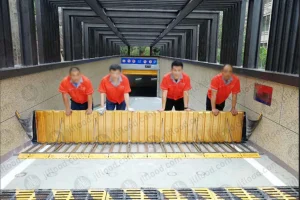
Junli’s metro-type flood barriers (e.g., Hm4d-0006E, Hm4e-006C) sit embedded flush at station entrances. When torrential water descends stairwells or street channels, the door self-raises to block water ingress into concourses and tunnels, maintaining urban transit safety.
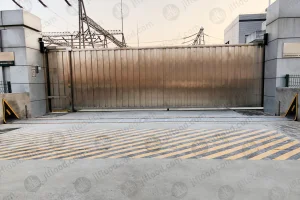
Power substations are vulnerable to water inundation, where flooding can destroy high-voltage transformers and cause widespread regional blackouts.
Junli’s heavy-duty substation automatic flood gates (e.g., installed in Jiangsu, Beijing, and Anhui power grids) provide continuous perimeter protection. Designed with non-conductive isolation components and heavy-duty vehicle load ratings, they secure power transformer gates and cable trenches against storm surges.
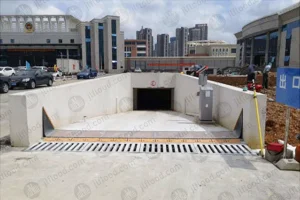
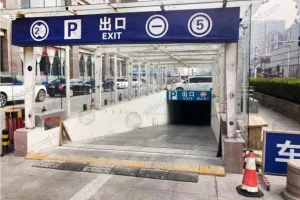
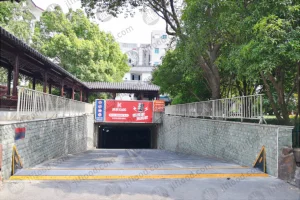
Underground parking ramps at commercial centers (e.g., Hefei Wanda Plaza, Shanxi commercial complexes, and Nanjing residential estates) are primary collection points for surface floodwaters.
Our hydrodynamic ramp barriers sit flush at the top or bottom of parking ramps. Vehicles roll smoothly over the embedded frame during normal business hours. During extreme rain, incoming runoff lifts the barrier, protecting subterranean vehicles, building MEP assets, and elevator shafts.
From high-speed rail concourses (e.g., Guilin South Railway Station) to airport landside perimeter gates (e.g., Guangzhou Baiyun Airport) and underground civil defense walkways (e.g., Jinan Civil Defense passages), Junli barriers provide robust, passive flood protection against extreme weather events.
Every unit is custom-tailored to structural width requirements, spanning single clear openings from 2 meters up to multi-leaf arrays exceeding 20 meters.
When specifying self-deploying flood barriers for international engineering projects, EPC contractors, municipal procurement officers, and architectural consultants must evaluate technical parameters to ensure compliance and structural longevity.
Ensure the embedded top plate withstands local traffic loads. Junli barriers meet heavy-vehicle standard loading (up to D400 / 40-ton to 60-ton axle loads), ensuring zero deformation when driven over by municipal buses, fire trucks, or delivery vehicles.
Standard retaining heights range from 500 mm up to 2000 mm. For wide openings such as double-lane garage entrances or wide metro portals, modular leaf configurations with intermediate drainage connections ensure uniform hydrostatic defense.
Embedded installations require proper concrete recess preparation. Junli provides precise civil engineering templates, rebar clearance notes, and bottom drainage outlet positions to connect seamlessly into municipal storm sewers.
Detailed technical insights for consulting engineers, architectural specifiers, and procurement managers
Heavy-duty hydrodynamic flood gates, flip-up systems, and custom modular solutions
Secure your infrastructure projects against urban waterlogging and seasonal storm surges. Contact Nanjing Junli Technology today for custom engineering proposals, structural BIM/CAD templates, factory-direct wholesale pricing, and worldwide project support.


