
Hydrodynamic self-rising flood gates engineered for zero-electricity protection. Field-proven defense across commercial hubs, railway transit networks, and industrial assets in Bucharest, Cluj-Napoca, Timișoara, and nationwide.
Send Inquiry Now →Tested under extreme hydrostatic heads, our self-actuating barrier systems deliver uncompromised security without reliance on electrical power grid availability.
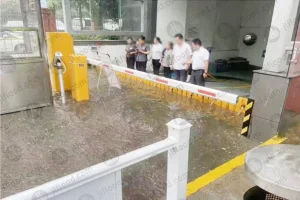
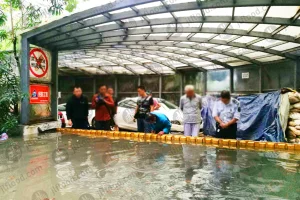
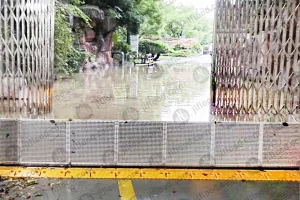
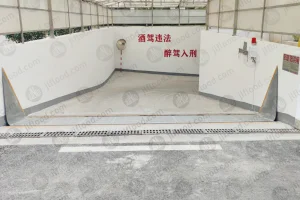
Romania represents one of the most hydro-geologically complex environments in Central and Eastern Europe (CEE). With major river basins including the Danube, Siret, Prut, and Olt, combined with intense flash-flood phenomena in the Carpathian mountain corridors, urban and industrial centers across Romania face escalating vulnerability to extreme rainfall events.
In municipal hubs such as Bucharest, Cluj-Napoca, Timișoara, Galați, and Iași, aging stormwater drainage infrastructure frequently experiences volumetric overwhelm during cloudburst events. This creates catastrophic surface water runoff that inundates underground parking garages, metro station pedestrian accesses, power transformer substations, and industrial logistics parks.
Under the European Union Flood Directive (Directive 2007/60/EC) and Romania's National Strategy for Flood Risk Management, commercial property developers, civil infrastructure authorities, and industrial facility managers are legally and financially mandated to implement resilient, self-actuating perimeter flood barriers to protect critical assets.
Replacing manual stop-logs and failure-prone motorized systems with hydro-mechanical buoyancy engineering.
Under dry normal conditions, the barrier panel rests completely flat within a recessed stainless-steel foundation frame, enabling heavy vehicular traffic (up to 60-ton axle loads) to pass without obstruction.
As surface floodwater enters the embedded basin, the integrated hydrophobic floating panel activates instantly due to Archimedes' principle. Hydrostatic pressure pushes the barrier upward automatically.
The rising water level exerts proportional hydrostatic force against the back face of the barrier leaf, compressing specialized EPDM side seals to create a 100% watertight barrier lock without electricity.
The self-rising mechanism operates on precise moment equilibrium. The opening moment ($M_o$) generated by the buoyant force ($F_b$) and incoming hydrostatic pressure ($P_h$) must exceed the structural hinge friction ($M_f$) and panel deadweight ($W_p$):
Because the activation force is directly provided by the floodwater itself, system responsiveness is mathematically guaranteed regardless of grid blackouts, operator delay, or sensor malfunction.
Bucharest Metro (Metrorex) and the upcoming Cluj-Napoca Metro project require absolute protection against catastrophic surface water ingress into underground stations and ventilation shafts. Junli's heavy-duty automatic flood gates fit seamlessly into subway entrance portals, sealing the opening the moment floodwaters rise past kerb level.
Facilities operated by Transelectrica or regional distributors require continuous uptime. Inundation of low-voltage cable trenches or transformer vaults causes long-term power outages. Surface-mounted and embedded hydrodynamic barriers provide automated, zero-maintenance perimeter sealing for critical energy nodes.
Underground parking structures in Bucharest's business districts (e.g., Pipera, Aurel Vlaicu) present steep vehicular access ramps. Our surface-mounted and recessed flip-up barriers allow smooth daily passage for passenger cars and delivery trucks while locking out flash floods during severe summer rainstorms.
Port assets in Constanța, Galați, and Brăila face dual flood threats from river surges and sea-level fluctuations. High-capacity modular flood gates engineered by Junli support wide-span openings up to 20 meters, protecting warehouses and bulk-goods logistics zones.
Why major specifiers in Romania are switching from legacy stop-logs to hydrodynamic automatic flood barriers.
| Performance Metrics | Hydrodynamic Automatic Gate (Junli) | Manual Aluminum Stop-Logs | Electric Motorized Gate |
|---|---|---|---|
| Power Dependence | Zero (100% Hydro-Mechanical) | Zero (Manual Labor) | High (Requires Electricity/UPS) |
| Human Activation Time | 0 Seconds (Instant Passive Deployment) | 30 to 120 Minutes (High Risk) | 1 to 5 Minutes (If Power Available) |
| Operational Reliability | 99.9% (No Electrical Failure Modes) | Low (Human Error / Absence Risk) | Medium (Motor/Sensor Failure Potential) |
| Traffic Drive-Over Load | Up to 60-Ton Heavy Vehicles | N/A (Must be Installed Post-Traffic) | Varies (Usually Light-Duty Ramps) |
| 20-Year Total Cost of Ownership | Lowest (Zero Standby Electricity) | High (Labor & Storage Costs) | High (Motor Maintenance & Wiring) |
While activation remains 100% mechanical and power-free, next-gen Junli barriers feature wireless IoT position sensors powered by ultra-long-life lithium batteries. Real-time gate movement alerts are broadcast to municipal SCADA networks and building management systems (BMS) in Bucharest and beyond.
Incorporating aerospace-grade structural aluminum alloys and high-density composite core panels reduces deadweight while increasing bending resistance against high hydro-dynamic wave impacts, ideal for Black Sea coastal storm surges.
In cooperation with hydraulic research institutes, our foundation frame chambers feature hydrodynamic micro-slits that prevent urban sediment, leaves, and debris from accumulating, ensuring frictionless panel elevation during emergencies.
Explore our certified product line, manufactured in Nanjing and exported with full engineering documentation to Romania and European markets.
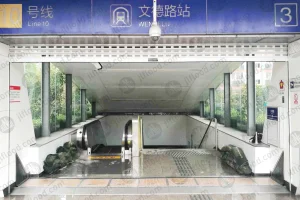
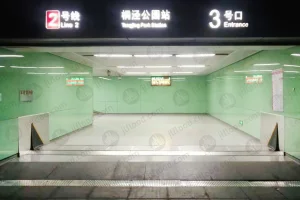
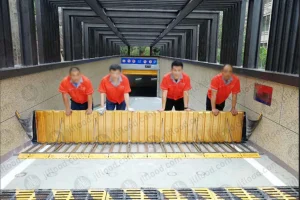
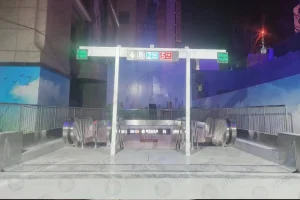
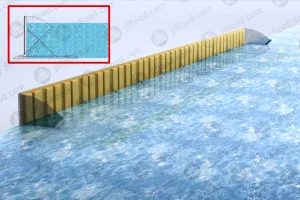
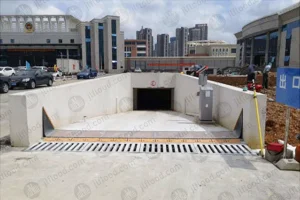
The barrier panel is installed flush within a recessed concrete foundation frame. When surface floodwater flows into the frame, it activates the buoyant internal core. Hydrostatic pressure from the rising water lifts the panel automatically and compresses high-grade EPDM gaskets against the frame. No electrical power, human intervention, motors, or hydraulic pumps are involved, making the system 100% operational during storm-induced power grid outages.
Yes. Junli embedded barriers are engineered with structural stainless steel or heavy-duty architectural aluminum alloy frames rated for load capacities up to 60 tons (E60 / D400 load classes). They easily accommodate heavy transport vehicles, fire trucks, and daily commercial delivery traffic in industrial parks and underground garages across Romania.
We supply complete engineering tender packages including CAD structural drawings, civil embedment work guides, hydrostatic load calculation reports, material test certificates (ISO/CE compliance), water-testing demonstration videos, and English/Romanian installation manuals. We also offer remote live commissioning support for municipal engineering contractors.
Junli flood barriers are built for a structural design lifespan of 20+ years. Thanks to passive mechanical construction, routine maintenance requires only periodic visual inspections, clearing of ground frame debris, and inspection of EPDM perimeter seals once or twice per year.
Consult with Nanjing Junli Technology's engineering specialists. Get custom barrier dimensions, structural calculations, and competitive factory-direct pricing for your project.
Send Inquiry Now →

