Field-tested automatic hydrodynamic flood gates designed for rapid deployment in high-density urban corridors, commercial centers, and residential developments in Riyadh.
Analyzing the transition from arid desert climate to localized cloudburst flash flooding across the Najd Plateau and its impact on subterranean building assets.
While Riyadh is historically recognized for its hyper-arid climate, atmospheric shifts and rapid urbanization across the Ar Riyad Province have drastically heightened the risk of flash flooding (Wadi runoff). Infrequent but intense precipitation events—often exceeding 40mm to 60mm within hours—overwhelm municipal storm drainage networks. In densely built districts like King Abdullah Financial District (KAFD), Olaya, and Al Malaz, surface water accelerates down impervious asphalt roadways into subterranean garage ramps.
Subgrade parking structures, server basements, and critical electromechanical vaults represent the most vulnerable failure points in Saudi architecture. Traditional manual flood gates or sandbags fail during sudden nocturnal deluges due to slow deployment latency and human error. Furthermore, electrical powered barriers frequently fail during severe storms due to localized power grid outages.
Eliminating human dependency and electrical failure modes through natural hydrostatic pressure dynamics.
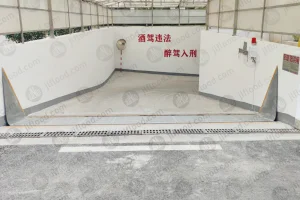
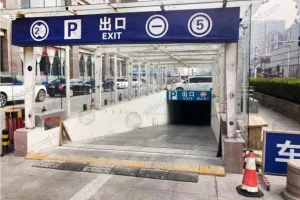
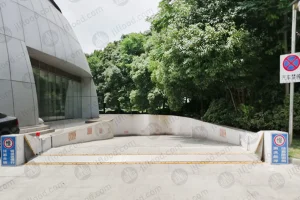
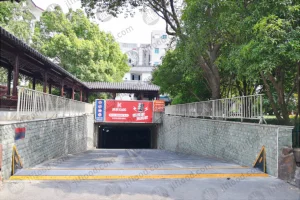
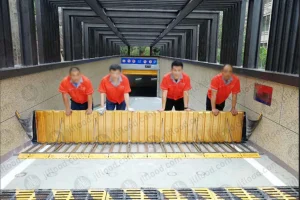
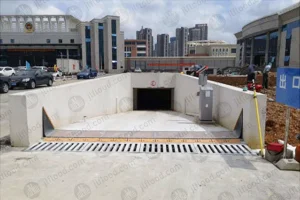
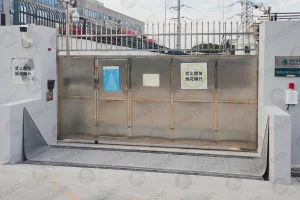
During normal operational conditions, the barrier leaf sits completely flush inside an embedded stainless steel bottom frame level with the garage ramp surface. Vehicles drive over the structural top plate without vibration, noise, or hindrance to traffic flow.
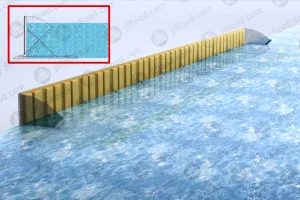
As flash flood runoff enters the embedded bottom chamber via front inlet grates, water buoyancy initiates panel elevation. As water levels rise, hydrostatic pressure forces the barrier leaf to automatically rotate upward around a heavy-duty stainless steel hinge axis.
Once fully upright, incoming floodwater pressure presses the barrier panel tightly against vertical side wall frames fitted with aging-resistant EPDM rubber gaskets. Higher water pressure creates a tighter, zero-leakage hydrostatic seal.
A crucial engineering modification for Riyadh is our proprietary fine-sand filtration and self-flushing bottom box. Standard global flood barriers often jam due to sand sediment settling inside the foundation chamber. Nanjing Junli’s Middle East export line integrates dual sediment deflectors and clean-out inspection ports, ensuring flawless hydro-buoyant activation even after violent desert sandstorms.
Evaluating total cost of ownership, deployment reliability, and climate adaptability for project consultants in Saudi Arabia.
| Evaluation Parameters | Junli Hydrodynamic Automatic Gate | Electric Motorized Flood Gates | Manual Aluminum Stop-Logs | Traditional Sandbag Barriers |
|---|---|---|---|---|
| Activation Power Source | Zero Power (100% Water Driven) | Grid Electricity / Backup Gen-Set | Manual Human Labor | Manual Human Labor |
| Response Time | Immediate (< 0.5 sec upon water ingress) | 30 to 90 seconds (if sensor triggers) | 30 to 120 minutes (Manual assembly) | 2 to 5 Hours (Filling & stacking) |
| Reliability During Power Blackouts | 100% Operational Immunity | High Risk (Vulnerable to grid trip) | Not Applicable | Not Applicable |
| Desert Heat Durability (+50°C) | Exceptional (SS304 / Aircraft Al 6063) | Moderate (Motor overheating risks) | High (Structural metal only) | Poor (UV degradation of polypropylene) |
| Riyadh Labor Deployment Cost | SAR 0 (Unattended Passive Defense) | Low (Automated under normal conditions) | High (Requires emergency standby crew) | Very High (Heavy manual logistics) |
| Vehicle Axle Drive-Over Rating | Heavy Load (AASHTO HS-20 / 40 Tonnes) | Medium to Heavy | None (Must be clear of traffic) | None |
Nanjing Junli Technology Co., Ltd. provides direct manufacturing, localized engineering support, and streamlined logistics to King Abdullah Port and Dammam Port.
Custom structural engineering dimensions tailored to Riyadh project specs, including driveway slope, curb offsets, and drainage channel tie-ins.
100% full-scale hydrostatic tank testing of every manufactured batch in our Nanjing facility prior to export packaging.
Custom wooden crating with anti-corrosion barrier protection shipped directly to Riyadh dry ports or job sites across KSA.
Complete English civil drawing sets, embedment templates, and remote video commissioning support for Saudi MEP contractors.
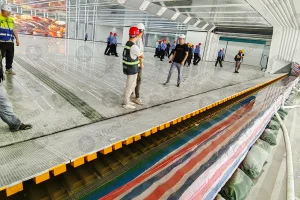
Explore our specialized range of embedded, heavy-duty, surface-mount, and metro-grade automatic flood barriers manufactured in China and exported globally.
Merging mechanical hydro-buoyant self-reliance with digital remote monitoring for modern Saudi smart buildings.
While the core rising mechanism remains 100% hydrodynamic (buoyancy-driven), our smart Middle East export configurations incorporate wireless telemetry sensors. These sensors transmit instant SMS/BMS alerts to facility managers in Riyadh as soon as bottom-chamber water levels exceed threshold levels, activating visual/audible alarms for garage occupants.
To survive the harsh soil chemistry and high ambient temperatures in Saudi Arabia, Junli barriers feature Marine-Grade Stainless Steel 316 embedded frames and hard-anodized 6063-T6 aluminum flood panels. Seals utilize high-tensile EPDM compounds rated for continuous operational exposure between -30°C and +120°C.
Addressing civil integration, maintenance protocols, SASO compliance, and ordering parameters for Riyadh projects.
Our hydrodynamic automatic flood barriers are entirely power-free. They operate using fluid buoyancy and hydrostatic pressure. When floodwater enters the recessed bottom foundation channel, natural buoyancy lifts the aluminum barrier panel into position automatically. Because it requires zero electricity, sensors, or manual intervention, it provides 100% protection reliability even during severe storm blackouts when electric pumps and powered gates fail.
Yes. Junli garage flood barriers are structurally reinforced with internal rib grids designed to support heavy vehicle traffic up to AASHTO HS-20 load standards (40-tonne gross vehicle weight). Vehicles can continuously drive over the embedded panel without causing structural deformation or seal degradation.
Our Middle East specification includes an integrated silt-settling channel, removable debris screens, and dual sediment deflectors. Fine sand passing through the top grate settles below the buoyancy panel without restricting hinge movement. Routine maintenance simply involves flushing the bottom channel during annual building inspections.
Standard hydrodynamic panels range in retaining height from 0.5m to 2.0m. Driveway entrance widths can extend seamlessly from single 3-meter garage ramps up to modular multi-leaf arrays exceeding 30 meters for wide commercial plazas, logistics parks, or metro entrance portals.
Local contractors need to excavate a shallow concrete trench across the garage entrance based on our shop drawings, pour a reinforced base concrete slab, and provide a low-point drainage pipe connection from the bottom frame to the building sump pit. Junli supplies embedded mounting frames, anchor bolt kits, and complete CAD embedment detail drawings.
We provide full OEM export support, including custom seaworthy wooden packaging, SASO-compliant documentation, commercial invoice legalization, and direct ocean freight to King Abdullah Port (Jeddah) or Dammam Port, as well as bonded truck delivery to Riyadh. Our engineering team provides step-by-step installation manuals, CAD/BIM support, and remote video commissioning.
Contact our engineering desk today for customized flood-defence CAD layouts, SASO-compliant material specifications, and direct factory quotation pricing.