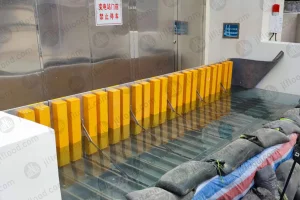
Deploying robust, zero-electricity automatic water-retaining barriers designed for high-density underground basements and urban entrances.
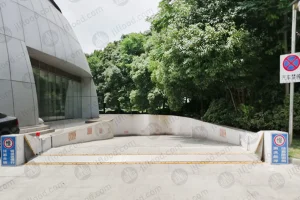
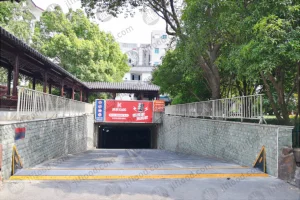
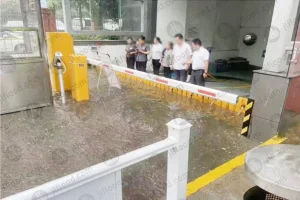
Nanjing Junli Technology delivers high-gain flood defense solutions built to endure severe monsoons, storm surges, and urban flash flooding without relying on external power grid stability.
The Philippine archipelago stands as one of the most hydro-meteorologically vulnerable regions in Southeast Asia. Exposed to an average of 20 tropical cyclones annually, coupled with the southwest monsoon (Habagat), key economic hubs including Metro Manila (Makati, Bonifacio Global City, Ortigas Center), Metro Cebu, Clark Freeport Zone, and Davao City face escalating urban flood risks. Rapid urbanization has intensified surface runoff, overwhelming municipal stormwater drainage systems and causing catastrophic inundation into subterranean assets.
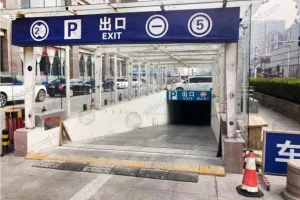
Underground commercial garages, multi-level residential basement parking, power distribution vaults, and logistics warehouse driveways represent single-point vulnerabilities. When extreme rainfall events exceed local drainage capacities (such as during Typhoon Carina or Typhoon Ondoy historic benchmarks), water ingress into basement levels results in catastrophic financial losses—destroying vehicle fleets, critical electrical switchgears, HVAC systems, and structural foundations, while causing business interruption costs that often exceed millions of US dollars per facility.
Information Gain Insight: Standard flood mitigation in the Philippines has historically relied on manual sandbags or human-operated aluminum stop logs. However, 85% of urban underground garage flood disasters occur during off-peak hours or sudden grid blackouts when maintenance personnel are absent or unable to install manual barriers in time. Automatic hydrodynamic flood barriers eliminate human dependency entirely.
Modern commercial infrastructure procurement in the Philippines requires strict adherence to flood risk management standards established by the Department of Public Works and Highways (DPWH) and local building codes. Electric active flood gates (motorized or hydraulic pumps) fail precisely when storm surges trigger power grid outages. Junli’s Hydrodynamic Automatic Flood Barriers operate on purely mechanical fluid dynamics: as water rises, hydrodynamic buoyancy and hydrostatic pressure automatically raise and securely lock the barrier wall into position.
Evaluating structural integrity, response velocity, and long-term OPEX for Philippine commercial and industrial specifiers.
| Performance Metrics | Junli Hydrodynamic Automatic Barrier | Manual Demountable Stop-Logs | Motorized / Hydraulic Electric Gates | Traditional Sandbag Deployment |
|---|---|---|---|---|
| Deployment Mechanism | 100% Passive Hydrodynamic Buoyancy | Manual Assembly Required | Active Electric / Hydraulic Motor | Manual Stacking & Transportation |
| Response Velocity | Instantaneous (< 1 Second Activation) | 30 – 120 Minutes | 2 – 5 Minutes (If Power Intact) | 2 – 6 Hours |
| Blackout Reliability | 100% Operational (No Grid Needed) | N/A (Labor Dependent) | High Risk (Fails without UPS/Genset) | N/A (Labor Dependent) |
| Human Error Risk | Zero Risk (Fully Automatic) | Severe Risk (Requires On-site Staff) | Moderate (Sensor/Control Failure) | Extreme Risk (Slow & Permeable) |
| Water Seal Efficiency | Double-Lip EPDM Seal (<0.15 L/h/m²) | Variable (>2.0 L/h/m²) | Mechanical Compression (<0.5 L/h/m²) | High Seepage Rate (>15 L/h/m²) |
| Vehicle Load Capacity | Heavy-Duty Truck Rated (AASHTO HS20 / 40 T) | N/A (Blocks Entrance Permanently) | Drive-over Frame Dependent | N/A (Blocks Driveway) |
| Design Service Life | 25+ Years Stainless Steel / T6 Aluminum | 5 – 10 Years (Seal Degradation) | 8 – 12 Years (Mechanical Wear) | Single Event Use |
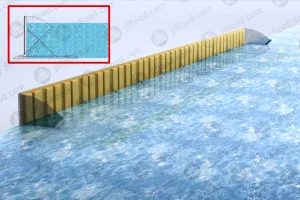
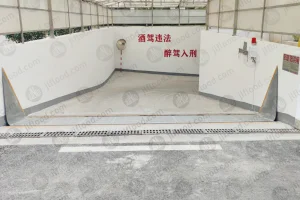
Nanjing Junli Technology’s garage flood barrier system is engineered based on fluid dynamics and buoyancy leverage principles. The system consists of three structural units: a ground embedded housing frame, a dynamic floating door panel, and high-durability lateral fluid-tight sealing strips.
1. Passive Inflow Activation: As flash flood surface runoff reaches the threshold frame, water flows into the bottom intake chamber through engineered hydrodynamic inlet grates.
2. Buoyancy & Mechanical Leverage: The lightweight, high-rigidity structural aluminum hollow panel contains sealed internal air chambers. As water fills the basin, buoyant force immediately forces the front edge of the barrier upward.
3. Hydrostatic Locking: As the retained water head increases, the hydrostatic pressure forces the barrier panel against the high-density EPDM sealing gasket, forming an airtight, watertight lock that holds back floodwaters up to 2.0 meters high.
4. Self-Resetting Drainage Phase: Once floodwaters recede through the site drainage system, residual water drains out via bottom weep holes, allowing the barrier panel to automatically settle flush back into its embedded ground frame.
Engineering solutions tailored to specific commercial, industrial, and municipal infrastructure protection needs in the Philippines.
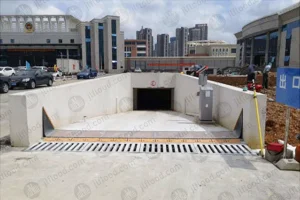
Ideal for commercial towers, shopping complexes, and residential condominiums in BGC, Makati, Ortigas, and Cebu IT Park. Protects multi-level underground parking ramps from flash surface floods while allowing smooth daily traffic of luxury passenger cars and delivery vans.
Designed for manufacturing plants, cold storage facilities, and warehouses within Clark Freeport, Subic Bay, Cavite, and Laguna Technoparks. Heavy-duty 40-ton load capacity accommodates container trucks and heavy industrial machinery.
Protection for power utility substations (such as Meralco grid perimeter gates and regional electric cooperatives), transformer bays, and cable trenches. Prevents flood-induced grid collapse and million-dollar transformer explosions.
Nanjing Junli Technology provides end-to-end engineering support for Philippine contractors, developers, and architectural specifiers. We bridge global manufacturing precision with local civil construction realities.
To receive an accurate customized factory quote and technical layout proposal within 24 hours, please prepare the following parameters:
Pioneering the intersection of mechanical hydrodynamic engineering and smart urban IoT building management systems.
Zero electricity, purely passive self-rising flood gates triggered by natural water displacement.
Integration of solar-powered IoT sensors reporting gate rising status, water level data, and alarm alerts to central building control rooms.
Incorporating manual mechanical locking pin overrides and hydraulic emergency manual pumps for preemptive operational locks.
Connecting flood barrier sensors directly into smart city flood early warning networks across metropolitan regions.
Detailed answers covering hydrodynamic principles, installation requirements, maintenance, and ordering procedures.
Our hydrodynamic automatic flood barriers are 100% power-free and purely mechanical. The system relies on Archimedes' buoyancy principle and hydrostatic pressure. When flood water enters the embedded foundation pit, water buoyancy naturally lifts the dynamic hollow aluminum barrier panel upward. As water level rises, the hydrostatic pressure forces the panel tightly against structural dual EPDM seals, securing the perimeter. No electric motors, sensors, or human operators are needed—making it 100% reliable during typhoon power blackouts.
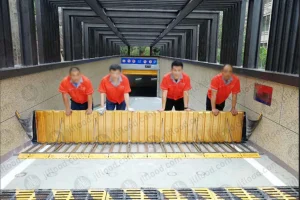
Yes. When no floodwater is present, the dynamic panel rests completely flush inside the recessed stainless steel bottom frame embedded in the ramp floor. Constructed with heavy-duty structural T6 aluminum extrusions and internal reinforcing ribs, the top surface can sustain axle loads up to 40 tons (conforming to AASHTO HS20 loading standards), allowing heavy logistics container trucks, fire engines, and commercial vehicles to drive over it continuously without structural deformation.
For embedded installation, local civil contractors must excavate a trench across the driveway opening matching our technical embedded frame dimensions (typically 150mm - 300mm deep depending on barrier height). Concrete reinforcement rebar ties and a bottom drainage outlet pipe (connected to the building’s sump pump or gravity storm drain) are required. Junli provides complete CAD civil engineering template drawings and step-by-step guidance for local contractors in Metro Manila or provincial sites.
All structural metal parts exposed to the elements undergo specialized anti-corrosion surface treatments. The main barrier panels are manufactured from high-grade 6063-T6 architectural aluminum alloy with hard anodic oxidation or fluorocarbon PVDF powder coating. Embedded frames and hardware components are available in SS304 or marine-grade SS316 stainless steel, offering superior resistance against saline air, coastal humidity, and atmospheric corrosion.
Maintenance is minimal. We recommend quarterly visual inspections to clear dirt, leaves, or debris from the bottom foundation trench water inlet grates. Flushing the bottom chamber with a water hose twice a year ensures weeping holes remain unobstructed. The military-grade EPDM rubber seals are UV-stabilized and engineered for over 15–20 years of service. Replacement seal kits can be ordered directly from our factory.
Standard manufacturing lead time is approximately 10 to 15 business days depending on custom span and height specifications. Direct sea freight transit from Shanghai or Ningbo port to Manila South/North Port typically takes 5 to 8 days, or 8 to 12 days to Cebu or Davao. Express air freight options are also available for urgent project spare parts or light flip-up models.
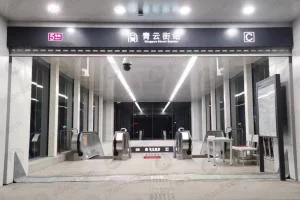
Select from our field-tested product line engineered for garages, metro networks, power stations, and municipal applications.