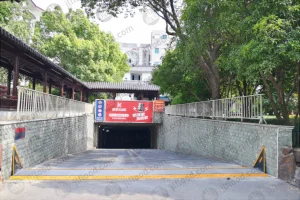
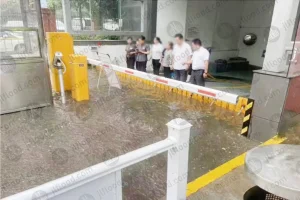
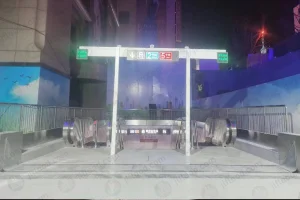
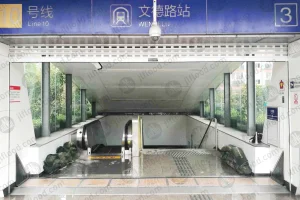
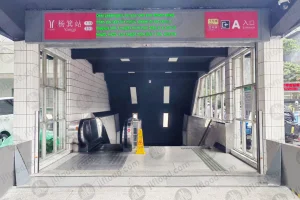
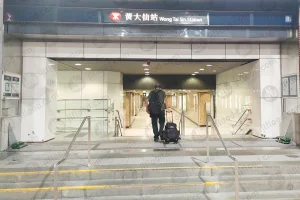
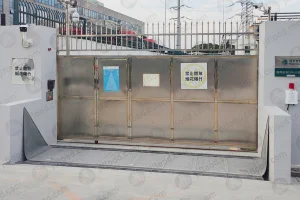
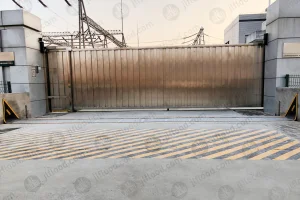
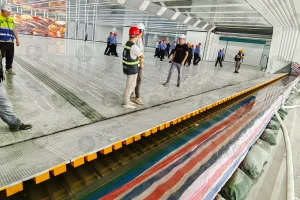
Initial deployment configurations engineered for immediate surface and embedded retrofit across transit hubs, substation perimeter gates, and commercial basements in Savannakhet Province.
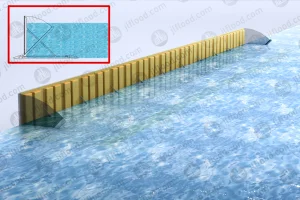
Savannakhet, as the primary economic hub of Southern Laos and a central anchor of the East-West Economic Corridor (EWEC), occupies a pivotal geographical position along the left bank of the Lower Mekong River basin. While this location facilitates vibrant international trade, logistics operations, and industrial manufacturing within the Savan-Seno Special Economic Zone (SSEZ), it simultaneously exposes critical infrastructure to acute hydrological vulnerabilities. The regional monsoon pattern (May through October) regularly generates high-intensity, long-duration pluvial events coupled with severe fluvial overflow from the Mekong and its key tributaries such as the Xebanghiang and Xebangfai Rivers.
As Savannakhet accelerates its industrialization—expanding dry ports, cross-border freight distribution centers, high-voltage electrical substations, and commercial basements—the threat of catastrophic water ingress becomes a top-tier operational risk. Urban surface runoff routinely exceeds legacy municipal drainage capacities, leading to flash waterlogging across critical low-lying access points, cargo bays, subterranean transformer vaults, and underground parking structures.
Critical Risk Mitigation Mandate: In monsoon-prone industrial corridors like Savannakhet, electrical blackouts typically accompany major flood surges. Conventional motorized or sensor-dependent flood gates fail when utility power is lost. Hydrodynamic passive automatic flood barriers—which deploy purely via hydrodynamic water buoyancy without reliance on electricity or human operators—represent the gold standard in modern resilient infrastructure design.
Engineering assessments conducted across logistics and industrial developments in Savannakhet highlight three high-vulnerability asset categories requiring continuous water-retaining flood protection:
Globally, flood risk management for industrial assets has undergone a radical paradigm shift over the past decade. Legacy manual defenses—such as demountable aluminum stop-logs, inflatable bladders, and temporary sandbags—have proven inadequate in real-world flash flood scenarios due to high failure rates caused by human absence, late deployment, missing seals, or power grid collapse. Modern structural engineering specs now mandate Passive Hydrodynamic Automatic Flood Gates.
Under international benchmarks such as FM 2510 (Flood Mitigation Equipment Standard), BS EN 13564, and ISO 9001 quality management systems, flood barriers must undergo rigorous empirical validation. Compliance demands that barriers operate maintenance-free under severe debris load, dynamic wave action, continuous hydrostatic pressure, and complete electrical failure.
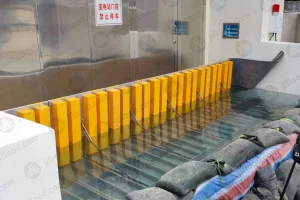
Utilizes incoming floodwater's own hydrostatic pressure and buoyancy forces inside a stainless-steel ground basin to automatically elevate and lock the retaining panel into position.
Eliminates reliance on weather forecasts, staff alerts, or manual labor. Protects facilities during off-hours, weekends, holidays, and sudden nocturnal flash floods.
When dry, the heavy-duty structural panel rests completely flush with the roadway surface, supporting heavy vehicle traffic (up to 60-ton container trucks) without noise or vibration.
A flood barrier is a critical life-safety and asset-protection system. Specifiers and procurement directors serving Savannakhet should never accept theoretical simulation models or static CAD drawings alone. Genuine operational reliability must be proven through physical, full-scale water testing prior to factory dispatch.
At our specialized Nanjing manufacturing plant, every custom-engineered flood barrier undergoes comprehensive hydraulic pool testing within a dedicated hydrostatic test chamber. Our quality assurance protocol verifies key performance parameters across four rigid domains:
| Test Domain | Testing Protocol / Methodology | Target Acceptance Threshold | Engineering Impact |
|---|---|---|---|
| Passive Buoyancy Trigger Time | Chamber flooding with controlled inlet flow rates simulating flash floods. | Panel activation starts at ≤50mm water depth; full rise in <15 seconds. | Ensures instantaneous deployment before initial surface runoff penetrates the facility entrance. |
| Continuous Hydrostatic Head Leakage Rate | Full-depth water pressure held for 72 consecutive hours at maximum design height (up to 2.0m). | Leakage rate <0.15 L/h per linear meter of perimeter seal (exceeds international standards). | Prevents basement seepage, structural dampness, and costly sump-pump overloads. |
| Structural Deflection & Stress Tolerance | Point-load dynamic impact testing combined with maximum static head pressure. | Max panel deflection <L/250 under full hydrostatic head; zero permanent deformation. | Guarantees structural integrity against floating debris impacts (logs, trash, urban debris). |
| Dynamic Traffic Load Fatigue | Repeated cyclic loading simulation using multi-axle heavy vehicle rigs. | 60-ton vehicle drive-over testing for over 100,000 continuous cycles. | Prevents trough deformation and structural cracking under heavy industrial truck traffic. |
Factory Acceptance Testing (FAT) Certification: Every batch exported to Savannakhet is accompanied by a certified Water-Testing Video Record, Factory Material Test Certificates (MTC for 6063-T6 Aluminum & 304 Stainless Steel), and an ISO-compliant Inspection Sign-off Report.
Long-term durability in Southeast Asia's tropical climate requires rigorous material selection to withstand high humidity, elevated ambient temperatures, localized chemical exposure, and intensive UV radiation. Our technical roadmap incorporates premium aerospace-grade alloys and synthesized elastomers.
Constructed from high-tensile 6063-T6 structural aluminum alloy extrusion profiles. Reinforced with internal dynamic load ribs to withstand heavy static hydro-head pressure and impact forces. Finished with fluorocarbon (PVDF) anti-corrosion coating resistant to UV breakdown and chemical runoff.
Fabricated from heavy-duty 304 / 316 stainless steel. Integrates seamless anchorage lugs for direct tie-in to reinforced concrete slabs. Embedded troughs feature self-cleaning slope profiles and integrated drainage connectors to eliminate sediment accumulation.
Features custom-extruded EPDM (Ethylene Propylene Diene Monomer) composite seals along the bottom base and vertical side frames. Formulated for high memory retention, oil resistance, and zero degradation across ambient operating temperatures from -20°C to +80°C.
Optional smart sensor modules with LoRaWAN / NB-IoT connectivity. Delivers instantaneous SMS/cloud alerts to facility management dashboards upon panel buoyancy activation, providing real-time height tracking during extreme storm events in Savannakhet.
Our engineering team provides comprehensive engineering support—from site survey consultation and CAD embedment drafting to FAT video validation, freight shipping, and installation guidance serving project sites across Savannakhet.
High-density stainless embedded barriers designed for high-voltage power sub-stations. Protects critical switchgear rooms and underground cable trenches against sudden river surges and flash surface flooding.
Request Substation Spec Sheet →Wide-span automatic surface-mounted and embedded hydrodynamic barriers engineered specifically for heavy container truck transit. Retains up to 1.5m water head across clear spans up to 10 meters per leaf.
Request Freight Ramp Spec Sheet →Flush-mounted garage entrance barriers that sit completely level with the driving surface. Automatically rises in seconds as storm runoff enters the entry trough, securing subterranean levels against severe inundation.
Request Garage Spec Sheet →Direct B2B factory wholesale pricing for flood barrier systems is determined by structural dimensions, retaining height requirements, embedment frame type (Surface Mounted vs. Recessed Embedded), surface finish, and specific water-testing certification level. Below is an engineering estimation guide for budgeting and tender preparation serving project sites in Savannakhet and broader Laos PDR.
| Barrier Type / Configuration | Standard Retaining Height | Clear Span Range | Primary Structural Materials | Est. Wholesale Price (USD/Linear Meter) |
|---|---|---|---|---|
| Embedded Hydrodynamic Automatic Barrier (Substation / Metro Grade) | 600mm – 1200mm | 2.0m – 6.0m per leaf (modular) | 6005-T6 Aluminum Panel + 304 Stainless Trough + EPDM Triple Seal | $680 – $1,250 / m |
| Surface Installation Metro/Driveway Type (Retrofit Model) | 500mm – 1000mm | 1.5m – 5.0m per leaf | High-tensile Marine Aluminum Panel + Galvanized/SS Base Frame | $550 – $980 / m |
| Flip-Up Automatic / Mechanical Barrier (Garages & Pedestrian Access) | 400mm – 800mm | 1.0m – 4.0m | Anodized Aluminum Alloy + Dual Hydraulic/Mechanical Dampers | $480 – $850 / m |
| Heavy Industrial Custom Substation Gate Array | 1000mm – 2000mm | Up to 12.0m (multi-leaf array) | Heavy 316 Stainless Steel Trough + Reinforced Structural Core | $950 – $1,800 / m |
* Note: Final pricing varies based on exact civil dimensions, door opening geometry, custom freight requirements to Savannakhet (via Mukdahan / Lao Logistics Network), and third-party inspection requirements. Contact our engineering desk for formal tenders.
Explore our complete portfolio of automatic hydrodynamic, embedded, flip-up, and metro-spec flood defense systems engineered for high-performance infrastructure protection.
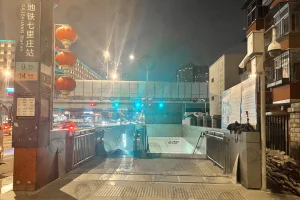
Send us your facility opening dimensions, clear width spans, and required retaining heights. Our engineering directorate will generate a complete technical proposal, embedment detail, and wholesale price quotation within 24 hours.