


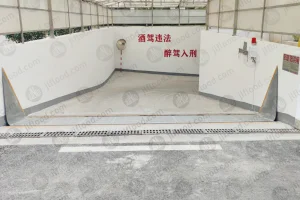

Discover our flagship self-closing, hydrodynamic, and embedded garage flood protection barriers, engineered to withstand extreme tropical monsoon events, high hydrostatic heads, and heavy vehicular wheel loads.
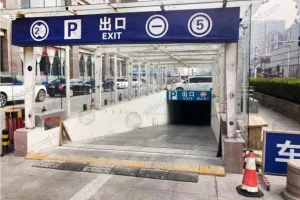
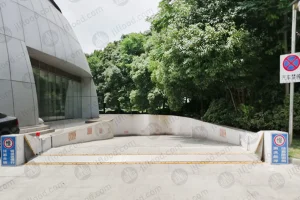
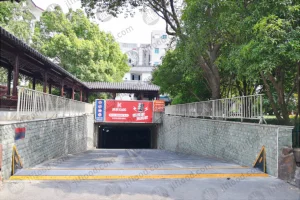
Bangladesh presents one of the most hydrologically complex built environments in South Asia. Characterized by dense urban centers, riverine delta systems, and intense monsoon seasons bringing over 2,500mm to 4,000mm of precipitation annually, major metropolitan regions such as Dhaka (DNCC/DSCC), Chittagong, Narayanganj, and Gazipur face systemic urban waterlogging. The rapid urbanization across Dhaka North and South, coupled with overloaded storm-water drainage networks, frequently causes torrential flash floods that submerge basement ramps, subterranean parking decks, utility control rooms, and ready-made garment (RMG) factory storehouses within minutes.
To secure critical infrastructure, corporate real estate, commercial shopping centers, and high-value industrial facilities, project developers, civil engineers, and EPC contractors in Bangladesh are pivoting toward Hydrodynamic Passive Automatic Flood Barriers. Engineered and manufactured by Nanjing Junli Technology Co., Ltd. and supplied on a wholesale B2B basis across Bangladesh, our garage flood barrier systems utilize the natural physical force of rising water to automatically deploy without requiring grid electricity, manual activation, or electronic sensors.
In high-density commercial centers such as Motijheel, Gulshan, Banani, and Dhanmondi, basement garages serve as crucial parking multi-levels and house high-voltage transformer rooms. When drainage overflows occur, floodwater depth on access roads can rise from 20cm to over 1.2 meters within 30 minutes, drowning vehicles, emergency generators, and building management systems. Installing flush-mounted hydrodynamic garage barriers eliminates risk at the precise ingress point.
As the maritime gateway of Bangladesh, Chittagong suffers from a combination of tropical monsoon rainfall and ocean-driven tidal surges. Saline air and brackish floodwaters accelerate corrosion on conventional steel flood barriers. Our wholesale range specifically integrates 6063-T6 marine-grade anodized aluminum profiles, SUS316 stainless steel housings, and chemical-resistant EPDM seals designed for severe coastal industrial environments.
Understanding the mechanical physics behind passive flood defense systems engineered for low-maintenance, continuous operational readiness in high-risk tropical zones.
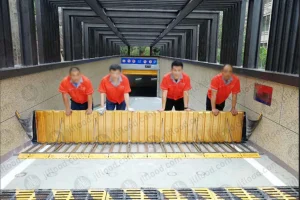
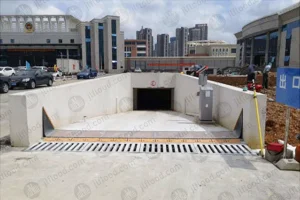
During normal dry weather conditions, the garage flood barrier panel rests completely flat inside an embedded concrete ground basin at the top or bottom of the garage entry ramp. The upper surface of the heavy-duty aluminum panel aligns flush with the asphalt or concrete road surface, creating zero obstacle for everyday vehicle ingress and egress. Built-in structural rib matrices allow heavy commercial vehicles, container lorries, and fire engines (up to 40–60 ton axle loads) to drive over the barrier casing without causing structural deflection or seal degradation.
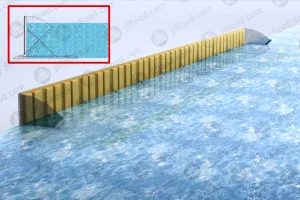
When severe urban runoff reaches the threshold level at the garage perimeter, surface water automatically flows into the embedded intake chamber through front drainage grates. As water fills the basin, natural hydrostatic buoyancy forces act upon the internal hollow air-tight flotation leaf (engineered with calculated volumetric density). The panel automatically pivots upward around its stainless-steel hinge assembly, rising proportionally to the incoming water level.
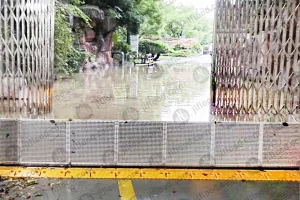
As floodwater levels continue rising toward maximum retaining height (customizable from 0.5m up to 2.0m retaining heads), the hydrostatic water pressure pushing against the front wall of the elevated barrier panel forces it firmly against heavy-duty lateral frame pillars. EPDM rubber seals lining the bottom, sides, and panel joints undergo elastomeric compression, forming a hermetic, zero-leakage hydrostatic seal capable of retaining continuous water heads under extreme dynamic wave action.
Once monsoon storm waters recede and municipal storm-drainage channels clear, the water retained inside the embedded basin drains out via gravity through secondary discharge valves or dedicated sump connection points. As the water level inside the chamber drops, the panel smoothly descends back into its recessed floor box, restoring open vehicular traffic automatically without human labor.
| Performance Metrics | Junli Hydrodynamic Passive Barrier | Manual Aluminum Stop-Logs | Electric Motorized Flood Gates | Traditional Sandbag Barricades |
|---|---|---|---|---|
| Power Requirement | Zero Power (100% Passive) | Zero Power | Requires Electricity / Backups | Zero Power |
| Human Operator Dependency | 0 Operators (Autonomous) | 2 - 4 Workers Needed | 1 Operator / Automated Sensor | 10+ Laborers Required |
| Deployment Response Time | Instantaneous (< 0.5 seconds) | 30 - 60 Minutes (Manual Assembly) | 1 - 3 Minutes (If Power Active) | 2 - 5 Hours (Filling & Stacking) |
| Sealing Reliability & Leakage Rate | Near-Zero (<0.1 L/hr/m) | Moderate (Joint Seepages) | High (If Gaskets intact) | Very Poor (High Infiltration) |
| Traffic Impact When Inactive | 100% Flush with Driveway | Requires Storage & Installation | Ramps/Side Posts Visible | Blocks Road Completely |
| Operational Life Expectancy | 25+ Years (Alloy/SS Construction) | 5 - 10 Years (Seal Degradation) | 5 - 8 Years (Motor/Sensor Failures) | Single-Use Only |
As a dedicated OEM/ODM manufacturer, we supply tailored flood defense systems matching the exact civil dimensions, flow rates, and loading specs of major Bangladesh commercial and municipal projects.
Modern high-rise towers across Dhaka (Gulshan 1 & 2, Banani, Uttara, Bashundhara RA) feature deep subterranean parking decks housing hundreds of vehicles. Standard ramp inclinations funnel surface runoff directly into the basement entry. Installing our Surface-Mounted or Embedded Hydrodynamic Garage Barriers at the top of the entry slope prevents surface water from overtopping the threshold, safeguarding luxury vehicles, electrical panels, and elevator pits.
Bangladesh’s RMG and textile export sector relies heavily on continuous production schedules and secure warehousing. Industrial zones in Gazipur, Savar, Ashulia, and Narayanganj store millions of dollars in raw cotton, finished apparel, dye chemicals, and steam boiler units in ground-level or semi-basement facilities. A single flooding event destroys raw inventory and causes severe buyer order defaults. Our heavy-duty wide-span automatic gates provide continuous perimeter protection against flash water ingress.
Power Grid Company of Bangladesh (PGCB) substations, transformer vaults, and telecom exchange centers require absolute dry-zone maintenance. Floodwaters entering high-voltage equipment enclosures trigger immediate grid trips, dangerous arc flashes, and widespread blackout conditions across urban districts. Junli specialized Substation Perimeter Flood Gates deliver IP67 water-tight integrity, ensuring electrical supply resilience during monsoon periods.
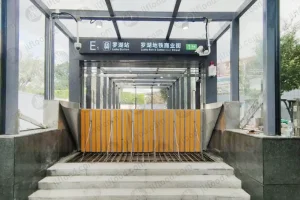
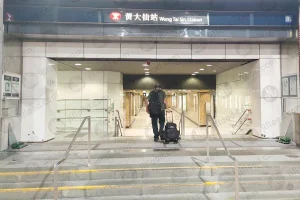
Rapid transit expansion like the Dhaka MRT Line network requires strict flood mitigation at station concourse entrances, ventilation shafts, and underground pedestrian passages. Junli line of Metro Station Hydrodynamic & Flip-Up Barriers complies with international transit civil engineering guidelines, supporting high foot traffic and offering rapid water protection for urban rail assets.
Nanjing Junli Technology provides end-to-end engineering, custom fabrication, export documentation, and installation guidance tailored for engineering consultants, contractors, and wholesale distributors in Bangladesh.
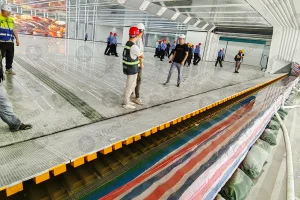
Every customized garage flood gate order undergoes 100% full-scale water retention testing at our factory hydrostatic testing facility in Nanjing prior to packaging. We measure zero-leakage performance under specified maximum water heads, verifying seal elastomeric compression, hinge torque response, and panel structural deflection. Factory Acceptance Test (FAT) video documentation and third-party inspection reports (CE / ISO standard compliant) are provided with every wholesale shipment bound for Chittagong Port or ICD Kamalapur.
Our engineering division assists Bangladesh civil consultants by issuing comprehensive CAD dimensional drawings, foundation concrete trench embedment templates, rebar reinforcement clearance details, and drainage pipe sizing rules. This ensures seamless integration into new architectural structural drawings (BNBC compliance) or retrofit applications for existing building entrance ramps.
Products are packed using export-grade reinforced fumigated wooden crates, wrapped with anti-corrosion protective films, and secured with steel strapping to prevent damage during containerized sea transit from Shanghai/Ningbo ports to Chittagong or Mongla ports. We handle full container loads (FCL) as well as consolidated shipping (LCL) for smaller commercial contracts.
We provide step-by-step English installation manuals, video instruction suites, and direct remote video commissioning guidance. For large-scale infrastructure projects, experienced Junli structural engineers can be dispatched to Bangladesh for site Supervision, commission verification, and local maintenance team training.
Send us your project driveway clear width, required retaining height, and loading requirements to receive a complete engineering proposal within 24 hours.
Send Inquiry NowExplore our complete range of high-performance hydrodynamic, automatic, and surface-mounted flood protection barriers supplied direct from our factory to project developers and contractors in Bangladesh.
As smart city initiatives progress in Bangladesh, Junli flood defense technologies are evolving to support digital integration with central building management systems (BMS) and municipal flood monitoring networks.
While our core hydrodynamic barriers remain 100% mechanically reliable without electricity, optional low-power IoT telemetry modules can be integrated into the foundation chamber. Wireless sensors transmit real-time alerts (via NB-IoT or GSM networks) to facility managers’ mobile devices the instant water enters the basin, confirming barrier activation status, water depth readings, and battery performance for auxiliary alarms.
To combat accelerating coastal corrosion in Chittagong, Cox's Bazar, and Khulna, our R&D team has developed multi-layer anti-corrosion surface treatments. Combining fluorocarbon (PVDF) electrostatic coating over anodized 6063-T6 aluminum alloys with passivated SUS316 stainless steel fasteners, these barriers deliver extended structural longevity under marine aerosol and chemical exposure.
Detailed engineering and commercial answers for architects, project developers, contractors, and procurement officers.
A: The system works purely on fluid hydrodynamics and Archimedes' principle of buoyancy. The barrier panel rests flush within a recessed floor channel. When floodwaters reach the driveway entrance, water flows into the chamber through intake grates. The buoyant structural panel automatically floats upward as water fills the basin. Rising water hydrostatic pressure then pushes the panel against vertical side frames, locking elastomeric EPDM seals to stop water ingress—completely independent of electrical power, motors, or manual labor.
A: Yes. Junli garage flood barriers are engineered with high-strength extruded aluminum alloy profile matrixes (6063-T6) and reinforced structural steel embedded housings. Standard models support axle wheel loads from 20 tons up to 40+ tons (compliant with AASHTO HS-20 and international heavy vehicle loading standards), making them fully suitable for heavy logistics trucks, fire engines, and dense commercial garage vehicle traffic.
A: We manufacture custom structural spans. Single clear barrier spans range from 1.5 meters up to 6.0 meters per leaf. For extra-wide commercial ramps or industrial perimeter gates exceeding 6 meters (e.g., 10m to 30m wide driveways), modular multi-leaf barrier arrays with removable or subterranean pop-up intermediate support posts are utilized. Standard retaining protection heights range from 0.5m, 0.6m, 0.9m, 1.0m, up to 2.0 meters water head rating.
A: Because there are no motors, pumps, electrical circuits, or sensors, routine maintenance is exceptionally simple. We recommend inspecting the embedded floor pit every 3 to 6 months (especially before the monsoon season in April/May) to clean out silt, leaves, or debris accumulated in the drainage chamber. Seals should be inspected visually once a year and lubricated with silicone grease. Spare seal kits are readily available directly from our factory.
A: Orders are manufactured to exact CAD project drawings at our factory in Nanjing, China. Products are packed in reinforced, seaworthy fumigated wooden crates. Shipments are dispatched via ocean freight directly to Chittagong Port (Sea) or ICD Kamalapur, Dhaka (Rail/Customs bonded). Transit time typically ranges between 12 to 18 days from factory dispatch to port arrival. Complete LC (Letter of Credit), commercial invoices, packing lists, and Certificate of Origin (CO) documentation are provided for smooth customs clearance.
A: Yes. We offer both Embedded Flush-Mounted Types (requiring cutting a shallow concrete trench across the driveway threshold) and Surface-Mounted / Flip-Up Ramp Types (which anchor directly onto the existing floor surface with minimal civil disruption). Our engineering team will review your site photos and incline slope angles to recommend the ideal retrofit barrier configuration.
Partner directly with China's leading hydrodynamic flood barrier manufacturer. Request technical documentation, customized CAD drawings, and factory-direct wholesale price quotes for your projects in Bangladesh.