
Explore our core certified anti-flood gates tailored for urban rail transit, power substations, underground commercial parking, and critical municipal infrastructure. Request factory-direct quotes below.
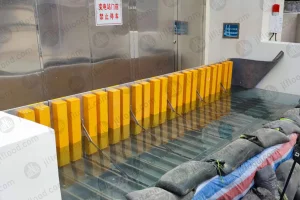
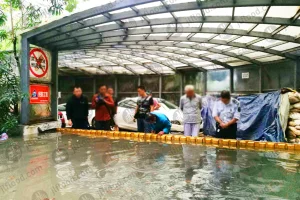
In an era defined by intensifying global climate volatility, urban centers across North America, Europe, East Asia, and the Middle East are experiencing unprecedented flash flooding events. Microburst rainstorms and record-breaking typhoons regularly overwhelm traditional municipal storm sewer networks, transforming civil roadways into active flood paths. For critical infrastructure—such as metro networks, high-voltage electrical substations, commercial underground parkades, and subterranean logistics hubs—uncontrolled water ingress leads to severe asset destruction, extended operational outages, and billions of dollars in economic disruption.
Consequently, architectural specifications and structural engineering codes have shifted dramatically. The global market for flood barriers has evolved from manual, labor-intensive flood gates—such as aluminum stop logs or sandbags—toward hydrodynamic automatic self-rising flood barrier systems. Municipal planners, asset managers, and insurance underwriters now demand passive, zero-power flood protection solutions that eliminate the human error element entirely during severe weather disasters.
As a leading premier China Anti Flood Gate Manufacturer, Nanjing Junli Technology Co., Ltd. sits at the forefront of this global shift. By combining advanced hydrodynamic mechanical engineering with automated manufacturing, Junli delivers structural flood barriers that provide passive protection 24/7 without requiring grid power, sensory electronics, or emergency field crews.
The central engineering vulnerability of legacy electrical or hydraulic flood gates lies in their dependence on grid power, sensors, and mechanical motors. Severe urban flooding events are frequently accompanied by city-wide power blackouts, electrical shorts, or telecommunication failures. If an automatic flood gate relies on water sensors or electricity to trigger, its failure rate during an actual extreme event increases exponentially.
When flash floodwater reaches the recessed ground chamber, water flows naturally into the basin through intake grates. As water fills the basin, buoyant force drives the hollow structural leaf to tilt upward smoothly on its bottom pivot hinges.
As the external water level rises, the hydrostatic pressure acting against the rear of the structural door leaf increases proportionately. This pressure presses the gate leaf firmly against the heavy-duty perimeter EPDM seal gaskets, producing a tighter seal as flood severity escalates.
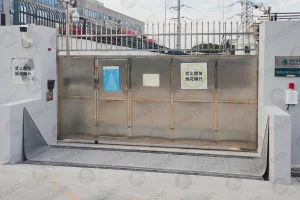
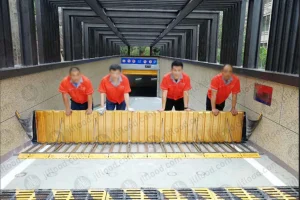
Under normal weather conditions, the barrier remains resting flush inside its embedded stainless steel foundation chamber. Vehicles, heavy trucks, and pedestrians cross freely over the heavy-duty driveable top plate without operational obstruction.
| Engineering Parameter | Hydrodynamic Self-Rising Gate | Electric Motorized Flood Gate | Manual Aluminum Stop-Logs |
|---|---|---|---|
| Power Requirement | 0 kW (100% Power-Free Mechanical) | 2.2 kW – 7.5 kW (Requires Backup Gen) | Manual Labor Dependent |
| Activation Response Time | Immediate / Automatic (<0.5 Seconds) | 30 – 90 Seconds (Dependent on Motor) | 30 – 120 Minutes (Deployment Time) |
| Failure Modes | Virtually Zero (No Motors/Sensors) | Power Outage, Sensor Failure, Motor Jam | Missing Parts, Delayed Deployment Crew |
| Structural Load Rating | AASHTO HS-20 / EN 124 D400 (40 Tons) | Variable (Dependent on Frame) | Pedestrian to Light Vehicle Only |
| Design Service Life | 25+ Years (Structural SS304/SS316) | 10–15 Years (Electrical Decay) | 10 Years (Manual Wear/Distortion) |
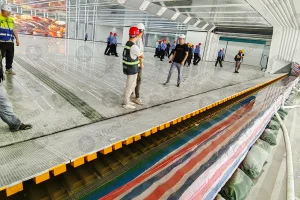
Over the past two decades, China has emerged as the global leader in modern structural manufacturing, industrial metallurgy, and infrastructure hardware. Overseas engineering procurement managers seeking a reliable China Anti Flood Gate Manufacturer gain immense advantages through China’s integrated Industry 4.0 supply chain ecosystem. At Junli Technology’s manufacturing complex in Nanjing, Jiangsu Province, advanced automated manufacturing processes ensure exceptional dimensional accuracy, material traceability, and production throughput.
High-power 12kW fiber laser cutting machines process heavy stainless steel (SS304/SS316) and structural grade aluminum panels with sub-millimeter precision, guaranteeing exact alignment of internal pivot points, sealing tracks, and modular embedment frames.
Robotic TIG/MIG welding cells produce continuous watertight structural welds across barrier chambers. Finite Element Analysis (FEA) software validates stress distribution under maximum hydraulic head pressures, eliminating weld fatigue risks.
Custom-formulated EPDM automotive-grade rubber seals undergo ozone, UV, and salt-spray accelerated aging tests (ASTM G154). The triple-ridge sealing profile prevents fluid migration under both high hydrostatic head and turbulent backwater flows.
International buyers, civil general contractors, EPC firms, and infrastructure asset owners require flexible flood mitigation options adaptable to diverse structural configurations. Below are key commercial and municipal environments where Junli hydrodynamic flood barriers are deployed globally:
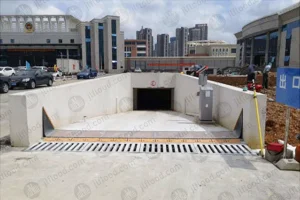
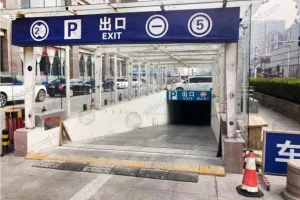
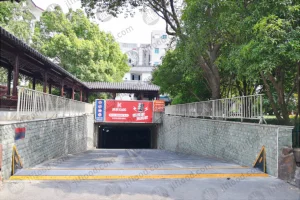
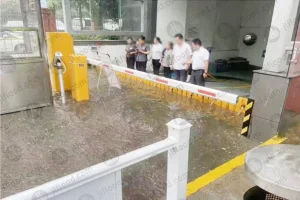
Commercial shopping malls, residential towers, and corporate headquarters feature wide ramp openings vulnerable to surface runoff. Flush-mounted car park barriers withstand continuous heavy vehicular traffic (up to 40-ton axle loads) and deploy automatically when runoff reaches designated depths.
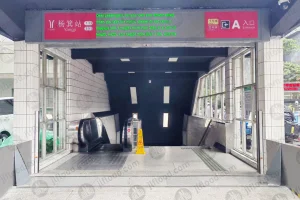
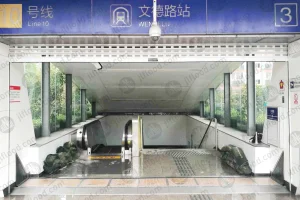
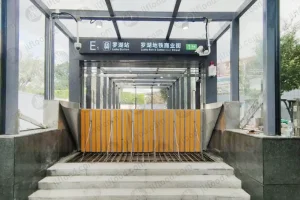
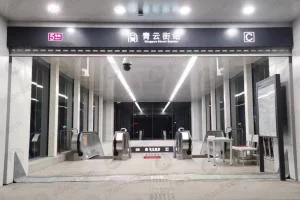
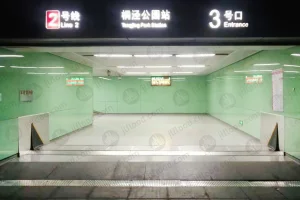
Subway station entrances, pedestrian vent shafts, and subterranean connection passages demand zero-failure flood mitigation. Installed across metro networks in Guangzhou, Suzhou, Beijing, and Dalian, Junli barriers preserve life safety without impeding commuter movement during dry conditions.
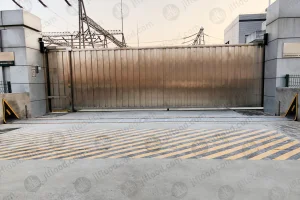
Electrical transmission substations, data centers, and water treatment plants house sensitive high-voltage assets. A single flood event can cause catastrophic short circuits. Perimeter gates and equipment-room barriers isolate electrical vaults from incoming floodwaters.
Review the remaining engineering configurations in our standard product series. Every barrier model can be customized for specific clear span widths, retaining heights, and structural loading classes.

When submitting Request for Quotations (RFQs) to a China Anti Flood Gate Manufacturer, engineering procurement directors must evaluate multiple custom variables beyond basic unit pricing. Junli Technology provides transparent structural estimations calculated against the following primary engineering metrics:
Standard clear spans range from 2.0 meters for single door frames up to multi-leaf modular spans exceeding 20 meters. Standard retention heights range from 0.5m to 2.0m. Larger spans require internal structural ribbing, increasing overall material weight and freight considerations.
Depending on site corrosivity (e.g., coastal marine environments vs. inland urban parking lots), units are fabricated from Marine Grade SS316, Structural SS304, or Anodized High-Yield T6 Aluminum. Corrosion protection treatments directly impact long-term maintenance costs.
Barriers installed across commercial driveways must support heavy surface loads without frame deflection. Specification classes follow AASHTO HS-20 (USA) or EN 124 D400 (EU) standards, requiring reinforced embedment frames and thicker top cover plates.
Here are comprehensive answers to technical questions raised by international engineering consultants, structural specifiers, and procurement managers:


