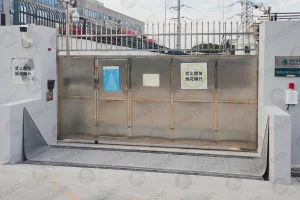
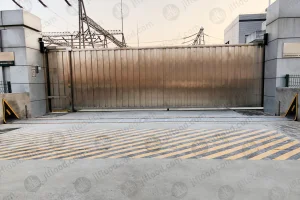
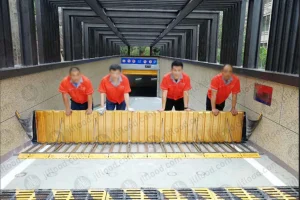
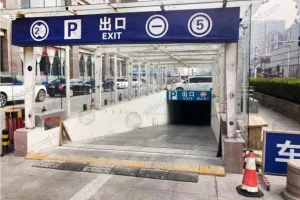
Direct factory supply models engineered for metro entrances, power grid substations, and commercial underground parking facilities.
How severe global climate anomalies and rapid urban densification are driving the global demand for passive, hydrodynamic automatic water-retaining devices.
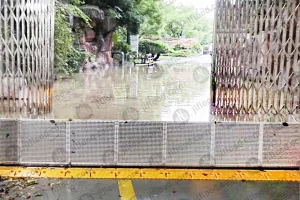
Traditional flood barriers relied on manual labor, sandbag deployment, or electric motor actuators. However, extreme flash flooding frequently triggers power grid blackouts and logistical bottlenecks. Modern municipal specifications demand zero-power hydrodynamic barriers that deploy automatically within seconds when floodwater arrives.
Civil engineering directives across the EU, North America, and Asia-Pacific (such as ASCE 24 and UK Environment Agency guidelines) now require zero-reliance emergency infrastructure. Commercial real estate developers must install certified hydrodynamic self-closing flood gates to secure environmental liability insurance and municipal construction permits.
As urban spatial efficiency modernizes, high-value assets—including traction substations, metro control centers, data centers, and multi-level underground parking ramps—are located below ground level. Single flooding incidents can cause millions of dollars in mechanical equipment destruction and operational downtime.
Exploring the physics of passive hydrostatic fluid pressure, mechanical lever leverage, and resilient polymer sealing systems.
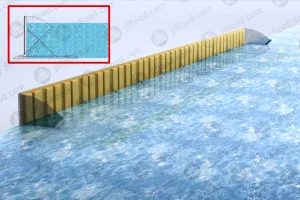
The core technology of China automatic water retaining devices (such as the Junli Hydrodynamic Series) relies on pure fluid dynamics and Archimedes' principle of buoyancy. Unlike electrical sensory gates that can suffer short circuits during severe rainstorms, hydrodynamic barriers operate automatically:
Why premier global EPC contractors, municipal engineers, and commercial developers partner with leading Chinese flood protection manufacturers like Nanjing Junli Technology Co., Ltd.
China accounts for over 50% of the world's primary aluminum extrusion and stainless steel refining capacity. Leading factories in Jiangsu and Yangtze River Delta industrial clusters benefit from direct access to high-grade 6063-T6 aluminum alloys and SUS304/316 sheet metal, dramatically lowering raw material procurement costs while guaranteeing alloy purity.
Modern Chinese suppliers utilize multi-axis CNC laser cutting centers, robotic friction-stir welding systems, and automated surface anodizing lines. This precision manufacturing ensures dimensional tolerances within ±0.5mm across single-span barrier lengths exceeding 6 meters, eliminating field assembly misalignments.
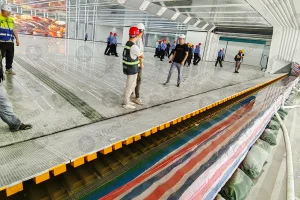
Top-tier suppliers do not rely solely on digital CAD simulations. Facilities feature dedicated hydraulic test basins capable of mounting full-sized automatic flood gates under realistic hydro-head pressure. Every batch undergoes rigorous seal leakage rate verification and mechanical buoyancy acceleration trials prior to export packaging.
Evaluating operational parameters, lifecycle maintenance, total cost of ownership (TCO), and failure points across competing flood barrier designs.
| Evaluation Parameter | Hydrodynamic Auto Gate (Junli Standard) | Motorized / Sensor Gate | Demountable Aluminum Plank | Traditional Sandbag Dike |
|---|---|---|---|---|
| Power Requirement | Zero Power (100% Passive) | AC 220V/380V or UPS Back-up | Zero Power (Manual) | Zero Power (Manual) |
| Deployment Response Time | Immediate (< 3 Seconds) | 30 - 90 Seconds | 1 - 3 Hours (Labor Required) | 4 - 12 Hours (Heavy Labor) |
| Human Reliability Risk | Zero (Fully Autonomous) | Low (Depends on Sensor/Grid) | High (Must be installed on site) | Extreme (Subject to human error) |
| Traffic Crossing Capability | Flush Ramp (Up to 40T Axle) | Flush Ramp or Overhead Arch | Blocked during deployment | Completely blocked |
| Initial Capital Expenditure (CapEx) | Moderate - OEM Direct Value | High (Motors, Controls, Wiring) | Low - Moderate | Very Low initial cost |
| Lifecycle Maintenance (OpEx) | Minimal (Annual Basin Flush) | High (Motor/Battery/Sensor tests) | Low (Storage & seal check) | Extreme (Single-use disposal) |
| Design Service Life | 20 - 30 Years | 8 - 12 Years (Electronics wear) | 10 - 15 Years | Single Emergency Event |
Tailoring hydrodynamic barrier frame geometry and mounting methods to key urban infrastructure configurations.
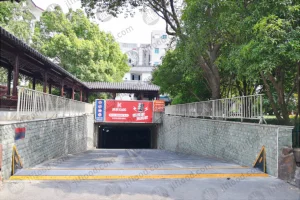
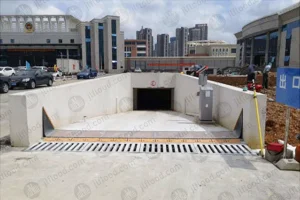
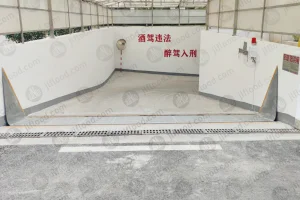
Installed flush at residential, commercial, and hospital garage entry ramps. Engineered to withstand heavy continuous vehicle passage. Rises dynamically when storm runoff pours down the ramp gradient, preventing subterranean vehicular drowning.
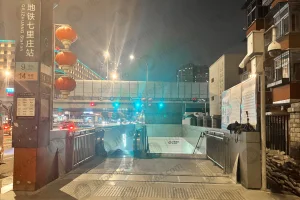
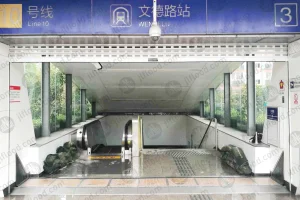
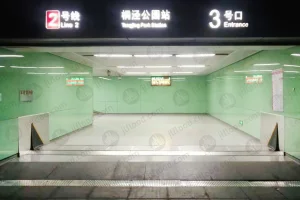
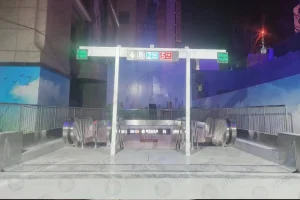
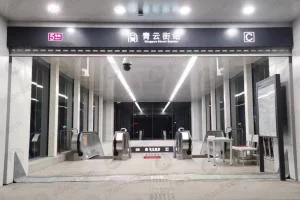
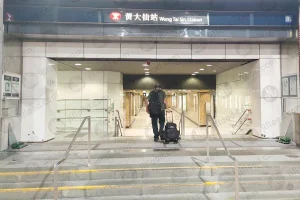
Surface-mounted or embedded barrier modules tailored for metro station pedestrian steps, connection channels, and ventilation shafts. Validated in high-density subway lines including Guangzhou, Beijing, Dalian, and Hong Kong MRT systems.
Critical grid equipment protection at 110kV / 220kV power transformer doors, switchgear rooms, and perimeter gates. Prevents catastrophic short-circuit blackouts caused by urban waterlogging without requiring electrical control power.
Perimeter protection for chemical plants, logistics warehouses, and pharmaceutical facilities. Retains toxic chemical spills internally while sealing against external storm surges, guaranteeing environmental compliance.
Key engineering variables and customized manufacturing parameters that govern factory quotes and bulk project pricelists.
When requesting a formal quotation and engineering design packet from Chinese manufacturers, prospective buyers should provide the following baseline project site parameters:
              [Project Specs Checklist]

              1. Opening Width (mm) & Height (mm)

              2. Vehicle Crossing Profile (Pedestrian / Light Car / Heavy Truck)

              3. Civil Interface (Concrete / Steel Structure / Existing Asphalt)

              4. Expected Delivery Lead Time & Incoterms (FOB / CIF / DDP)
Nanjing Junli Technology Co., Ltd. provides full CAD embedment drawings, 3D structural simulation analysis (FEA), and English installation procedures with every B2B RFP response.
Detailed technical clarifications on installation, maintenance, reliability, and global shipment logistics.
The hydrodynamic flood gate is housed flush inside a recessed foundation pit. When floodwater reaches the entrance, water flows into the chamber through bottom inlet grates. The engineered hollow aluminum panel generates buoyant force, lifting the gate automatically. As water pressure increases, it presses the door against dual EPDM rubber seals, forming a tight water-retaining wall without requiring power supplies, sensory wiring, or human operators.
Yes. Heavy-duty models (such as the Hm4d-0006 series) are specifically structural-rated for heavy traffic loading. Constructed from high-tensile 6063-T6 extruded aluminum with internal vertical load ribs, the flush top panel safely supports passenger cars, delivery trucks, and emergency vehicles up to 40 tons axle weight without structural deflection.
Because hydrodynamic systems contain no complex electrical motors, maintenance is minimal. A quarterly visual inspection to clear sediment, leaves, or municipal debris from the bottom recessed drainage channel is recommended. Seals should be inspected annually and lubricated with silicone grease. The robust materials ensure a design service lifespan of over 20 to 30 years.
Standard OEM models require approximately 15 to 20 business days for manufacturing and factory water-pool seal testing. Custom structural spans or specialized color finishes typically take 25 to 30 days. Shipments are packaged in steel-reinforced export wooden crates to prevent bending during ocean container transport.
Advanced automatic flood control barriers designed for severe storm conditions, metro channels, and infrastructure assets.