Explore China’s leading engineered flood defense solutions deployed across municipal metro networks, high-voltage transformer stations, and commercial underground parking facilities.
As climate change accelerates extreme weather events and urban flash flooding, municipal planners, structural engineers, and asset managers worldwide face unprecedented risks to subterranean infrastructure. Traditional manual sandbags and motorized flood barriers fail precisely when extreme storms strike due to delayed human reaction times and regional grid power blackouts.
Leading China flood barrier manufacturers and suppliers like Nanjing Junli Technology Co., Ltd. have revolutionized global water mitigation by commercializing non-powered, hydrodynamic automatic flood protection systems. Operating purely on hydro-buoyancy and hydrostatic pressure principles, these automatic gates deploy in seconds without human intervention, electricity, or electronic sensors.
This comprehensive whitepaper outlines the structural physics, finite element analysis (FEA), material science, and manufacturing protocols governing modern flood barrier production in China. Built upon extensive real-world field data from metro rail networks (Guangzhou, Dalian, Suzhou, Beijing), high-voltage electric substations, and deep underground garages, this document provides international procurement teams with the precise metrics required for rigorous tenders.
The fundamental limitation of legacy active flood barriers—such as hydraulic flip-up gates or electrically driven drop-down doors—is their reliance on external power grids, emergency generators, moisture sensors, and manual operators. During cataclysmic cloudbursts, power substations are frequently the first assets to fail, rendering electrical gates completely useless.
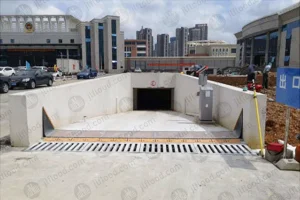
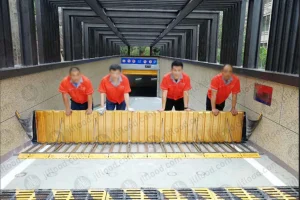
The system features a flush-mounted structural steel or high-grade aluminum frame recessed directly into the pavement or threshold. When no water is present, the heavy-duty barrier panel rests completely flat inside the bottom basin, allowing heavy vehicular traffic (up to 50 tons) and pedestrian movement to cross seamlessly without obstruction.
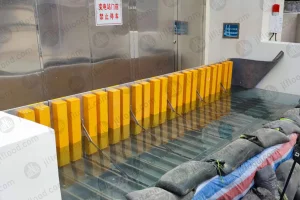
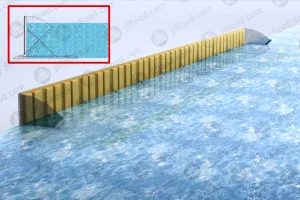
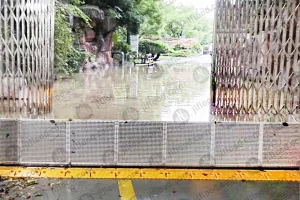
As flash floodwater arrives at the entrance, water naturally flows through front intake grilles into the bottom basin. Internal buoyant chamber geometry—engineered using closed-cell marine-grade polyurethane density matrices—generates instantaneous upward hydro-buoyancy, rotating the panel upward on precision stainless steel pivot hinges.
As incoming water depth rises against the barrier leaf, rising hydrostatic pressure pushes the door panel firmly against vertical side frame seals. The hydrostatic force acts proportionally to the flood height: the higher the floodwater, the tighter the dual-lip EPDM seals compress, guaranteeing a near-zero leakage rate.
Chinese manufacturers customize flood barrier structural configurations based on localized dynamic water heads, structural foundation capacities, and operational traffic demands.
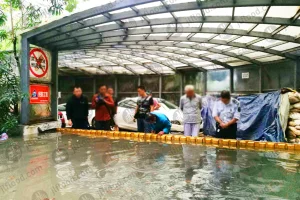
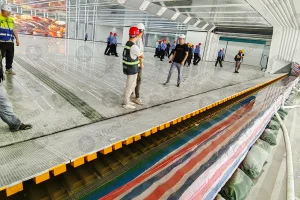
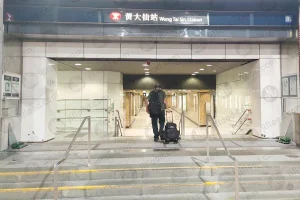
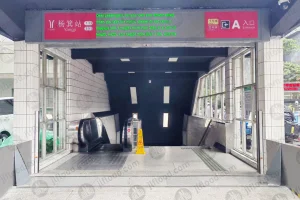
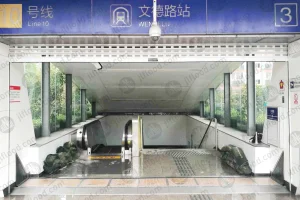
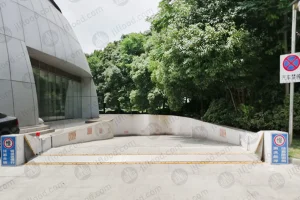
Subway entrances and pedestrian connection channels demand high structural rigidity, low maintenance, and rapid modular installation. Embedded surface-type gates (e.g., Hm4d and Hm4e series) installed at Guangzhou and Dalian Metro stations feature low-profile thresholds that comply with ADA accessibility guidelines while providing up to 1.5m retained water height during severe typhoons.
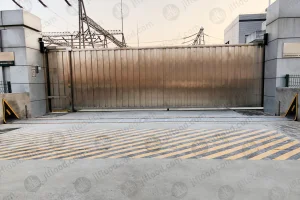
High-voltage substations contain sensitive electrical transformers where water ingress causes catastrophic regional blackout failures. Substation flood barriers are constructed with anti-corrosive stainless steel 304/316 and dielectric isolation interfaces, sealing perimeter access gates and cable trench doors against severe rain runoff.
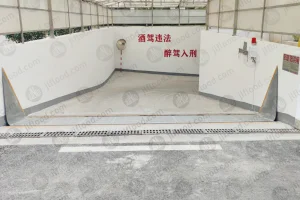
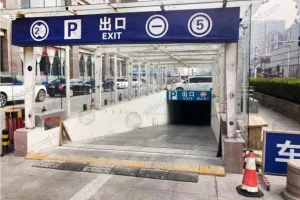
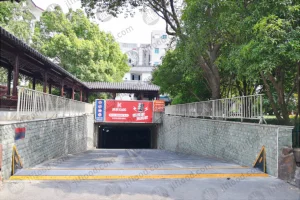
Underground parking ramps at commercial shopping plazas and residential towers require extra-wide clear spans (6m to over 20m). Heavy-duty flip-up and hydrodynamic self-closing barriers feature reinforced structural ribs capable of supporting continuous heavy commercial vehicle traffic without structural fatigue or alignment drift.
Underground pedestrian crossings, utility tunnels, airport landside passages, and civil defense facilities utilize modular automatic flood barriers engineered to resist continuous hydrostatic head pressure, impact from floating urban debris, and high dynamic wave loadings generated by nearby vehicular movement during heavy storms.
China’s manufacturing ecosystem for structural flood control equipment combines mature metallurgical supply chains, automated precision machining, and rigorous hydro-testing protocols. As a primary global manufacturing hub, Nanjing Junli Technology Co., Ltd. leverage advanced Industry 4.0 production capabilities to deliver certified flood gates at unmatched scale and cost efficiency.
Utilizing multi-kilowatt fiber laser cutting systems and high-precision CNC press brakes, custom gate components achieve dimensional tolerances within ±0.5mm. This ensures perfect seal seat alignment and zero mechanical binding during automatic deployment.
Structural aluminum alloys (6063-T6 / 6061-T6) and stainless steel frames undergo automated robotic MIG/TIG welding. Continuous full-penetration seams eliminate structural porosity, preventing water seepage under high hydrostatic loads.
Unlike trading companies, dedicated Chinese factories test 100% of barrier model designs in full-scale water testing pools. Each unit undergoes full head static pressure tests, dynamic wave impact testing, and automated deployment speed verification prior to export dispatch.
The flood defense industry is shifting from static containment barriers toward intelligent, self-reporting cyber-physical flood protection ecosystems. Strategic R&D roadmaps from top Chinese manufacturers focus on integrating smart sensing networks with non-powered mechanical reliability.
Future flood barriers incorporate ultra-low-power NB-IoT and LoRaWAN wireless telemetry sensors. While the barrier continues to deploy passively via water buoyancy, embedded micro-sensors transmit real-time deployment status, water level data, and structural displacement alerts directly to municipal Smart City SCADA command centers.
Next-generation seal manufacturing incorporates self-healing elastomers and fluorine-doped EPDM nanocomposites. These advanced materials resist UV degradation, thermal cracking (-40°C to +90°C), aggressive industrial chemical runoffs, and ozone exposure, extending seal maintenance intervals to over 15 years.
R&D initiatives are introducing carbon-fiber reinforced polymer (CFRP) composite door panels. CFRP construction reduces overall panel moving mass by 45% while doubling tensile yield strength, enabling ultra-fast hydro-buoyancy trigger times during sudden flash floods.
Procuring critical life-safety infrastructure hardware from overseas requires absolute compliance with localized civil engineering building codes, hydraulic testing standards, and site-specific installation guidelines.
China’s top-tier automatic flood gates are engineered to meet or exceed global performance metrics, including FM Approvals Class 2510 (Flood Abatement Equipment), BS PAS 1188-1 (Flood Protection Products), ASTM F3057 (Standard Test Method for Water Penetration of Flood Barriers), and EU CE Machinery Directives.
Engineering support teams supply complete 3D BIM models (Revit, IFC) and 2D CAD architectural detail drawings. Foreign contractors receive precise embedded frame concrete anchor schedules, rebar clearance notes, and localized slope drainage channel specifications prior to shipment delivery.
Comprehensive English installation manuals, step-by-step video installation guides, and remote technical video commissioning support are provided with every order. Standardized OEM replacement seal kits and mechanical hinge overhaul sets are archived for 20-year guaranteed availability.
When sourcing flood barriers from China, international EPC contractors and municipal purchasing agents must evaluate suppliers across four critical technical metrics:
Ensure the embedded frame and surface top plate are rated for site-specific traffic. Ramp installations require minimum heavy vehicle wheel load ratings (e.g., AASHTO HS-20 / HS-25 or Chinese Grade-A vehicle load standards up to 50 tons).
Verify factory water test certificates. Leading hydrodynamic barriers achieve leakage rates below 0.5 liters/hour per meter of perimeter seal length under full hydrostatic head height—significantly outperforming traditional manual modular aluminum stoplogs.
For coastal or high-salinity urban environments, specify anodized aluminum profiles (thickness ≥25µm) or 316 stainless steel housings finished with fluorocarbon (PVDF) powder coating to withstand de-icing salts and coastal ocean spray.
Non-powered hydrodynamic flood barriers dramatically reduce long-term TCO compared to motorized electric gates. By eliminating annual electrical motor inspections, backup battery system replacements, sensor recalibrations, and 24/7 emergency staffing costs, passive gates deliver a full return on investment (ROI) within the first flood event.
Review specialized surface-mounted, flip-up, and metro-grade flood barrier models manufactured in China for OEM and global project distribution.
Protect your subterranean assets with field-proven, non-powered hydrodynamic flood gate engineering. Contact our Nanjing engineering team today to submit site opening dimensions, request customized CAD embedment drawings, or obtain certified factory water test documentation.