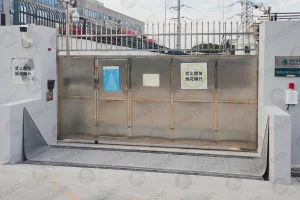
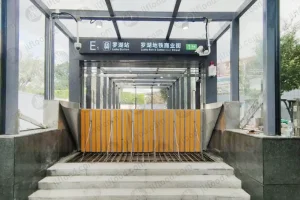
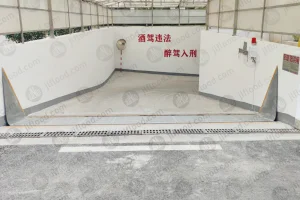
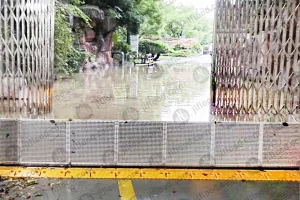
Field-proven automatic and modular flood protection barriers manufactured for rapid global deployment and infrastructure defense.
A comprehensive analysis of how passive, hydrodynamic flood barrier systems are replacing legacy manual and electric barriers in global civil protection projects.
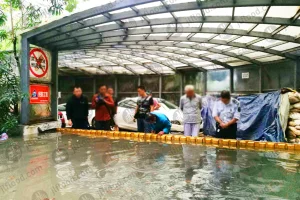
Urban flooding caused by cloudbursts, severe typhoons, and storm surges poses an existential threat to underground infrastructure, rail transit networks, electrical substations, and commercial basements worldwide. Traditional flood mitigation strategies—such as manual sandbag deployment, temporary aluminum stop-logs, and electrically powered flood gates—fail repeatedly during catastrophic events due to human delay, operational blackout, motor submersion, or power grid failure.
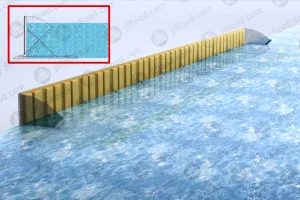
As municipal authorities and private developers pivot toward climate-resilient civil design, China has emerged as the global epicenter for the R&D and industrial manufacturing of hydrodynamic automatic flood gates. Engineering innovations led by specialized manufacturers such as Nanjing Junli Technology Co., Ltd. have pioneered buoyancy-driven water control barriers that operate entirely without human intervention, electricity, or sensors.
This technical whitepaper provides EPC contractors, civil structural engineers, municipal procurement officers, and architectural specifiers with a thorough evaluation of Chinese flood defense manufacturing capabilities, regulatory compliance frameworks, hydraulic engineering mechanics, and global supply chain integration.
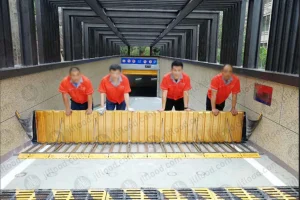
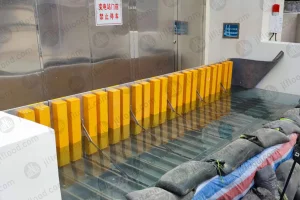
Transitioning from active motorized systems to self-rising hydrodynamic gates eliminates single points of failure like power outage, control board shorting, or delayed staffing.
Increasing subterranean utilization in mega-cities requires flush-mounted embedded barriers capable of withstanding heavy vehicular loads while remaining ready for instant deployment.
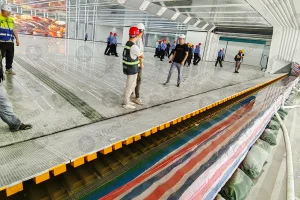
Standardized stainless steel and aviation-grade aluminum modules enable continuous spans exceeding 20 meters without compromising structural rigidity or sealing integrity.
How the Yangtze River Delta industrial hub delivers unprecedented cost efficiency, material precision, and production throughput for global infrastructure.
China's flood control manufacturing sector, centered in advanced industrial cities like Nanjing, leverages an end-to-end supply chain integration that is unmatched globally. From raw metallurgical processing to precision hydraulic testing, domestic suppliers access high-grade Q355B structural steel, marine-grade 304/316L stainless steel, and specialized EPDM vulcanized sealing profiles directly from regional suppliers.
| Engineering Metric | China Advanced OEM Supplier (e.g., Junli) | Traditional Western Competitors | Impact on Global Procurement |
|---|---|---|---|
| Lead Time for Custom Spans | 2 to 4 Weeks | 10 to 16 Weeks | 70% reduction in project schedule risk |
| Structural Material Options | 6063-T6 Al-Mg Alloy / 316L Stainless Steel | Standard Extruded Aluminum Only | Superior corrosion resistance & yield strength |
| Pre-Shipment Verification | 100% Full-Scale Pool Hydrodynamic Test | Theoretical Computer Simulation Only | Guaranteed zero site leakage upon installation |
| Capital Expenditure (CAPEX) | Direct Factory Wholesale Pricing | High Overhead & Tier-3 Distributor Markup | 35% to 50% overall cost savings |
Furthermore, Chinese engineering facilities utilize 12,000W fiber laser cutting systems, automated multi-axis robotic welding cells, and finite element analysis (FEA) software to model panel deflection under extreme hydrostatic pressure head prior to manufacturing.
In-house hydro-testing basins allow real water pressure validation up to 2.0m retaining height, generating empirical leakage rate certifications per order.
Engineers adapt frame embedment depths, lip-seal durometers, and surface load ratings (up to AASHTO HS-20 / EN 124 D400) to meet localized civil codes.
Export packaging features heavy-duty steel crates, anti-corrosion barrier wrapping, and pre-sorted anchoring hardware for smooth international transit.
Addressing the technical, structural, and contractual standards demanded by international EPC contractors and municipal clients.
When issuing Requests for Quotation (RFQs) or drafting technical specifications for major flood control installations, global engineering firms require precise mathematical, structural, and mechanical guarantees. Suppliers must demonstrate non-compromising performance across key structural criteria:
Chinese direct-factory suppliers provide global buyers with comprehensive BIM (Building Information Modeling) objects, CAD detail drawings (DWG/STEP formats), structural stress calculation sheets, and bilingual installation manuals to streamline project submittals.
Custom-engineered flood protection deployments across critical urban assets, public transit networks, and high-value energy facilities.
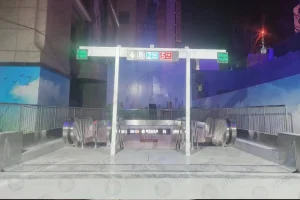
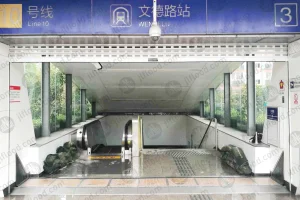
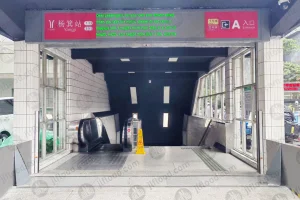
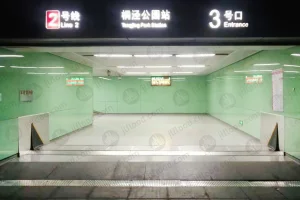
Station portals, emergency escape stairwells, and underground mall connection channels require total flood exclusion. Field-proven installations at Guangzhou Metro, Beijing Metro, Suzhou Metro, and Dalian Metro safeguard millions of commuters daily.
Transformer rooms, high-voltage switchgear buildings, and cable trenches require non-electric automatic flood barriers. Substation perimeter installations in Jiangsu and Beijing prevent regional grid blackouts during cloudburst events.
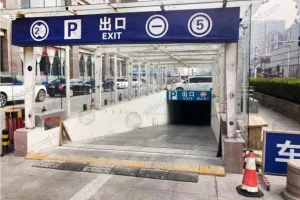
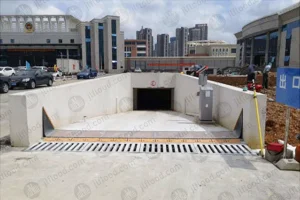
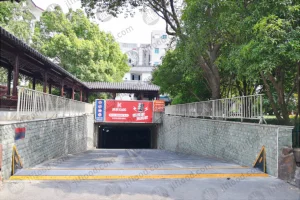
Shopping mall car parks (e.g., Wanda Plaza) and hospital subterranean parking ramps utilize low-profile surface-mounted or embedded hydrodynamic barriers that allow daily vehicular ingress while providing automatic flood protection during flash floods.
Watch full-scale water retaining tests and automated self-rising barrier mechanics in our state-of-the-art testing facility:
Adhering to international engineering standards, civil construction codes, and comprehensive lifecycle support.
Leading Chinese flood barrier manufacturers operate under stringent quality management systems to meet global procurement prerequisites. Factory acceptance testing (FAT) and site acceptance testing (SAT) protocols align with major global building norms:
Supply of detailed civil interface drawings, embedded frame recess dimensions, and concrete pouring anchor specs to site contractors.
Technical support via video commissioning, English technical manuals, spare part kits, and online engineering consultation.
Designed for minimal upkeep; simple semi-annual debris clearance of intake troughs and routine visual inspection of EPDM seals.
In-depth responses to engineering, hydraulic, procurement, and installation queries.
Complete product listings with direct wholesale pricing access and engineering specs.