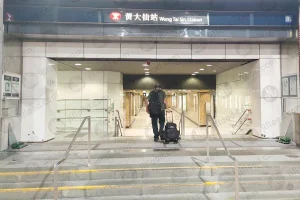
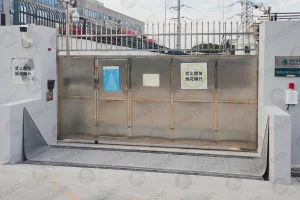
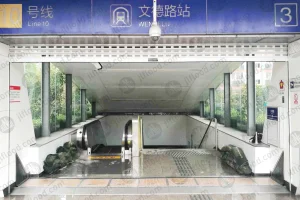
Explore field-tested automatic flood barriers engineered for residential entrances, subway stations, and utility substations.

As extreme weather events become increasingly unpredictable and severe due to global climate shifts, civil engineers, municipal authorities, estate managers, and industrial facility owners face an unprecedented challenge: protecting critical underground assets against catastrophic urban waterlogging. Traditional flood defense methods—such as sandbag stacking, manual modular flood boards, and electrically powered flood gates—are failing at an alarming rate during severe cloudbursts, typhoons, and flash floods.
The core vulnerability of legacy systems lies in their dependency on human intervention and grid electricity. When extreme storms hit, power grids often trip, emergency personnel are delayed by traffic or hazardous conditions, and manual barriers cannot be deployed in time. This structural weakness has sparked a worldwide technological transition toward Hydrodynamic Automatic Passive Flood Barriers.
Nanjing Junli Technology Co., Ltd. stands at the forefront of this industrial revolution. Situated in Nanjing, Jiangsu Province, Junli Technology operates a state-of-the-art research and manufacturing complex dedicated to engineering high-precision floodgates for residential homes ("Floodgate for Home"), commercial underground garages, urban rail transit (Metro systems), and high-voltage power substations. Sourcing flood barrier products directly from China's premier direct-factory manufacturer provides global B2B buyers, architectural consultants, and EPC contractors with superior cost efficiencies, world-class engineering compliance, and tailored OEM customization.
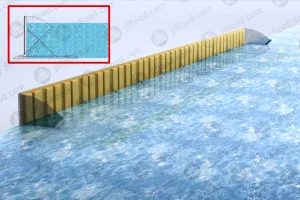
The fundamental principle behind Junli's zero-power automatic flood barriers is pure hydrodynamics and hydrostatic buoyancy. Unlike electrical or pneumatic systems that require complex sensors, wiring, motors, and back-up generators, Junli's passive automatic flood barrier utilizes incoming floodwater itself as the sole driving force for deployment.
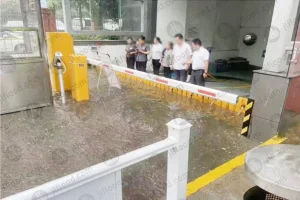
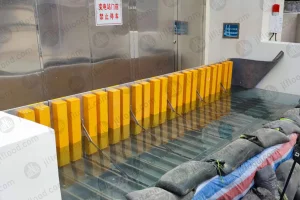
As surface runoff flows toward the barrier, it fills the recessed stainless steel ground basin. Built-in buoyancy chambers within the high-density aluminum alloy door panel immediately generate upward force, causing the gate leaf to lift automatically within seconds of water contact.
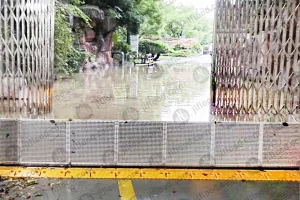
As the retained water level rises, hydrostatic lateral pressure forces the barrier panel against the resilient EPDM side and bottom seals. The higher the floodwater level, the tighter the compression seal, guaranteeing near-zero leakage (< 0.05 L/hr/m span).
Once storm floodwaters recede and the ground basin drains through integrated non-return drainage channels, the barrier panel smoothly descends back into its flush ground frame under gravitational force, restoring full vehicular or pedestrian traffic access.
To ensure structural durability in harsh coastal, industrial, and urban environments, Junli Technology manufactures every component to rigorous structural engineering standards:
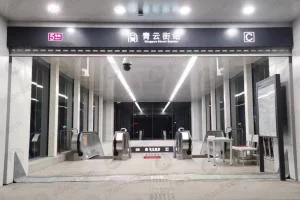
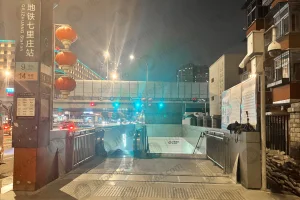
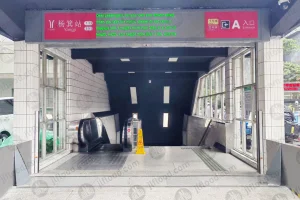
Whether protecting private villas or high-volume metro transit systems, flood control requirements vary significantly based on spatial geometry, water head pressure, and site traffic flow. Junli Technology provides targeted engineering solutions across four core macro sectors:
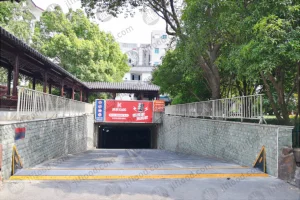
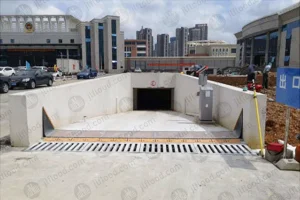
Target Entrances: Underground private garage ramps, driveway entrances, basement walk-out stairs, and residential courtyard gates.
Flush ground mounting allows homeowners to drive vehicles smoothly over the gate every day. During sudden midnight cloudbursts, the home floodgate rises passively, preventing multimillion-dollar water damage to home foundations, vehicles, and subterranean electrical systems.
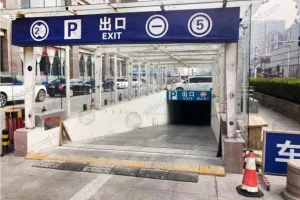
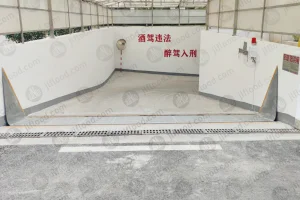
Target Entrances: Shopping mall car parks, office tower subterranean parking, hospital ambulance bays, and logistics warehouse loading docks.
Supports wide multi-panel span arrays exceeding 20 meters in width with continuous inter-panel seals, guaranteeing complete perimeter protection against extreme urban waterlogging.
Target Entrances: 110kV/220kV/500kV power substation perimeter gates, transformer room doorways, and cable trench access points.
Prevents water ingress that could cause catastrophic electrical short-circuits, explosion hazards, and widespread urban power blackouts. Operates flawlessly without requiring electrical power from the grid.
To assist procurement officers, architectural consultants, and civil engineers in making informed technical decisions, the following matrix compares Junli Hydrodynamic Automatic Passive Barriers against conventional market alternatives:
| Performance / Spec Metric | Junli Hydrodynamic Passive Gate | Manual Aluminum Stop-Logs | Electric Motorized Flood Gates | Pneumatic Inflatable Barriers |
|---|---|---|---|---|
| Power Requirement | 0 Watts (100% Water-Powered) | 0 Watts (Manual Deployment) | High (Requires AC Grid / Backup UPS) | High (Requires Air Compressor & Grid) |
| Human Deployment Needed | Zero (Fully Automatic) | Extensive (Requires On-Site Team) | Low (Remote / Sensor Triggered) | Low (Control Panel Triggered) |
| Blackout Reliability | 100% Immunity | 100% (If labor arrives in time) | High Risk (Failures during power trip) | Medium Risk (Pneumatic valve failure) |
| Response Speed | Immediate (< 0.1s Trigger) | Slow (30 - 120 minutes) | Moderate (30 - 90 seconds) | Moderate (60 - 180 seconds) |
| Traffic Impact | Zero (Flush-Mounted Underground) | High (Requires manual placement) | Low (Overhead or side recess) | Low (Surface bump or shallow recess) |
| Maintenance Cost | Minimal (Visual check & basin clean) | Low (Storage management) | High (Motor, wiring & PLC service) | High (Air pump & membrane checks) |
| Service Life | 25+ Years | 10 - 15 Years | 8 - 12 Years | 5 - 8 Years (Rubber degradation) |
Nanjing Junli Technology operates under strict international quality management standards. To ensure that every flood gate shipped overseas satisfies localized structural and civil engineering codes, Junli enforces a comprehensive multi-stage Quality Assurance (QA) protocol.
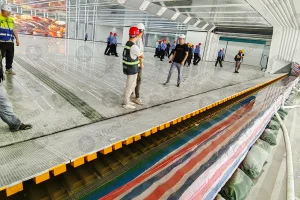
Every custom-manufactured floodgate undergoes full-scale hydro-testing in Junli's dedicated in-house water pool. We measure and record buoyancy lifting velocity, dynamic seal tightness, and deflection under maximum design water head pressure before dispatching products to global clients.
Our manufacturing processes and product designs strictly align with ISO 9001:2015 (Quality Management), ISO 14001 (Environmental Management), ISO 45001 (Occupational Health & Safety), and European Standard EN 13564 for anti-flooding devices.
We provide global engineering partners with complete Civil Works Drawing Sets, embedded steel frame positioning templates, concrete rebar clearance notes, and CAD/BIM models for seamless integration into architectural designs.
As smart cities evolve, passive flood barriers are transforming into intelligent, connected infrastructure assets. Junli Technology's R&D division in Nanjing is actively pioneering several groundbreaking innovations:
Integrating ultra-low-power LoRaWAN and NB-IoT wireless sensors inside the foundation basin to transmit real-time telemetry to city emergency command systems, notifying municipal operators the millisecond a barrier rises.
Developing next-generation elastomeric seals embedded with micro-encapsulated hydrophobic polymer agents that automatically fill minor micro-abrasions caused by gravel or sharp sand during flood deployment.
Engineered for extreme openings (>30 meters width), combining pure passive buoyancy triggering with redundant hydraulic dampening systems to prevent rapid panel bouncing during heavy ocean storm surges.
Direct technical answers addressing procurement, installation, and performance inquiries.
Junli's hydrodynamic automatic flood barriers are 100% power-free. They operate entirely through mechanical hydrodynamics and buoyancy. Rising surface water fills the ground foundation basin, lifting the hollow aluminum panel automatically. No electrical motors, sensors, wiring, or backup power generators are involved, ensuring 100% operational reliability during power outages.
Yes. When resting in its default flat position, the barrier panel sits completely flush inside a high-strength stainless steel ground frame. Designed using Finite Element Analysis (FEA), our residential and industrial ramp barriers support vehicle axle loads up to 40–60 tons, easily accommodating heavy fire trucks, delivery vehicles, and daily car traffic.
For embedded barriers, the site requires a recessed concrete foundation trench with an integrated drainage outlet to connect to the building's storm drain system. Junli provides full engineering support, including embedded steel frame assembly templates, rebar clearance schematics, and step-by-step pouring guides for local civil contractors.
Our ground basins are equipped with removable stainless steel sediment filter grates that prevent large leaves, trash, and stones from entering the dynamic chamber. Additionally, flexible bottom wipers push fine silt out during the draining process, ensuring smooth panel retraction after floodwaters recede.
Standard single-panel retaining heights range from 0.5 meters (20 inches) up to 2.0 meters (78 inches). Clear spans can be customized from single residential doorways (1.2 meters wide) up to multi-leaf modular arrays covering wide driveway ramps over 30 meters wide.
Yes. As a primary direct-factory manufacturer in China, Junli Technology regularly exports worldwide. We provide custom OEM/ODM production, private labeling, custom dimensional engineering, export-compliant wooden crate packaging, and comprehensive English documentation (manuals, test reports, and CAD drawings).
Consult with Nanjing Junli Technology's engineering specialists to receive custom CAD drawings, civil works layout proposals, and factory-direct price estimates within 24 hours.
Contact Our Engineering TeamExplore our full line of flip-up, surface-mounted, and embedded flood mitigation gates.