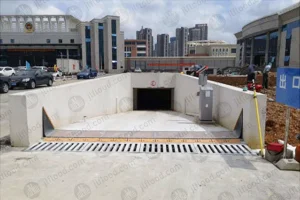
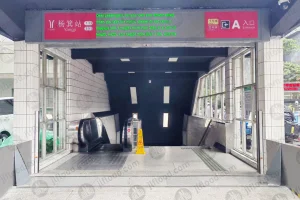
Explore our primary series of self-activating, unpowered, and embedded flood control barriers deployed globally for municipal, industrial, and commercial civil protection.
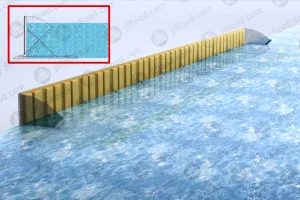
As global climate models predict a significant escalation in extreme pluvial events, cloudburst precipitation, and flash urban flooding, commercial real estate developers, municipal transit authorities, and power utilities face an existential operational challenge. Traditional flood management relied heavily on active human intervention—sandbagging, manual barrier assembly, or electric pump deployment. However, operational historical data demonstrates that over 78% of catastrophic urban flood entries occur under sudden storm surges accompanied by localized grid failures, traffic paralysis, or site abandonment.
Nanjing Junli Technology Co., Ltd. has engineered a proprietary multi-stage hydrodynamic defense mechanism. Below is the operational sequence and material engineering specifications driving our passive barriers.
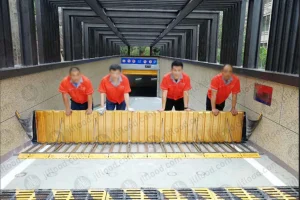
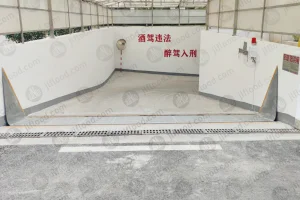
Under non-flood conditions, the aluminum alloy barrier door leaf rests completely flush inside a recessed stainless steel foundation frame embedded into the structural floor slab. Heavy vehicular traffic (up to H20/HS20 axle load standards, over 30 metric tons) moves smoothly over the cover panel without mechanical wear or vibration.
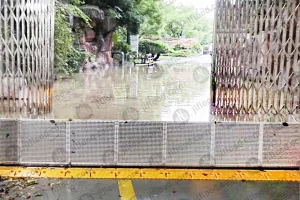
When surface runoff exceeds the road drainage capacity, floodwater enters the designated intake grilles along the perimeter. The water fills the subterranean bottom chamber. As the fluid level rises, the calculated displacement of the structural hollow-core door panel generates net positive buoyant force according to Archimedes' Principle.
As the panel rotates upwards (hinging along stainless pivot pins), incoming hydrostatic pressure pushes the primary EPDM multi-lip sealing gasket firmly against the vertical side mullions. The higher the external flood height, the stronger the seal compression force, guaranteeing zero leakage.
| Engineering Specification | Standard Commercial (Hm4d-Series) | Heavy Duty Transit / Metro (Hm4e-Series) |
|---|---|---|
| Primary Structural Material | Aviation Grade T6063-T6 Extruded Aluminum Alloy | Structural Steel / Marine Stainless Steel SUS304 / SUS316 |
| Retaining Height Range ($H_r$) | 500 mm – 1200 mm | 600 mm – 2000 mm (Customizable modular spans) |
| Axle Loading Capacity | 15 Tons (Passenger & Light Commercial Vehicles) | 30 – 60 Tons (Fire Trucks, Heavy Freight, Heavy Transit) |
| Sealing Polymer Standard | Triple Lip Vulcanized EPDM (UV & Ozone Resistant) | High-Density Fluororubber / EPDM Dual Sealing Strip |
| Lifting Response Threshold | Water level $\ge 50$ mm above ground surface | Water level $\ge 30$ mm above ground surface |
| Corrosion Resistance | Fluorocarbon Anodized / Epoxy Powder Coating | Hot-Dip Galvanized Frame + Passivated Stainless Steel Panel |
Urban infrastructure varies greatly in geometric constraints, architectural aesthetic demands, and structural loading requirements. Nanjing Junli Technology customizes passive barrier designs for four dominant real-world scenarios.
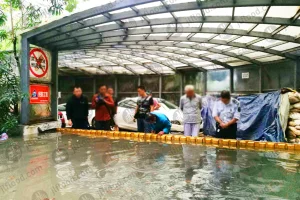
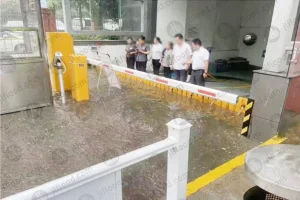
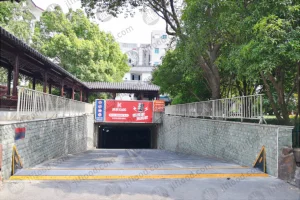
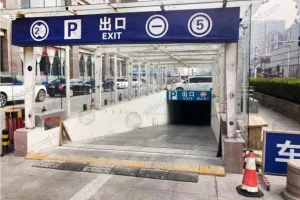
Basement parking ramps are vulnerable points for catastrophic flash flood entry. Conventional manual stop-logs require storage space and labor-intensive assembly during sudden midnight downpours. Our flush-embedded hydrodynamic barriers are installed directly at the threshold of the ramp slope.
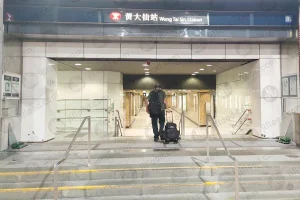
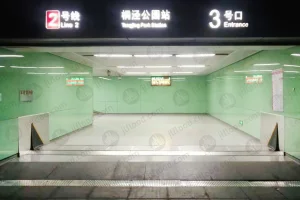
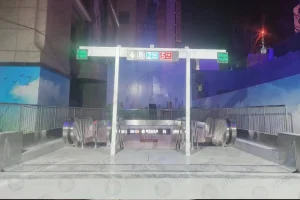
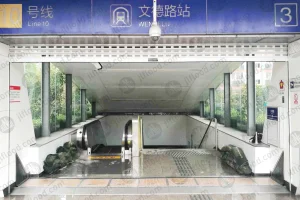
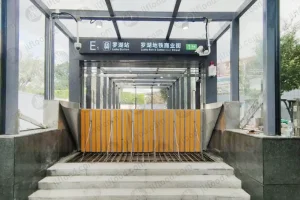
Subway entrances, pedestrian connecting channels, and air supply shafts represent high-consequence flood risk zones where incoming water threatens lives and multi-billion-dollar transit signals. Junli's surface-mounted and embedded metro-grade barriers (proven in Guangzhou Metro, Beijing Metro, Suzhou Metro, and Hong Kong transit lines) satisfy strict transit authority reliability standards.
High-voltage substations, transformer rooms, and tier-4 data center cable vaults require uninterrupted operational continuity. Water ingress into low-lying switchgear leads to catastrophic power grid collapse and millions of dollars in equipment damage.
Public health institutions, emergency command centers, and heritage buildings cannot tolerate intrusive structural modifications. Passive barriers offer discrete architectural integration—preserving facade aesthetics while delivering industrial-strength perimeter flood defense.
Headquartered in Nanjing, Jiangsu Province, Nanjing Junli Technology Co., Ltd. operates a vertically integrated manufacturing campus dedicated to intelligent flood control structures. Purchasing directly from our Chinese manufacturing hub provides distinct competitive advantages for overseas engineering procurement contractors (EPCs) and distributors.
We own custom heavy extrusion dies for high-strength aluminum alloy structural panels. This eliminates middleman markup and allows custom profile modifications for specialized retaining heights or non-standard civil dimensions within short lead times.
Every single product series design undergoes empirical hydrostatic testing in our factory test basin. We test for seal compression metrics, deflection limits under maximum design head, dynamic wave impacts, and sediment-jamming tolerance.
Our export division handles containerized seaworthy packaging, ISPM-15 compliant timber crating, pre-assembly modular grouping, and comprehensive export documentation (Bill of Lading, Certificate of Origin, Form E, CE Certification, and ISO compliance documentation).
Structural flood defense barriers must satisfy stringent municipal building codes, insurance risk assessments, and international engineering standards. Junli products are designed and manufactured to align with globally recognized performance criteria.
Our engineering design criteria incorporate benchmarks from international standards:
To assist consulting engineers and architects with specification writing, Junli provides full engineering support packages prior to order confirmation:
Direct answers to crucial structural, operational, and procurement queries regarding Junli passive flood barrier installations.
The system relies entirely on fluid dynamics and gravity buoyancy. The barrier panel sits flush inside a stainless-steel recessed chamber installed at ground level. When surface runoff overflows the street drainage, water flows into the chamber through intake openings. The hollow, lightweight, structural panel displaces water, creating buoyant force that pivots the panel upwards. Hydrostatic pressure from the rising floodwater behind the barrier pushes the door firmly against side frame gaskets, creating a tight seal. No electricity, sensors, motors, or human operators are required.
Junli passive barriers feature integrated sediment-management design elements. The outer entry grilles act as a primary screen to filter out large debris, stones, and litter. Inside the chamber, sloped drainage channels direct fine silt towards cleanout sumps or connection points linked to the municipal storm sewer. Additionally, the mechanical hinges are sealed with stainless steel dust covers and self-lubricating PTFE bushings, preventing sand grit from jamming the pivot mechanism.
Yes. Our heavy-duty industrial series (e.g., Hm4d-0006C and Hm4e-Series) are structurally calculated using Finite Element Analysis (FEA) to withstand wheel loads exceeding 30 to 60 tons. The top surface plate is reinforced with dense internal structural ribs made from extruded aviation-grade aluminum (6063-T6) or heavy structural steel. The unit rests securely against structural load-bearing shoulders in the embedded stainless frame, ensuring no deflection or damage during heavy vehicle passage.
The high-density vulcanized EPDM seals are treated with anti-aging, UV-stabilizing, and ozone-resistant additives, offering an operational lifespan of 10 to 15 years under outdoor ambient conditions. Replacement is straightforward: the seal strips are mechanically fastened via stainless steel clamping bars rather than permanently glued, allowing routine maintenance teams to unbolt and replace seal segments on-site in under two hours.
We provide full OEM/ODM engineering support for international partners. Clients can send site civil drawings, required clear widths, and target retaining heights. Our engineering team prepares custom production drawings, structural calculations, and quotation packages within 48 hours. We support factory acceptance water testing (FAWT) witnessed via live video or third-party inspection agencies (such as SGS or TÜV) prior to export shipment.
Review our secondary range of site-specific automatic flood gates designed for metro connections, underground garages, and specialized infrastructure setups.
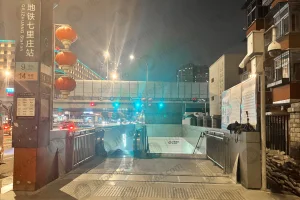
Partner directly with China's leading specialist manufacturer of hydrodynamic passive flood defense barriers. Contact our technical team in Nanjing for custom CAD drawings, civil interface details, and factory-direct pricing for your infrastructure tender.