
Explore our field-tested hydrodynamic self-closing flood gates tailored for critical urban infrastructure and subterranean entrances.
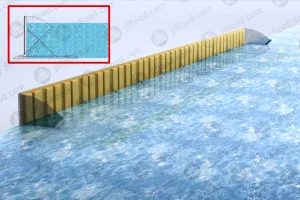
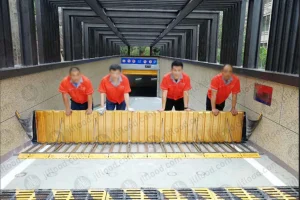
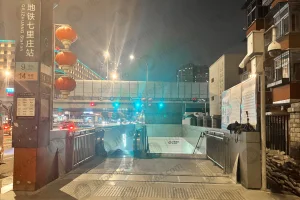
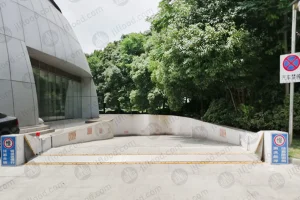
In modern civil engineering and urban flood management, the vulnerability of underground infrastructure during extreme precipitation events has become a critical threat to economic stability and human safety. Traditional flood defense relies on manual slot-in aluminum stoplogs or electrically driven flood gates. However, real-world flood disasters—such as flash floods caused by cloudbursts or typhoons—frequently trigger grid power failures, communication disruptions, and rapid localized inundation. Under these conditions, manual deployment often fails due to lack of response time or absent personnel, while electrical systems malfunction due to short circuits.
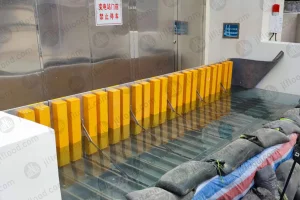
The Self-Closing Passive Hydrodynamic Flood Barrier represents a structural paradigm shift. Operating completely independently of external electrical power, human operation, hydraulic pumps, or sensor microcontrollers, passive barriers utilize pure fluid dynamics—specifically hydrostatic pressure and water buoyancy—to lift, deploy, and seal automatically as floodwaters arrive.
Operates continuously during citywide electrical blackouts. Eliminates risks associated with motor burnouts, wiring corrosion, or standby battery degradation.
Constructed from fluorocarbon-coated structural aluminum alloy and T304 stainless steel hardware to resist urban road salts and marine corrosion.
Seamlessly link individual 2m to 6m barrier modules to cover ultra-wide commercial garage ramps, metro plazas, or substation gates exceeding 30 meters.
A comparative engineering audit evaluating operational risk, labor expenditure, response time, and total cost of ownership (TCO).
| Evaluation Parameter | Hydrodynamic Self-Closing Barrier | Electrically Motorized Flood Gate | Manual Slot-In Stoplog Barrier |
|---|---|---|---|
| Activation Mechanism | 100% Passive Water Buoyancy | Electric Motor / Hydraulic Actuator | Manual Human Labor |
| Power Source Requirement | None (0 kWh) | Main Grid + UPS Battery Backups | None |
| Response Time | Immediate (< 0.5s upon water entry) | 30 - 90 seconds (If power intact) | 30 - 120 minutes (Labor dependent) |
| Failure Modes | Zero mechanical failure points | Grid failure, motor jam, sensor glitch | Staff absence, traffic delay, lost panels |
| Vehicle Axle Load Capacity | Up to 40 Tons (Custom heavy-duty) | Typically light to medium duty | Non-passable (Blocks entry permanently) |
| Maintenance Overhead | Low (Semi-annual trench cleaning) | High (Electrical, motor, hydraulic fluids) | Medium (Storage box inspection, gaskets) |
| 20-Year Total Cost of Ownership | Lowest (Zero power & minimal labor) | Highest (Constant servicing & power) | High (Labor costs per flood alert) |
As municipal governments and global institutional developers push for climate resilience standards (such as EN 12101, BREEAM, and LEED flood risk mitigation criteria), demand for Self Closing Passive Flood Barriers has escalated rapidly across Europe, North America, Southeast Asia, and the Middle East.
China has emerged as the premier manufacturing hub for heavy-duty architectural water-retaining solutions. Sourcing direct from specialized Chinese OEM/ODM factories provides significant strategic advantages for engineering procurement contractors (EPCs) and municipal project bidders:
Proximity to world-class industrial aluminum clusters in Jiangsu and Guangdong enables custom profile extrusions up to 600mm width in high-grade 6063-T6 alloy. This eliminates structural welding seams and provides exceptional moment of inertia against high hydraulic head pressure.
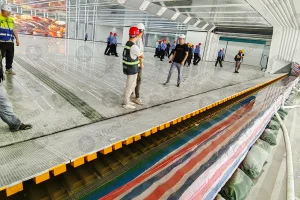
Top-tier Chinese manufacturers operate dedicated hydrostatic testing chambers. Every production batch undergoes real water-retaining leakage validation (measured in L/min/m seal length) prior to issuing factory acceptance test (FAT) documentation.
Automated robotic laser cutting, CNC profile machining, and standardized stainless steel trench assembly yield a 30%–50% cost advantage over European or North American counterparts without compromising sealing integrity or structural safety factors.
From single clear spans of 2.0m to multi-span connected installations over 50m, Chinese engineering teams provide tailored structural calculation reports, CAD embedment details, and BIM models for seamless integration into architectural designs.
The versatility of self-closing passive flood barriers allows them to be deployed across a broad spectrum of civil, industrial, and infrastructure developments:
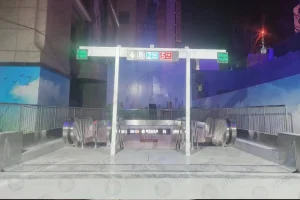
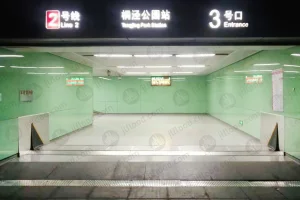
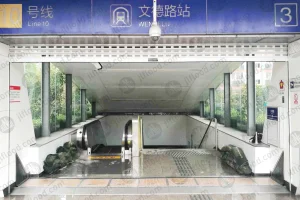
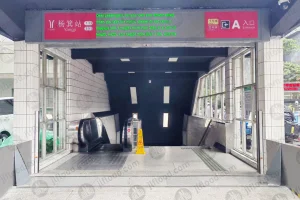
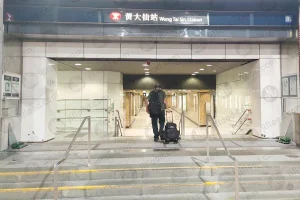
Metro station entrances, pedestrian subway connection channels, and underground ventilation shafts are vulnerable to surface water ingress during cloudburst events. Systems installed in locations such as the Guangzhou Metro, Dalian Metro, and Suzhou Metro demonstrate that surface-mounted and embedded hydrodynamic barriers can block floodwaters up to 2.0 meters high, protecting million-dollar transit equipment and passenger safety.
Substations house high-voltage transformers, switchgear rooms, and cable trenches. A single flooding incident can cause catastrophic electrical fires, transformer explosions, and regionwide blackouts. Self-closing flood gates installed at perimeter access gates and equipment room doorways provide round-the-clock defense against urban waterlogging without requiring substation operators to be present on-site.
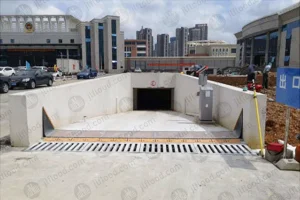
Underground car parks are often the lowest point in commercial complexes and residential developments, making them prime collection zones for urban floodwaters. Surface-mounted hydrodynamic barriers allow continuous daily vehicle transit over the recessed threshold plate, rising automatically within seconds when storm runoff floods the entrance ramp.
Manufacturing plants handling hazardous materials require secondary containment to prevent toxic runoff from leaking into surrounding watercourses during flash floods. Hydrodynamic self-closing gates serve dual roles: preventing external flood waters from entering processing areas and retaining internal chemical spills.
Select from our certified range of surface-mounted, embedded, flip-up, and metro-grade automatic flood barrier systems.
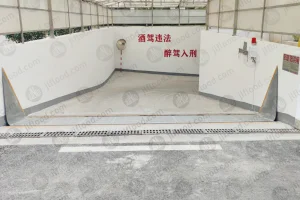
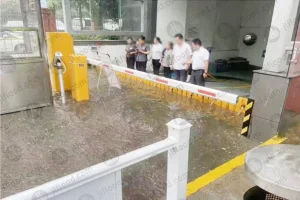
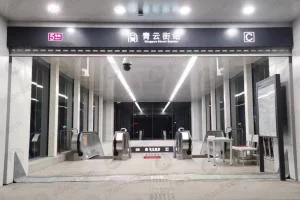
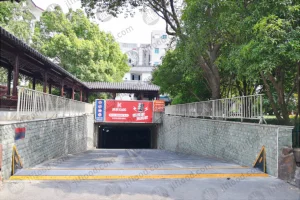
When issuing tenders or requesting direct wholesale factory quotes for self-closing passive flood gates, engineering consultants and procurement agents should evaluate key technical variables that directly influence pricing and installation viability:
Wholesale quotations for self-closing flood gates are calculated primarily on a per linear meter ($/m) or per module unit basis. Pricing typically ranges from $450 to $1,200 per meter depending on the following parameters:
To ensure tender compliance and seamless site integration, include the following design parameters in your Request for Quotation (RFQ):
| Specification Parameter | Standard Commercial Specification | Heavy Duty Infrastructure Specification |
|---|---|---|
| Clear Opening Width (Single Span) | 2,000mm – 4,500mm | 4,500mm – 6,000mm+ (Multi-leaf unlimited) |
| Water Protection Height | 500mm – 1,000mm | 1,000mm – 2,000mm |
| Response Trigger Height | Water level ≥ 50mm in trench | Water level ≥ 30mm in trench |
| Sealing Efficiency / Leakage Rate | < 0.1 L/min per meter seal | < 0.02 L/min per meter seal (Near zero) |
| Primary Door Panel Material | Extruded Aluminum Alloy 6063-T6 | Structural Alloy 6005A-T6 / Stainless 304 |
| Sealing Gasket Compound | EPDM Marine Grade (Anti-aging) | Self-Pigmented EPDM + Fluororubber Core |
| Surface Finish Coating | Fluorocarbon Spray Coating / Anodized | PVDF Coating / Electropolished Stainless |
As smart cities evolve, the flood defense sector is undergoing rapid technological convergence. While the core mechanical operation of self-closing barriers remains strictly passive and hydrodynamically powered, modern systems increasingly integrate non-intrusive smart telemetry:
Expert answers on installation, operational safety, maintenance protocols, and international shipping logistics.
The barrier relies on fundamental principles of physics—specifically water buoyancy and hydrostatic pressure. The panel rests flush inside a shallow recessed bottom chamber. When flood surface runoff enters the chamber, high-buoyancy internal cores lift the door leaf automatically. As water levels increase, the hydrostatic weight of the flood pushes the panel tightly against the lateral frame sealing gaskets, creating a completely watertight seal with zero electrical power required.
When in its closed horizontal position, the barrier panel and embedded trench frame form a flush surface with the road. Heavy-duty commercial models are structurally engineered with reinforced internal vertical ribs and high-tensile 304 stainless steel hinge axles, capable of supporting standard vehicle load ratings up to 30 to 40 tons (certified for heavy trucks and emergency fire apparatuses).
Yes. We offer both Embedded Types (for new construction requiring flush surfaces) and Surface Installation Types (for retrofits). Surface-mounted models feature a ultra-thin frame height with low-profile modular rubber or aluminum transition ramps, allowing quick installation onto existing sound concrete foundations using chemical anchor bolts without breaking up the existing slab.
Routine maintenance is straightforward. The barrier panel can be manually lifted to a 90-degree vertical position using temporary maintenance lifting hooks or gas spring supports. The bottom trench features smooth stainless steel surfaces and built-in drainage outlets, allowing maintenance crews to sweep or pressure-wash out accumulated silt and leaves during semi-annual inspections.
Our marine-grade EPDM rubber seals are formulated with anti-ultraviolet, anti-ozone, and anti-aging additives, providing an estimated outdoor operational service life of 10 to 15 years under normal atmospheric exposure. The sealing gaskets are designed as modular push-in components, making them easy and cost-effective to replace on site without replacing the aluminum door panels or foundation frames.
Yes. Every order manufactured at our factory undergoes rigorous quality assurance. We conduct full-scale real water testing in our dedicated test pool to verify deployment speed, panel deflection under maximum hydrohead, and gasket leakage rates. We provide official Factory Acceptance Test (FAT) documentation, video records, and material mill test certificates (MTC) alongside export shipping documents.
Standard production lead times range from 15 to 25 business days depending on total linear meter quantity and custom structural specifications. We support all international commercial shipping terms, including EXW, FOB (Shanghai/Ningbo/Guangzhou), CIF, and DDP to destination ports worldwide, complete with seaworthy wooden crate packaging and internal shock protection.


