Field-proven passive flood gates designed to deploy automatically under hydrostatic water pressure without electricity or human intervention.
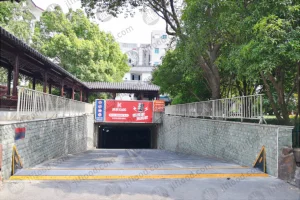

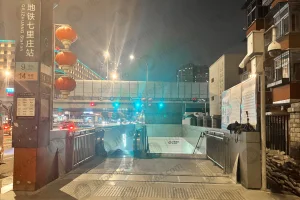
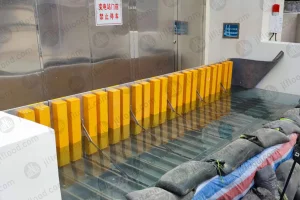
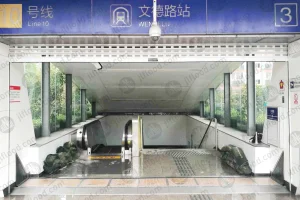
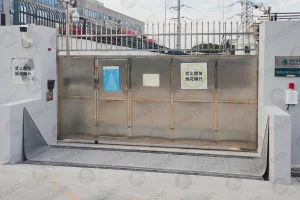
Decades of hydraulic innovation validated across extreme typhoon rainfall and severe urban flash flooding events.
In an era characterized by intensifying climate volatility, cloudburst rainstorms, and rapid urban concrete expansion, civil infrastructure faces unprecedented vulnerability to flash floods. Traditional flood mitigation strategies—such as manual sandbag placement, removable aluminum demountable stoplogs, and electromechanical motorized flood gates—are failing under modern disaster conditions. Manual barriers depend entirely on human response times, labor availability, and early storm warnings, which frequently collapse during sudden midnight cloudbursts. Conversely, motorized electric gates are inherently fragile: severe urban waterlogging often cuts off power grids precisely when flood defense is required, causing electrical actuators to freeze and fail.
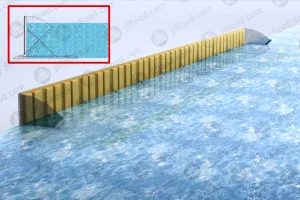
This critical vulnerability has accelerated a worldwide paradigm shift toward passive entryway self-closing flood barriers. Engineered on fundamental fluid mechanics and hydrostatic pressure principles, self-closing flood gates deploy automatically when rising surface runoff flows into an underground basin chamber. By leveraging the natural buoyancy of custom-extruded alloy door panels and hydrostatic uplift pressure, these barriers rise, lock, and seal completely—requiring zero electricity, zero sensor networks, zero manual intervention, and zero standby energy cost.
Core Engineering Principle (Information Gain): Hydrodynamic self-closing entryway barriers utilize the incoming water's kinetic and potential energy to engage high-torque hinge mechanisms. As water fills the foundation basin beneath the road surface, buoyancy forces push the leaf upward. As water level rises further against the gate, hydrostatic pressure tightly compresses the continuous EPDM rubber seals against side frames, creating a 100% watertight barrier rated for extreme water heads up to 2,000 mm.
Professional engineering specifiers, architectural consultants, and municipal procurement directors must evaluate several structural and hydraulic components when selecting self-closing entryway flood barriers for heavy-duty commercial and municipal applications:
Heavy-gauge extruded aluminum alloy door panels combined with 304/316 stainless steel foundation basins provide exceptional bending stiffness, resisting high dynamic hydrodynamic impacts and vehicle drive-over wheel loads up to 40 tons (AASHTO HS-20 rating).
Industrial vulcanized EPDM rubber gaskets line the lateral frame jams and base hinges. Hydrostatic water pressure compresses the primary seal profile, ensuring near-zero leakage (<0.05 L/hr/m) exceeding international standards such as FM 2510 and BS EN 12247.
Integrated sediment mitigation slots and continuous bottom drainage valves prevent sediment accumulation, silt buildup, or debris clogging within the recessed basin, guaranteeing smooth hinge rotation over a 20+ year service life.
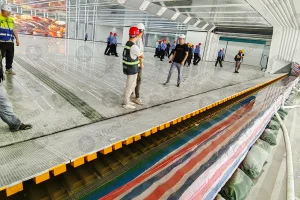
Inside Nanjing Junli Technology’s modern manufacturing facility: Vertical integration from engineering design to full-scale pool testing.
Our manufacturing complex utilizes high-power fiber laser cutting machines, CNC press brakes, and automated robotic welding cells to ensure sub-millimeter tolerances on embedded frame channels, barrier panels, and structural hinges. High structural alignment prevents frame twisting under severe water pressure, ensuring seamless installation during civil works setup.
Unlike trading companies or regional assemblers, Nanjing Junli maintains a dedicated, full-scale hydraulic testing basin. Every custom-manufactured batch undergoes rigorous seal leakage tests, panel deflection measurements, and hydrodynamic trigger velocity tests before export packaging, complete with English quality inspection certificates.
We provide global civil engineering consulting, embedded frame template drawings, CAD/BIM model integration, and customized steel crating for secure international ocean freight. Direct factory-wholesale sourcing reduces procurement budgets by 30% to 50% compared to European or North American brand markups without sacrificing material grade or performance certifications.
We work closely with EPC contractors, municipal authorities, and commercial developers worldwide to offer tailor-made barrier widths (spanning from single 1.5m pedestrian entryways up to 20m+ continuous driveway spans), specified anodized surface coatings, and surface-mounted retrofit frames.
Comparative analysis for engineering specifiers: Evaluating operational reliability, life-cycle costs, and disaster performance.
| Evaluation Parameter | Hydrodynamic Self-Closing Barrier | Manual Demountable Stoplogs | Motorized Electric Flood Gates |
|---|---|---|---|
| Power Dependency | Zero (100% Passive Hydraulic) | Zero (100% Manual Labor) | High (Requires AC Power or Backup Battery) |
| Deployment Trigger Time | Instantaneous (< 0.1s on water contact) | Slow (30 mins – 2 hours assembly) | Moderate (30s – 3 mins motor drive) |
| Human Reliability Risk | Zero (Fully Autonomous) | Extreme (Requires trained staff on-site) | Moderate (Requires manual button/sensor activation) |
| Blackout Reliability | Unaffected (Fully Functional) | Unaffected | High Failure Risk (Grid power outages during severe storms) |
| Pedestrian & Driveway Aesthetics | Flush embedded in road; invisible when dry | Requires external storage shed for beams | Above-ground posts; potential obstacle hazard |
| Drive-Over Weight Rating | Heavy Duty (AASHTO HS-20 / 40 Ton Trucks) | N/A (Barrier must be erected after traffic stops) | Medium Duty (Varies by guide rail profile) |
| 20-Year Total Cost of Ownership (TCO) | Lowest (Zero standby energy, minimal maintenance) | High (Ongoing labor training & emergency drills) | High (Motor servicing, battery replacements, electrical inspections) |
Custom-engineered entryway protection deployed in high-risk municipal, commercial, and utility environments.
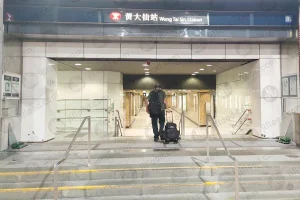
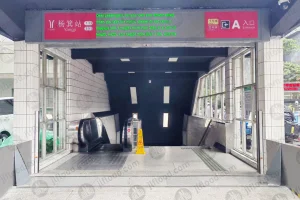
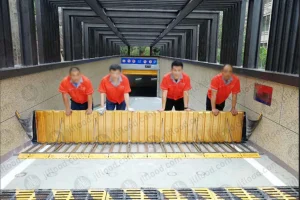
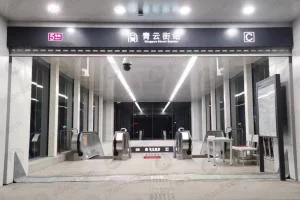
Underground metro stations represent high-density life-safety zones. Self-closing barriers installed at station portals and subterranean connection channels activate automatically when surface runoff cascades into entry steps, protecting rail lines from cataclysmic flooding.
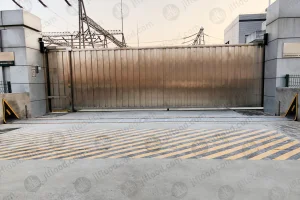
Substation transformer gates and cable trench entryways require continuous flood security. A single flooded substation can disable an entire regional power grid. Self-closing barriers provide 24/7 unpowered defense around transformer enclosures and control rooms.
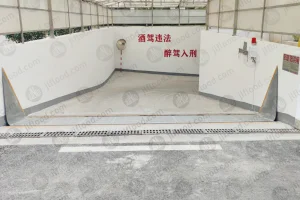
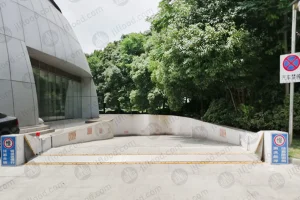
Shopping mall ramps, high-rise residential basements, and hospital car parks utilize flush-embedded surface barriers. Vehicles drive smoothly over the barrier plate daily. During severe storms, the panel rises automatically to protect parked vehicles and lower-level building infrastructure.
Chemical processing plants and hazardous waste storage facilities require dual-purpose containment. Self-closing barriers keep floodwater out while preventing accidental chemical spills or contaminated firewater runoff from escaping into local municipal waterways.
Hospitals, emergency response centers, and municipal data archives cannot afford operational downtime. Passive self-closing flood gates guarantee structural resilience against unexpected flash floods without relying on facility maintenance crews during crisis events.
Expert answers addressing civil engineering, installation details, maintenance routines, and international order specifications.
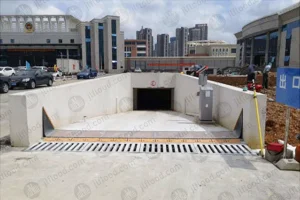
The barrier mechanism relies on fundamental buoyancy and hydrostatic pressure principles. The flood gate leaf sits flush inside a recessed foundation chamber embedded at the entryway. When rainwater surface runoff exceeds threshold levels, it flows into the chamber through stainless steel inlet grates. As the chamber fills, water exerts buoyancy forces on the hollow, high-grade aluminum panel, causing it to pivot upward automatically. As the flood depth increases against the gate, hydrostatic water pressure forces the panel firmly against the frame gaskets, creating a completely watertight seal. No sensors, motors, wiring, or human intervention are needed.
Yes. Junli entryway self-closing flood barriers are engineered with heavy-duty structural aluminum panels and reinforced stainless steel foundation frames designed for high wheel loads. Standard units are certified to support AASHTO HS-20 and EN 124 heavy vehicular traffic (up to 40-ton truck loads), making them ideal for busy commercial garage ramps, industrial logistics parks, and fire department access channels.
For embedded models, civil contractors need to excavate a trench across the entryway according to our CAD architectural drawings. A reinforced concrete basin with embedded steel angle frames must be prepared, along with a bottom drainage pipe connection linked to the municipal storm sewer or sump pump pit. For retrofit applications where excavation is restricted, we also supply surface-mounted flip-up flood barrier models that anchor directly onto existing flat concrete aprons.
Junli self-closing barriers feature integrated stainless steel debris grates that filter out leaves, trash, and large sediment particles from entering the interior basin. Additionally, the bottom of the foundation frame is designed with a sloped self-clearing drainage channel. Routine maintenance simply involves lifting the top access grates once or twice a year to flush out accumulated fine silt with a standard water hose.
Standard retaining heights range from 500 mm up to 2,000 mm (2.0 meters) per barrier leaf. Clear span widths can be customized for single-leaf spans up to 6.0 meters. For extra-wide commercial entrances (such as multi-lane parking ramps or 20-meter wide subway portals), we manufacture modular multi-leaf barrier arrays with inter-panel seal columns that deploy seamlessly as a unified water-retaining wall.
Every wholesale shipment from Nanjing Junli Technology includes comprehensive English documentation: Material Test Reports (MTR) for alloy components, EPDM elastomer aging test certificates, factory hydrostatic pool test videos, structural load calculation reports, and step-by-step English installation/maintenance manuals. Third-party inspection witnessing (SGS, TUV, Bureau Veritas) can also be arranged upon request.
Explore our complete catalog of embedded, surface, and custom industrial entryway flood protection systems.