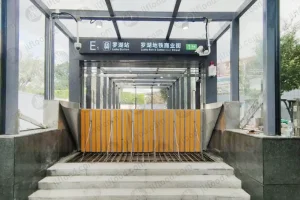
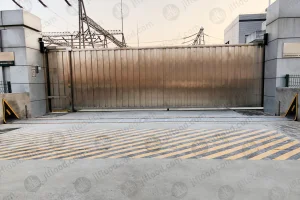
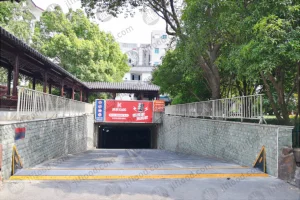
Engineered for immediate deployment, passive hydraulic actuation, and continuous perimeter protection against extreme storm surge and flash flooding events.
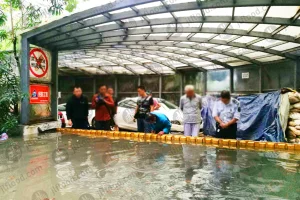
A comprehensive whitepaper on how passive buoyancy mechanics and hydraulic flip-up gates are redefining climate resilience for modern municipal and industrial infrastructure.
Urban waterlogging, intensified atmospheric rivers, and rapid climate shifts have escalated urban flood mitigation from a routine building design consideration to a critical life-safety and asset-preservation priority. Worldwide municipal authorities, metro transit networks, and commercial real estate REITs are drastically overhauling their flood vulnerability criteria. Traditionally, flood protection relied on manual sandbags, removable aluminum stop logs, or heavy motorized flood gates. However, catastrophic failures during power outages, delayed deployment responses, and human error have proven that manual or electrically dependent systems are fundamentally flawed during sudden cloudburst events.
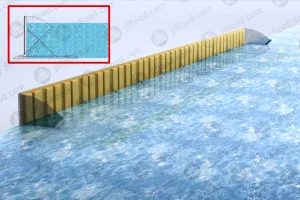
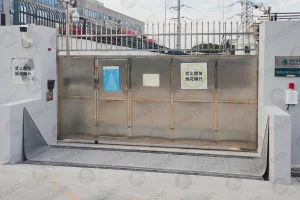
This dynamic has propelled the global flood protection industry toward automated, hydrodynamic, and mechanical flip-up flood door architectures. A Flip Up Flood Door—also engineered as a buoyant automatic flood gate or hydraulic flip barrier—remains completely flush with the surrounding pavement during normal operations. Upon the arrival of surface floodwater, the system leverages hydro-buoyancy physics to raise a structural barrier panel automatically, forming an impenetrable hydro-seal without requiring grid power, human activation, or external telemetry signals.
Zero electrical reliance. Incoming water fills an underground retention basin, naturally lifting the counterbalanced leaf panel into position within seconds.
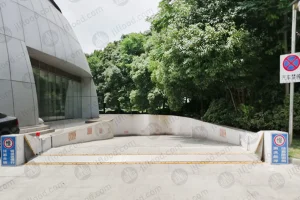
Installs completely level with pedestrian walkways and vehicle driveways, supporting daily heavy axle loads without impeding standard facility access.
Utilizes commercial EPDM and hydro-inflatable elastomeric seals to guarantee near-zero leakage (< 0.5 L/h/m) even under maximum hydrostatic water heads.
Evaluating operational risks, mechanical efficiency, deployment speed, and life-cycle costs across enterprise flood protection choices.
| Performance Dimension | Passive Hydrodynamic Flip-Up Gate | Motorized Vertical Drop Gate | Manual Aluminum Stop-Logs |
|---|---|---|---|
| Power Grid Dependency | 0% (100% Mechanical Hydro-Power) | High (Requires UPS / Generator Backup) | 0% (Manual Installation) |
| Activation Trigger Speed | Immediate (< 15-30 Seconds on water influx) | 2 - 5 Minutes (If sensors function) | 2 - 4 Hours (Requires dedicated crew) |
| Human Error Risk | Zero (Fully Autonomous) | Moderate (Control panel/PLC failures) | Extreme (Requires on-site staff during storms) |
| Structural Load Rating | AASHTO HS-20 / EN 124 D400 Drive-Over | Non-load bearing (Airspace deployment) | Non-load bearing (Pedestrian/Trench only) |
| Aesthetic & Architectural Impact | Concealed Flush Mount (Invisible when idle) | High Visual Intrusion (Overhead guide tracks) | Storage space needed off-site |
| Maintenance Overhead | Low (Annual chamber flush & gasket inspection) | High (Motors, hydraulics, electrical PLC) | Moderate (Gasket replacement & dry runs) |
Addressing structural engineering specifications, site-civil interfaces, material metallurgy, and factory acceptance testing (FAT) for international tenders.
When engineering firms and main contractors evaluate a Wholesale Flip Up Flood Door Supplier, the primary technical consideration is the structural bed preparation. Recessed flip-up barriers require a cast-in-place reinforced concrete foundation pit with integrated drainage outlets. Sourcing teams must ensure the supplier provides fully documented CAD structural details, rebar clearance schematics, and concrete strength specifications (e.g., C35/45 grade concrete minimum) to resist both vehicle drive-over shear force and hydrostatic uplift forces.
Infrastructure assets are expected to endure 25 to 50 years of environmental exposure. Industrial-grade flip-up gates must incorporate high-grade materials such as 6063-T6 or 6005A-T6 structural extruded aluminum alloy with fluorocarbon (PVDF) electrostatic coatings or marine-grade 316/316L Stainless Steel for coastal deployments subject to saltwater intrusion and road salt spray.
A flood barrier is only as robust as its elastomeric seals. Top-tier manufacturers utilize dual-durometer EPDM compound gaskets co-extruded with self-lubricating silicone additives. The structural geometry must create continuous compression along the bottom hinge and side jambs, converting hydrostatic fluid pressure into additional sealing force.
Commercial entrances range from standard 3-meter pedestrian ramps to massive 24-meter wide underground logistics driveways. A leading OEM manufacturing plant must deliver modular multi-leaf configurations linked via intermediate removable or automated mullions, preserving structural moment capacity across extreme spans without deflection failure.
Deploying specialized flip-up flood doors to defend high-risk urban sectors against catastrophic water ingress.
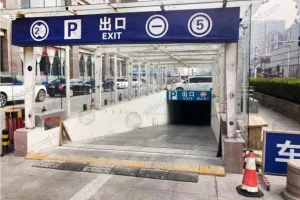
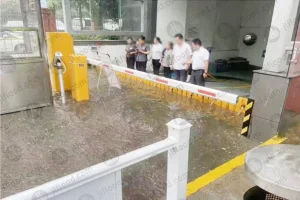
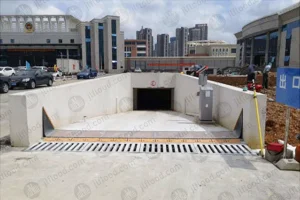
Basement ramps at commercial complexes and residential towers are high-risk funnels during urban flash floods. Flush flip-up doors prevent catastrophic vehicle loss and electrical room submersion while accommodating daily high-frequency vehicular traffic.
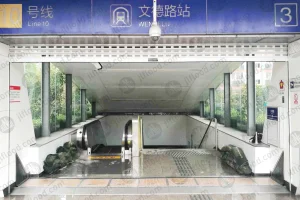
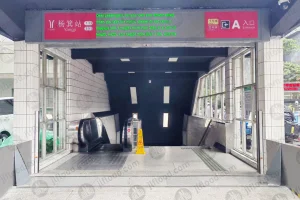
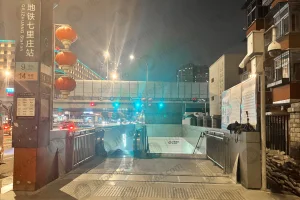
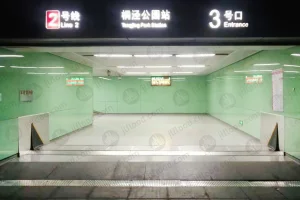
Metro station entrances, emergency exits, and ventilation shafts require extreme hydrological reliability. Customized subway-grade automatic flood barriers seal off underground rail networks from surface flood waves, safeguarding millions in transit assets.
Electrical substations and cloud data facilities demand uninterrupted operational continuity. Specialized flip-up doors isolate critical transformer vaults and cable trenches from water ingress, avoiding regional blackouts and server destruction.
Ensuring compliance with global civil defense engineering frameworks and rigorous third-party testing standards.
To successfully pass municipal building control inspections and secure structural engineering approvals, enterprise buyers must verify that their flood protection supplier complies with international standardizations:
Integrating digital twin monitoring, smart city SCADA connectivity, and advanced composite materials into next-generation flip-up systems.
Modern flip-up flood doors are being equipped with dual optical and hydrostatic sensors linked directly to building management systems (BMS) and municipal SCADA networks. Facility managers receive instant cellular alert notifications, live panel status telemetry, and video verification as soon as hydro-buoyancy deployment begins.
Future engineering iterations focus on reducing moving mass while expanding structural span capabilities. Integrating carbon-fiber reinforced polymers (CFRP) with high-strength extruded aluminum enables wide 30-meter single-span deployments without requiring intermediate mullions.
In-depth technical answers for structural engineers, project managers, and enterprise buyers.
Hydrodynamic flip-up flood doors operate purely on passive hydraulic buoyancy and gravitational mechanics. As surface runoff fills the embedded retention basin, the buoyant density of the hollow aluminum leaf panel overcomes its counterweight equilibrium, causing the panel to rise automatically. No electricity, batteries, sensors, or human intervention are required.
Our industrial flip-up flood doors are engineered to AASHTO HS-20 / HS-25 and EN 124 D400 load standards. Reinforced extruded aluminum structural ribbing allows loaded commercial trucks, buses, and fire engines (up to 40-ton gross vehicle weight) to drive over the flush surface continuously without structural deformation.
Civil works require excavating a structural trench, casting a reinforced concrete foundation with embedded anchor bolts, and connecting a bottom drainage outlet (typically DN100 or DN150) to the facility storm sewer or sump pit to handle routine rainwater accumulation inside the housing frame.
Side sealing relies on vertical stainless steel jamb channels fitted with continuous EPDM compression gaskets. As water level rises against the outer face of the barrier leaf panel, hydrostatic pressure pushes the panel tighter against the rubber gasket, achieving a tighter seal under higher water heads.
Standard engineering lead time is 2 to 4 weeks depending on order volume and custom span requirements. Full OEM/ODM customization is provided, including custom retaining heights (0.5m to 2.0m), tailor-made surface finishes (anodized, powder-coated, anti-slip patterns), and custom civil embedments.
Explore our full catalog of heavy-duty, automatic, and surface-mounted flood protection doors engineered for global commercial and civil infrastructure projects.