Factory-direct quotes, engineering CAD specifications, and bulk procurement options for high-performance flood control gates.
In an era marked by accelerating climate volatility, extreme hydrological events, and severe urban waterlogging, the global procurement market for high-capacity flood dam gates and automatic flood barriers has transitioned from a reactive insurance measure to a critical structural mandate. Municipal utilities, civil defense authorities, commercial property conglomerates, and transit agencies across North America, Europe, the Middle East, and Asia-Pacific are re-evaluating traditional flood mitigation mechanisms in favor of zero-power, hydrodynamic self-closing flood gates.
Urban density has led to an exponential expansion of underground infrastructure—subway networks, multi-level subterranean parking structures, high-voltage electrical substations, data centers, and underground commercial complexes. When torrential rainfall exceeds municipal storm-sewer capacities, these underground volumes become high-risk flood sinks. Traditional flood defense approaches, such as manually deployed aluminum stop logs, sandbags, or electrically powered motorized gates, consistently exhibit catastrophic single-point vulnerabilities during real-world inundations:
Engineering Gain Insight: Modern civil engineering specifications increasingly demand passive, hydrodynamic automatic flood gates—such as those manufactured by Nanjing Junli Technology Co., Ltd. These barriers harness the physical energy of incoming water hydrostatic pressure and buoyancy forces to self-deploy without requiring human intervention or electrical power.
To assist procurement managers, EPC contractors, and structural engineers in evaluating wholesale flood gate options, the following matrix contrasts hydrodynamic self-closing flood barriers against legacy flood control solutions across core operational dimensions.
| Technical Dimension | Hydrodynamic Automatic Barrier (Junli System) | Electromechanical Flood Gate | Manual Aluminum Stop-Logs |
|---|---|---|---|
| Power Requirement | Zero (100% Hydro-buoyancy & Hydrostatic Driven) | External Grid Power + Backup Generator | Zero (Manual Labor Required) |
| Activation Time | Immediate (<0.1 sec upon water entering basin) | 30 sec - 3 min (Requires Sensor Trigger) | 30 min - 2 hours (Crew Mobilization) |
| Blackout Operationality | 100% Operable (Mechanically Immune) | High Failure Risk if UPS/Gen Fails | Operable (Assuming Personnel Present) |
| Driveway Flush Fitting | Flush embedded in floor; heavy vehicle rated | Surface bumps or overhead gantry needed | Requires manual channel slots |
| Annual Maintenance | Minimal (Inspection & Basin Debris Sweep) | High (Motor, Seals, Sensors, Hydraulics) | Low (Storage check & seal checks) |
| Structural Service Life | 20+ Years (Marine Stainless & Anodized Al) | 8-12 Years (Mechanical Wear & Electronics) | 10-15 Years (Component Loss/Damage Risk) |
Global B2B procurement of structural flood barriers requires a strategic balance between engineering rigor, material quality standards, structural compliance, and cost competitiveness. Sourcing directly from top-tier Chinese manufacturers like Nanjing Junli Technology Co., Ltd. offers global buyers distinct structural and commercial advantages:
From raw alloy extrusion (6063-T6 marine aluminum & SUS304/316 stainless steel) to precision laser cutting, robotic seam welding, and specialized EPDM rubber molding, Nanjing Junli controls the full manufacturing chain in-house.
Unlike trading suppliers who rely on virtual software simulations, Junli operates a dedicated full-scale hydraulic testing basin. Every model undergoes physical hydrostatic pressure loading, leak-rate verification, and lifting speed certification prior to mass production.
Junli flood barriers are engineered to meet stringent municipal civil defense, rail transit, and electrical grid specifications, backed by ISO9001, ISO14001, and ISO45001 international certifications.
By leveraging concentrated supply chain clusters in Jiangsu Province, Chinese manufacturers achieve up to 30% to 50% cost efficiencies compared to Western European or North American fabricators, without compromising structural integrity or material specifications.
Hydrodynamic automatic flood dam gates are versatile civil structures adaptable to diverse urban, commercial, and industrial architectural profiles:
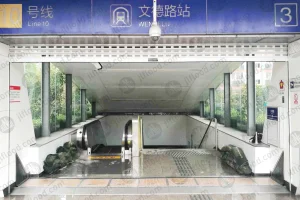
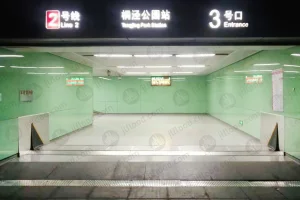
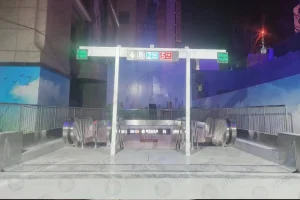
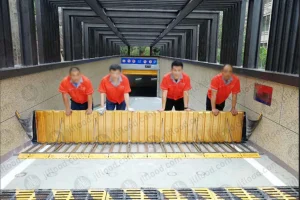
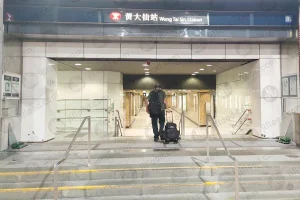
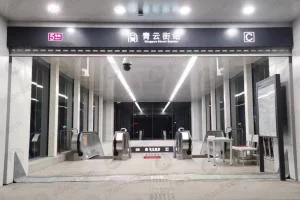
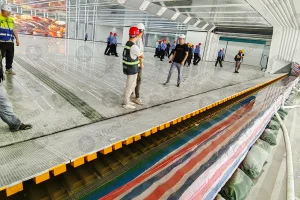
Metropolitan underground rail networks represent high-consequence flood zones. Water ingress at a single station entrance can inundate miles of subterranean tunnels, causing billions in equipment damage and paralyzing urban transport. Junli's surface-mounted and embedded metro flood gates (such as the Hm4d-0006E series) are specifically calibrated for pedestrian transition channels, station stairs, and connection passages in major subway systems including Guangzhou, Beijing, Suzhou, Dalian, and Hong Kong Metro.
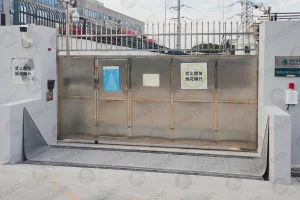
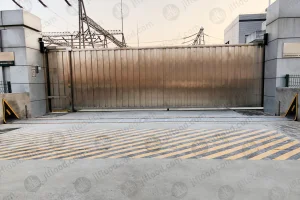
Electrical transformer rooms, cable trenches, and utility switchgear gates require absolute water isolation. A flood event inside a power substation leads to catastrophic electrical arcing, transformer destruction, and grid blackouts. Junli substation gates feature continuous oil- and chemical-resistant EPDM perimeter gaskets, providing non-electric passive protection that seals equipment vaults against aggressive surface runoff and urban waterlogging.
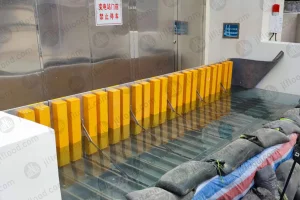
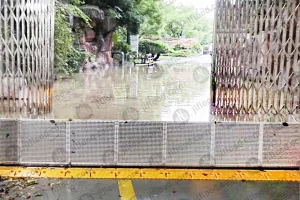
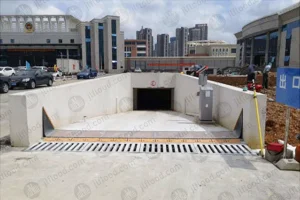
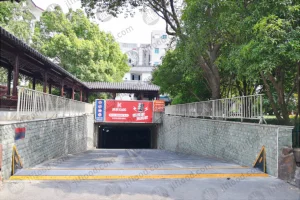
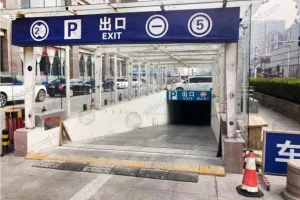
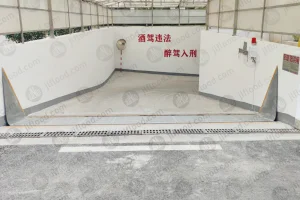
Parking garage access ramps present wide clear openings vulnerable to sudden rainwater runoff. Junli flip-up and hydrodynamic self-rising garage flood barriers are embedded flush with the vehicle drive level, engineered to withstand heavy vehicle load axle pressures (up to 40 tons). When water fills the bottom drainage chamber, the barrier leaf automatically rotates upward, sealing the ramp opening before water reaches subterranean parking decks.
In municipal river diversion channels, dam crests, and civil defense retention basins, modular flood dam gates act as automated crest gates or secondary defense lines. Their heavy-duty stainless steel structural frames maintain hydraulic tightness even under sustained dynamic water head pressure and floating debris impact.
When sourcing wholesale flood barriers from manufacturers, procurement leads must understand the key engineering parameters that govern unit pricing and overall project quotation structures:
Direct Factory Procurement Benchmark: Wholesale factory-direct prices typically range between $350 to $950 per linear meter depending on specification, height, and order volume, representing a 40-60% savings over localized distributor retail markups.
The global flood protection industry is undergoing rapid technological convergence. Leading engineering firms and municipal specifiers are driving adoption of next-generation features:
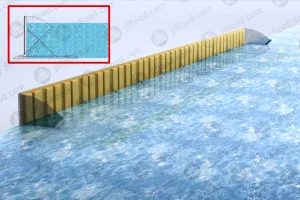
The system operates on pure physical fluid dynamics: Archimedes' buoyancy principle and hydrostatic pressure. The flood panel rests horizontally inside a recessed floor foundation chamber flush with the ground. When floodwaters overflow into the chamber inlet, water buoyancy exerts an upward force on the panel. As the water level rises, the panel automatically swivels upward along its stainless steel pivot axis. Hydrostatic pressure from the retained floodwater then forces the panel against specialized perimeter EPDM seals, automatically locking it firmly in place. When floodwaters recede, water drains out of the chamber, allowing the panel to return smoothly to its flush horizontal position.
Standard production lead times at Nanjing Junli range from 15 to 25 working days depending on total linear meter quantity and structural customization (e.g., custom retaining height, special alloy grades, embedded anchor boxes). Expedited manufacturing schedules can be arranged for emergency municipal infrastructure tenders. Sea freight delivery times typically add 12-18 days for Asian ports, 22-30 days for Europe/Middle East, and 18-28 days for North America.
Yes. Junli underground garage and road flood barriers are structural load-rated. Standard commercial models easily sustain 20 to 40-ton vehicle axle loads (equivalent to standard city buses, delivery trucks, and fire engines). The top cover plates are constructed from reinforced marine aluminum or stainless steel with internal structural stiffener ribs to prevent deflection under repeated traffic roll-over.
For embedded models, the site contractor must excavate a recessed concrete foundation trench according to Junli's engineering CAD drawings, ensuring concrete compressive strength of at least C30/C35. Primary requirements include leveling the base, embedding anchor bolt templates, and connecting a bottom drainage outlet pipe (DN100 or larger) to the municipal storm drain or sump pit to clear residual rainwater after a flood event. For surface-mounted models, only a flat, level concrete slab is required for chemical anchor bolt fastening.
Junli flood gates feature dual-chamber EPDM elastomeric gaskets with memory retention properties. Hydrostatic pressure from the impounded water pushes the barrier panel firmly against side frame channels, creating a tight seal. In factory hydrostatic basin tests, leakage rates are measured under maximum design head pressure and consistently stay far below international standard limits (under 0.2 L/min per meter of wetted perimeter, essentially zero-leak performance).
Explore specialized hydrodynamic barriers engineered for heavy-duty infrastructure, transit channels, and utility substations.