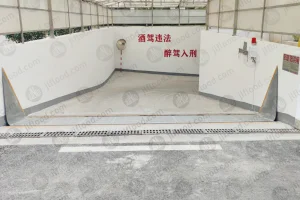
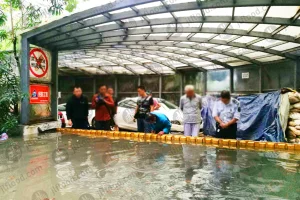
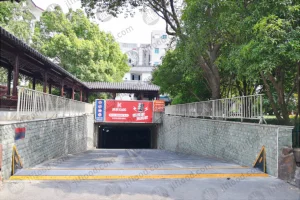
Explore heavy-duty, unpowered automatic flood barriers validated under rigorous water-retaining tests for global municipal and industrial deployments.
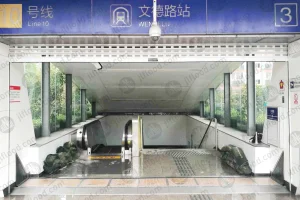
Analyzing climate-driven flash flooding, structural asset protection standards, and municipal flood defense engineering requirements across North America, Europe, and Asia-Pacific.
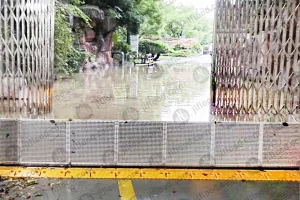
Urban microclimates and rapid climate variations have significantly intensified the frequency and volume of extreme precipitation events worldwide. Atmospheric rivers, convective cloudbursts, and coastal storm surges present immense threats to underground infrastructure and commercial real estate assets. Standard drainage channels and gravity-fed stormwater pumps regularly experience catastrophic failure due to grid blackouts, rapid surcharge, or mechanical debris blockages.
Modern structural protection strategies dictate that physical barriers must transition from reactive manual placement to fully automated passive dynamic response systems. In dense metropolitan zones, subterranean assets—such as rail transit tunnels, electrical substations, commercial car parks, and subterranean logistics hubs—represent billions of dollars in critical infrastructure. A single unchecked water ingress incident can lead to long-term asset impairment, business interruption losses, and severe structural compromise.
Historical forensic engineering reviews of municipal floods reveal that over 74% of power-dependent electric flood gates fail during catastrophic weather events. Power outages, localized short circuits, motor burnouts, and sensor fouling frequently freeze motorized gates in an open position. Passive hydrodynamic barriers remove electrical dependencies entirely, leveraging natural hydrostatic buoyancy to activate protection guaranteed during total power grid failure.
Detailed technical breakdown of modular aluminum alloy extrusions, self-contained water buoyancy mechanics, EPDM seal profiles, and structural finite element analysis.
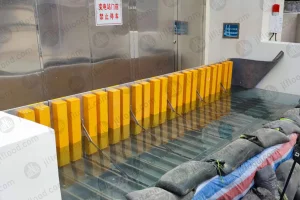
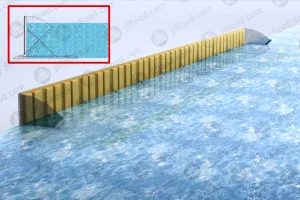
Utilizes hydrostatic pressure differential. Water entering the embedded ground basin exerts an upward force on the internal flotation chamber, causing the door panel to automatically pivot upward without human intervention.
Manufactured from high-tensile marine-grade 6063-T6 aluminum alloy or 304/316 stainless steel. Reinforced structural ribbing withstands extreme dynamic hydrodynamic wave impacts and vehicular wheel loading.
Integrates multi-lip vulcanized EPDM rubber gaskets around all perimeter contact joints. Under hydraulic pressure, the seals compress dynamically, achieving near-zero leakage rates under head pressures up to 2.5 meters.
Engineering departments must evaluate structural deflection criteria ($L/250$ maximum allowable flexure under dynamic fluid load) and installation geometries. The table below outlines parameters across core factory-manufactured flood defense models:
| Model Series | Activation Mechanism | Standard Height Range | Structural Load Class | Primary Material Standard | Leakage Rate (L/hr/m) |
|---|---|---|---|---|---|
| HM4D-0006C Heavy Duty | Hydrodynamic Passive Buoyancy | 600 mm – 1500 mm | AASHTO H-20 / HS-20 (40T) | ASTM 6063-T6 Aluminum / SUS304 | < 0.05 L/hr/m (FM 2510 Approved) |
| HM4D-0006E Surface Mount | Surface Water Floats / Non-Embedded | 300 mm – 900 mm | Medium Duty Vehicle (15T) | Anodized Structural Alloy 6061-T6 | < 0.10 L/hr/m |
| HM4E-006C Substation Special | Hydro-Mechanical Counterbalance | 500 mm – 2000 mm | Heavy Machinery (50T Axle) | Stainless Steel SUS316L / EPDM Seals | 0.00 L/hr/m (Hermetic Seal) |
| Flip-Up Garage Module | Dual Hydraulic Assist / Passive Float | 400 mm – 1200 mm | Passenger Vehicle (5T) | Extruded Modular Alloy 6063-T6 | < 0.08 L/hr/m |
Understanding unit pricing dynamics, OEM manufacturing workflows, material surcharges, and bulk order engineering customization for enterprise tenders.
Procuring wholesale flood protection systems directly from primary Asian manufacturing facilities offers a distinct cost-to-performance advantage for municipal infrastructure contractors, civil engineering groups, and commercial developers. However, evaluating factory price lists requires an understanding of underlying cost drivers, engineering customization fees, and international freight packaging standards.
Base structural costs scale primarily with aluminum ingot spot prices (6063-T6 / 6061-T6) and nickel content in SUS304/SUS316 stainless steel. Marine-grade anodized treatments (20μm minimum film thickness) add a 5-8% cost premium but extend service lifespan in saline coastal environments by over 15 years.
Standard unit spans range from 2.0 meters up to 6.0 meters per leaf. Interlocking modular arrays allow infinite clear width coverage across multi-lane car park entrances or metro concourses. Unit prices per linear meter decrease by 12–18% on volume purchases exceeding 50 linear meters.
Pedestrian-only or light vehicle flip-up gates require minimal ground excavation depth (approx. 150mm). Heavy-duty H-20/HS-20 axle-rated barriers demand deep-embedded structural steel sub-frames (350mm–500mm depth), increasing raw steel consumption and factory welding labor hours.
Direct B2B factory contracting eliminates distributor markups (typically 35% to 65%), provides raw material chemical analysis test reports (Mill Test Certificates to EN 10204 3.1), and grants direct access to factory hydraulic test pool live video verification prior to packing and export shipping.
Deployment methodologies across rail transit networks, electrical power utilities, commercial property basements, and critical municipal passages.
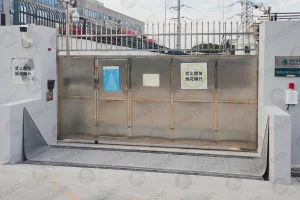
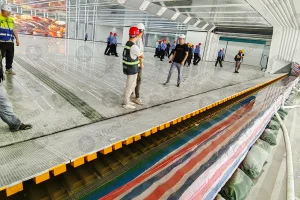
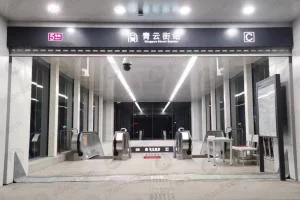
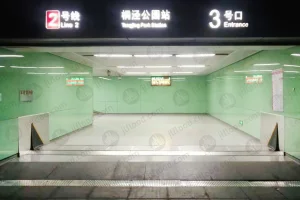
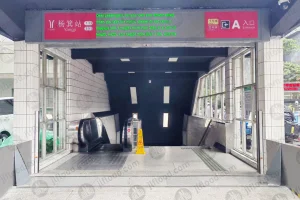
Subway entrance portals and ventilation shafts require zero-threshold flush mounting to prevent tripping hazards during normal passenger flow. Automatic flood barriers trigger seamlessly during water ingress, blocking tunnel inundation.
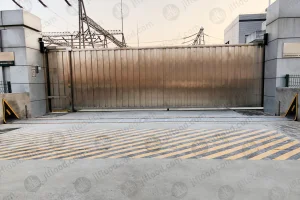
Transformer rooms and high-voltage switchgear buildings must prevent water contact at all costs. Substation flood barriers feature non-conductive boundary seals and rapid rising profiles to safeguard national energy grids.
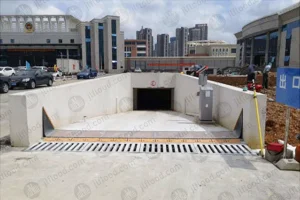
Heavy vehicle ramps in shopping malls, hospitals, and residential towers require wide-span surface or embedded barriers capable of supporting continuous daily traffic without mechanical wear or seal deformation.
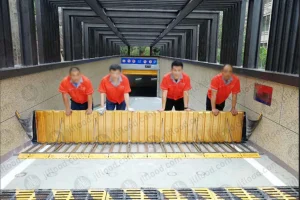
Successful installation requires precise coordination between civil contractors and barrier engineers. Embedded models mandate a dedicated drainage collector pipe ($\min \varnothing 110\text{mm}$) connected directly to the site's primary storm sump. This prevents stagnant rainwater accumulation inside the bottom housing tray during low-volume rainfall events, ensuring the internal float mechanism remains dry until emergency surge activation occurs.
Ensuring global project compliance through certified testing protocols, structural calculations, and localized engineering support.
Products undergo rigorous hydrostatic testing, hydrodynamic wave impact testing, and debris impact resistance tests to comply with global FM Approvals standard 2510 for flood mitigation equipment.
Strict conformity with British and European standards for factory-built flood defense systems, guaranteeing allowable leakage rates well below the maximum industry benchmark of 0.5 liters per hour per meter of wetted perimeter seal.
Direct supply of 3D BIM models (Revit format) and 2D AutoCAD civil detail drawings, enabling engineering consultants to integrate flood barrier dimensions directly into building design schematics.
Pioneering the convergence of passive mechanical buoyancy with smart IoT telemetry, early warning sensors, and eco-friendly alloy recyclability.
As smart cities evolve, physical flood mitigation hardware is expanding to incorporate real-time digital monitoring networks. The future of flood protection relies on hybrid systems: mechanically autonomous deployment combined with digital operational status reporting.
Browse our complete production line of automatic self-closing barriers, metro connection channel gates, and embedded flood protection assemblies.
Comprehensive engineering and commercial responses derived from real-world site queries, procurement specifications, and maintenance standards.
The barrier panel is housed flush inside a recessed foundation chamber installed across the opening. Rising surface floodwater automatically flows into the intake chamber, generating buoyancy under the engineered internal flotation tanks. As water levels rise, hydrostatic pressure drives the panel upwards to pivot and lock into the sealed upright retaining position. When floodwaters recede, water drains naturally from the chamber, allowing the gate to lower smoothly back into its flush home position without human intervention or power consumption.
Our heavy-duty embedded barrier models (HM4D series) are structurally designed and Finite Element Analysis (FEA) verified to meet AASHTO H-20 / HS-20 load standards, accommodating single axle loads up to 40 tonnes (40,000 kg). Vehicles including fire engines, fully loaded freight trucks, and public transit buses can drive directly over the flush-mounted barrier frame without damaging the structural frame or internal sealing gaskets.
Standard continuous single-leaf clear spans range from 1.5 meters up to 6.0 meters, with retaining heights available from 0.3 meters to 2.0 meters. For extra-wide driveways, metro plaza concourses, or perimeter openings exceeding 6 meters, modular intermediate support posts or multi-leaf interlocking barrier arrays can be linked continuously to cover widths over 50 meters.
Because the mechanical activation system relies on natural physics rather than electric motors or hydraulic pumps, routine maintenance is minimal. We recommend quarterly visual inspections to clear leaves or debris from the bottom basin drain and biannual water flushing of the internal chamber. EPDM rubber seals are UV-stabilized and chemical resistant, requiring replacement only after 10-15 years of standard exposure.
All flood defense assemblies are packed inside heavy-duty ISPM-15 compliant export wooden crates, reinforced with corner protection guards and vapor-barrier moisture shrink wrapping. Complete CAD layout drawings, concrete rebar embedment templates, anchor bolt kits, and step-by-step English installation/operation manuals are included in every shipment crate.