
Explore our core catalog of zero-power self-rising flood barriers, engineered by Nanjing Junli Technology Co., Ltd. for instant structural deployment during extreme urban rainstorms.
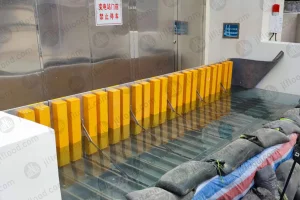
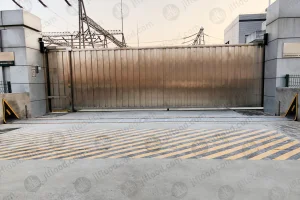
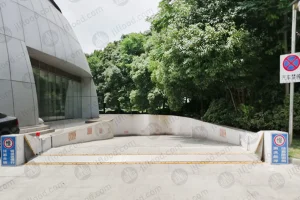
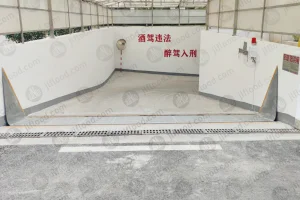
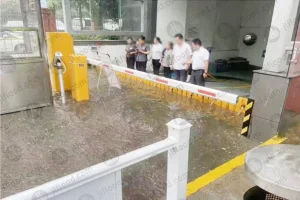
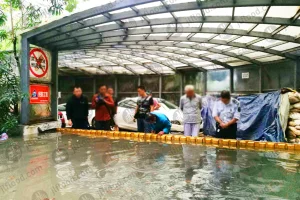
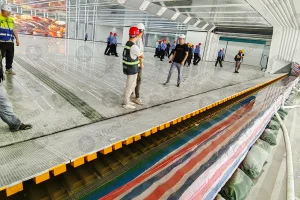
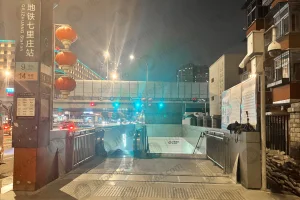
In an era of intensifying global climate volatility, extreme precipitation events regularly exceed municipal stormwater network capacities. The traditional approach to urban flood mitigation—relying on manual sandbag stacking, motorized flip-up gates, or electric sensor-driven barriers—presents structural single-point-of-failure vulnerabilities. Flash floods frequently trigger district-wide electrical grid collapses, leaving motorized barriers completely non-functional precisely when water-retaining defence is needed most.
As a specialized manufacturer, Nanjing Junli Technology Co., Ltd. (headquartered in Qinhuai District, Nanjing, Jiangsu Province) engineers high-performance Non-Electric Automatic Flood Barriers operating on pure hydrodynamics and buoyancy physics. By eliminating external power supplies, motorized actuators, optical sensors, and human physical labor, our self-rising flood gates guarantee 100% operational readiness during extreme typhoon flash floods, power blackouts, and unstaffed overnight emergency events.
The core innovation of Junli’s hydrodynamic automatic flood gate lies in its passive mechanical force balance mechanism. The structural system consists of an embedded ground casing chamber, a high-strength aircraft-grade aluminum panel, composite EPDM dual-lip rubber seals, and specialized leverage hinges.
During normal weather, the barrier panel rests completely flush inside a subterranean ground casing embedded in the entrance concrete threshold. Vehicles (up to 40-60T axle loads) and pedestrians drive and walk over the barrier smoothly without vibration or noise.
When flash flood surface runoff breaches the designated perimeter threshold, water automatically flows into the embedded intake basin. The rising water level inside the chamber generates natural upward hydrostatic buoyancy force, immediately rotating the panel upward on its stainless steel pivot axis.
As floodwaters deepen against the exterior side of the erect panel, hydrostatic pressure forces the panel tighter against the lateral wall upright frames. Special EPDM dual-lip memory gaskets deform under water load, creating a near-zero leakage hydrodynamic barrier wall.
Sourcing high-integrity civil defence infrastructure requires strict verification of manufacturing equipment, structural calculation validation, and batch quality control. Junli Technology provides end-to-end OEM/ODM custom engineering, positioning China’s advanced aluminum extrusion and laser-fabrication ecosystem at the forefront of worldwide flood protection delivery.
Our factory utilizes 6063-T6 marine-grade anodized aluminum alloy extrusions and SUS304/SUS316 stainless steel frame assemblies. Every weld joint undergoes non-destructive ultrasonic testing to withstand continuous dynamic wave impacts during severe storms.
Unlike trading intermediaries that rely solely on 3D computer renderings, Junli Technology maintains a dedicated full-scale hydraulic test basin at our Nanjing facility. Prior to dispatch, custom production lots undergo simulated flood head pressure testing.
Urbanization, combined with increased severe storm frequency, has reshaped global architectural and civil engineering specifications. Standard building codes now mandate robust flood control infrastructure for subterranean real estate assets. Commercial real estate developers, municipal transit authorities, and power grid operators are systematically transitioning to passive non-electric technology based on three strategic drivers:
Typhoons and extreme rainstorms frequently knock out localized power sub-stations. Electric pump systems and automated motorized flood gates fail when back-up diesel generators become submerged or experience transfer-switch delays. Passive hydrodynamic barriers operate entirely independent of power grids.
Global corporate sustainability directives mandate lower standby energy footprint. Electric flood gates consume continuous parasitic power monitoring water sensors and warming heaters year-round. Junli non-electric barriers require zero standby electricity, directly contributing to LEED and ESG infrastructure goals.
Traditional stop-log barriers require building facility staff to manually transport and assemble heavy aluminum beams during emergency flood alerts. If storms hit unstaffed facilities overnight, major flooding occurs. Automatic self-rising gates activate passively without human presence.
Every subterranean aperture presents unique structural constraints, traffic requirements, and hydrodynamic heads. Junli Technology provides tailored configuration packages designed for critical installation environments:
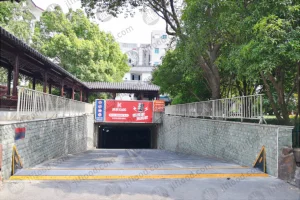
Basement garages are prime collection points for surface water during urban cloudbursts. Junli embedded hydrodynamic barriers sit at the top or bottom of slopes. Vehicles pass effortlessly over the lowered panel without impacting luxury vehicle low clearance. Verified in major residential complexes across Suzhou, Shanxi, and Hefei (Wanda Plaza).
Flooding inside a transformer bay or distribution substation causes cataclysmic grid destruction and high financial liability. Our specialized substation perimeter flood gates block surface runoff from entering equipment gateways, preserving regional power distribution stability.
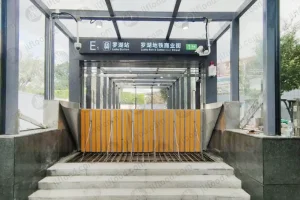
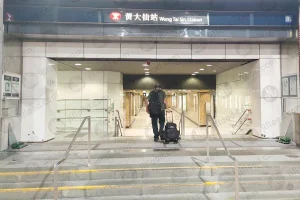
Subway systems require zero-tolerance flood barriers to protect subterranean passenger corridors. Junli hydrodynamic gates are operational across high-density transit hubs including Guangzhou Metro (Yangji Station), Beijing Metro, Suzhou Metro, and Hong Kong Transit facilities.
From hospital basement emergency doors to airport landside access tunnels and Jinan civil defence passages, Junli barriers ensure robust structural seal boundaries, shielding high-value medical assets and transit infrastructure during state-level natural disasters.
Consulting engineers and procurement officers must analyze life-cycle expenditures, maintenance burdens, and emergency failure risks. The matrix below demonstrates the engineering superiority of non-electric hydrodynamic automatic systems:
| Performance Metrics | Junli Non-Electric Hydrodynamic | Electric / Motorized Gates | Manual Aluminum Stop-Logs |
|---|---|---|---|
| Power Dependence | 0% (Pure Passive Buoyancy) | 100% (Requires Grid / Genset) | 0% (Manual Labor Required) |
| Response Time | Instant (< 1 minute passive lift) | 1 to 5 minutes (If power live) | 30 to 120 minutes (Manual assembly) |
| Human Operation | Zero Personnel Required | Requires Remote / Push Button | Requires 2-4 Physical Workers |
| Blackout Reliability | 100% Operational Readiness | High Risk of Failure | High Risk of Delayed Deployment |
| Vehicle Load Bearing | Heavy Duty (40T - 60T Axle Load) | Medium to Heavy Duty | N/A (Barrier blocks road permanently) |
| 20-Year Total Cost of Ownership | Lowest (Minimal Gasket Checks) | High (Motor & Sensor Repairs) | High (Labor & Drills Costs) |
When issuing tenders or procuring custom non-electric flood barrier arrays for international civil works, project engineers must provide specific site parameters to ensure optimal hydraulic sealing and load-bearing performance. Junli Technology supports global clients with full technical submittal packages:
Specify clear opening width ($W$), required retaining water height ($H$), and cross-sectional curb slope. Junli produces custom AutoCAD embedded frame drawings for seamless concrete recess integration.
Identify peak vehicular weight class. Standard models withstand 40-ton container trucks; reinforced underground parking ramp models are rated for heavy fire engine transit.
The subterranean casing chamber incorporates integrated bottom drain ports ($\Phi 110\text{mm}$ or custom) to route residual rainwater into municipal storm sumps after floodwaters recede.
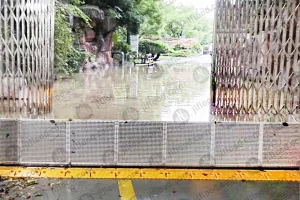
Review our specialized product line up for metro openings, electrical sub-stations, flip-up garage entrances, and surface-mounted retrofits.
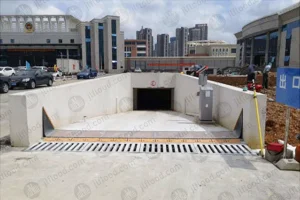
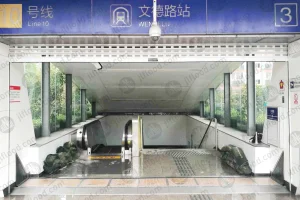
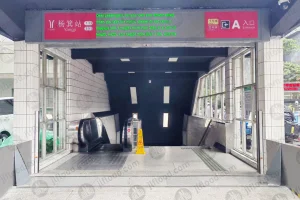
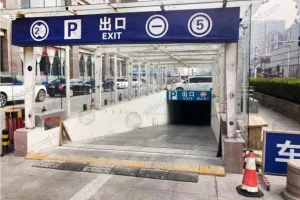
Get expert answers regarding technical specifications, maintenance schedules, civil engineering requirements, and export documentation.
The barrier panel is installed flush inside a recessed foundation chamber embedded at the threshold. Rising surface water flows into the chamber, creating hydro-buoyancy and hydrostatic pressure. This force passively pivots and locks the heavy-duty aluminum panel into its upright water-retaining angle. No sensors, pumps, wiring, or human intervention are required, guaranteeing instant operation even during complete city grid blackouts.
We engineer single-span leaves covering retaining heights from 0.5m to 2.0m, with individual span widths up to 6.0 meters. For wide driveways, metro station plazas, or utility portals exceeding 20 meters, modular interconnected panel arrays are installed with structural intermediate mullions. Custom flip-up models are also produced for narrow doorway passages.
Yes. Every engineered batch undergoes full-scale hydraulic pool testing at our Nanjing test laboratory. We measure exact trigger activation time, structural deflection under maximum design water head, and seal leakage tightness. Official water-retaining test reports, video proof, and third-party inspection certificates (SGS/TÜV) can be furnished with each shipment.
For embedded types, contractor teams construct a reinforced concrete pit following Junli’s structural template drawings. The embedded frame is level-set into the concrete, accompanied by a bottom drainage connection ($\Phi 110\text{mm}$). Surface-mounted retrofits require a level concrete curb base with high-strength anchor bolt fastening, making them ideal for operational assets.
Junli provides complete global support including CAD structural drawings, BIM models, English installation manuals, maintenance protocols, spare EPDM gasket replacement kits, and online engineering video commissioning. On-site technical engineer dispatch is available for large-scale municipal infrastructure tenders.
Partner directly with China's leading hydrodynamic flood gate manufacturer. Send us your clear opening dimensions, site photos, and retaining head requirements to receive a complete technical solution package within 24 hours.


