Field-proven hydrodynamic flood prevention barriers and self-acting perimeter gates deployed across high-density metro lines, power utility substations, and critical subterranean facilities.
In the era of compounding climate volatility, intense convective storms, and accelerated urban pluvial flooding, traditional flood defense systems are reaching their operational limits. For over a century, municipal authorities and industrial facility managers relied almost exclusively on heavy sandbags and emergency water-absorbing bags—historically termed preventing flood bags—as the primary line of defense against flash inundation. However, real-world deployment data demonstrates that manual sandbags present critical systemic vulnerabilities: extreme labor requirements, delayed deployment times, swift structural degradation under hydro-dynamic shear stress, severe environmental disposal hazards, and total dependence on human intervention during power blackouts.
As a global premier preventing flood bag manufacturer and hydrodynamic flood barrier supplier, Nanjing Junli Technology Co., Ltd. has spearheaded an engineering revolution. By integrating high-molecular polymer water-activating barriers with zero-electricity self-closing hydrodynamic gate systems, modern flood mitigation has transitioned from reactive manual effort to passive, autonomous, hydro-powered architectural integration.
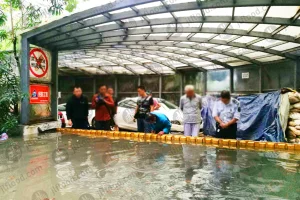
Rapid urban urbanization has converted natural hydrological watersheds into impermeable concrete landscapes. When precipitation exceeds municipal drainage capacity, low-lying infrastructure—such as metro station concourses, subterranean parking complexes, electrical distribution substations, and industrial logistics parks—becomes an immediate sink for surface runoff. The financial ramifications of subterranean inundation are catastrophic, encompassing structural civil damage, electrical transformer destruction, multi-month operational downtime, and legal liability.
To quantify the risk matrix across major infrastructure categories, consider the following structural vulnerability assessment based on recent global flood events:
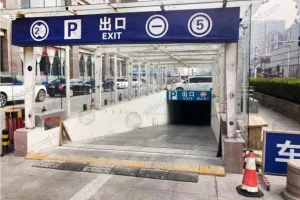
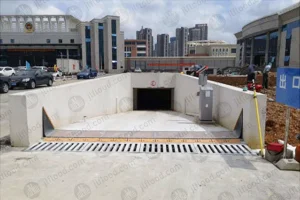
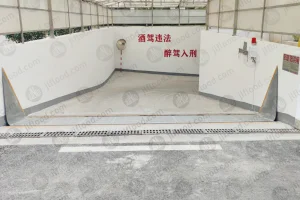
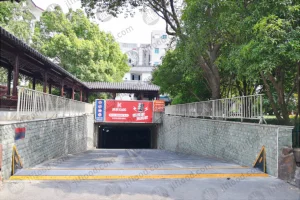
High vehicle density and vulnerable mechanical rooms. Ingress through driveways can submerged hundreds of vehicles within 15 minutes. Self-closing flip-up barriers provide 24/7 protection without obstructing daily vehicular ingress.
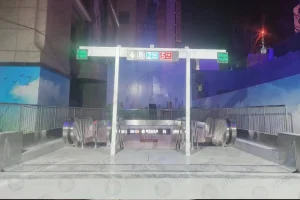
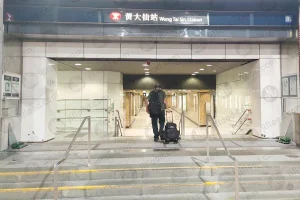
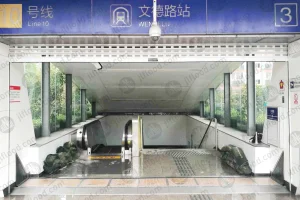
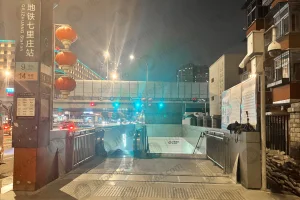
Mass transit networks feature extensive underground tunnels where water ingress at a single entrance can disable an entire regional transit grid. Custom embedded metro flood gates provide instantaneous sealing to standard head pressures.
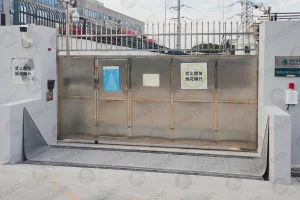
Water intrusion into cable trenches and transformer vaults causes immediate short-circuiting, grid blackouts, and equipment destruction. Non-conductive, heavy-duty modular barriers shield perimeter gates and access points.
Moving beyond basic sandbag technology into precision structural engineering: How buoyancy, hydrostatic balance, and advanced polymer sealing protect mission-critical infrastructure.
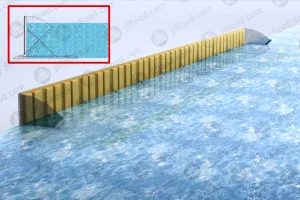
Modern flood mitigation engineered by Junli Technology relies on the physical law of buoyancy ($\text{F}_{\text{buoyant}} = \rho \cdot V \cdot g$) paired with hydrostatic force differential. Unlike electro-mechanical flood gates that require water sensors, motorized winches, emergency backup generators, and regular human maintenance, hydrodynamic automatic flood barriers operate completely passively.
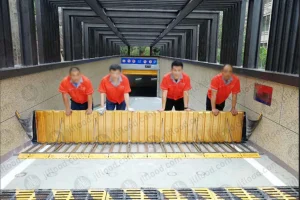
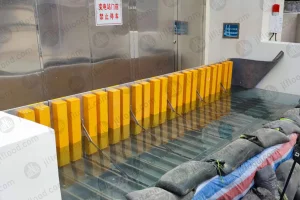
The system is installed flush with the finished road surface inside a reinforced foundation channel. The functional sequence occurs in four automated phases:
To guarantee a minimum 20-to-30-year operational life in harsh environmental conditions, every component material is specified for extreme tensile strength, corrosion resistance, and thermal stability:
| Performance Parameter | Traditional Sandbags / Preventing Bags | Sandless Water-Absorbing Bags | Junli Hydrodynamic Automatic Barrier |
|---|---|---|---|
| Deployment Response Time | 1 to 4 Hours (Heavy Manual Labor) | 10 to 30 Minutes (Water Activation) | Instantaneous / 0.1s Passive Trigger |
| Power Dependence | Manual Effort | Manual Effort | Zero Electricity (Pure Hydro-Power) |
| Maximum Retaining Height | 0.5 meters (Structurally Unstable) | 0.6 meters (Localized Only) | 0.5m to 2.0m Continuous Retention |
| Structural Material | Woven Polypropylene / Jute | Non-woven Fabric + SAP Polymer | 6063-T6 Aerospace Aluminum Alloy |
| Sealing Efficiency (Leakage) | High Leakage Rate (Seepage) | Moderate Seepage at Joints | Near-Zero (<0.15 L/h per meter span) |
| Operational Lifespan | Single-Use / Emergency Disposable | Single-Use / Disposable | 20+ Years Maintenance-Free Frame |
| Life-Cycle Cost (10 Years) | High (Storage, Labor, Replacement) | Moderate (Frequent Re-stocking) | Lowest (Capital Expenditure Amortized) |
How distinct climate zones and architectural regulations drive customized flood barrier configurations across international commercial and municipal sectors.
Global climatic conditions vary dramatically, creating localized hydrological hazards that demand custom engineering approaches. As an established global B2B supplier, Nanjing Junli Technology delivers specialized configurations engineered for specific regional requirements:
Regions impacted by severe tropical cyclones face sudden tidal surges coupled with torrential rainfall (often exceeding 100mm/hour). In urban coastal hubs such as Hong Kong, Guangzhou, Singapore, and Manila, flood protection must handle dynamic wave action and high debris impact. Junli’s heavy-duty Hm4d series surface and embedded barriers feature reinforced internal structural ribs and anti-debris deflectors, preventing leaves, trash, and sediment from interfering with internal buoyancy mechanics.
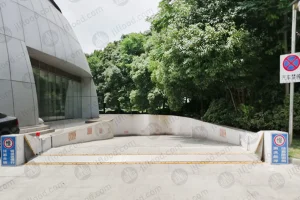
Municipal retrofits in cities such as London, New York, or Amsterdam face strict architectural heritage constraints and shallow road foundations. Excavating deep bottom channels is often impossible due to subterranean utility lines. For these scenarios, Junli supplies Surface-Mounted Flip-Up Automatic Flood Barriers. These units require zero deep trench excavation, mounting directly onto existing reinforced concrete slabs while delivering immediate passive deployment when floodwaters approach.
In modern industrial parks and mission-critical enterprise environments, flood prevention must seamlessly interface with security access control. Junli barrier systems are integrated with smart IoT monitoring modules that send real-time SMS/email alerts to site safety managers the instant water triggers panel elevation, while transmitting status telemetry directly to centralized Building Management Systems (BMS).
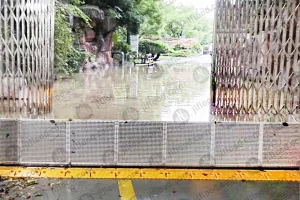
Installed across multiple subway entrance plazas. During severe summer cloudbursts, incoming surface runoff was blocked completely, preserving continuous transit operations for over 400,000 daily commuters.
Custom marine-grade anodized aluminum barriers installed at coastal station entrances to withstand high-salinity air, heavy storm surges, and high-frequency foot traffic without corrosion.
Substation perimeter gate barriers fitted with non-conductive composite insulation base plates, preventing flood intrusion into underground cable trenches during regional river inundation.
Leveraging Nanjing’s advanced industrial manufacturing ecosystem to supply cost-effective, precision-engineered flood barriers to global wholesale partners.
When engineering global infrastructure defense, manufacturing capacity, raw material quality control, and export logistics speed are paramount. Operating from Qinhuai District, Nanjing, Jiangsu Province, Nanjing Junli Technology Co., Ltd. stands as a benchmark Chinese high-tech enterprise specializing in intelligent civil defense and flood protection systems.
Unlike trading intermediaries, Junli maintains 100% control over the industrial manufacturing value chain:
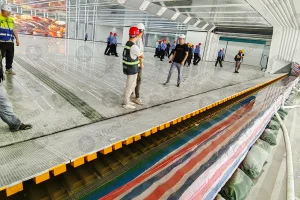
Quality assurance is the core pillar of E-E-A-T (Experience, Expertise, Authoritativeness, Trustworthiness). Junli operates a dedicated, full-scale hydraulic testing basin. Every custom barrier design undergoes full hydrostatic water-retaining verification before factory release:
For international B2B distributors, civil contractors, and municipal procurement tenders, Junli offers full white-label OEM manufacturing support. We supply complete CAD/BIM dimensional drawings, embedded frame templates, English installation engineering manuals, and containerized export packing designed for safe maritime freight delivery worldwide.
Next-generation advancements: Integrating smart sensors, material innovations, and urban digital-twin flood forecasting.
As smart cities evolve, static flood defenses are giving way to connected, intelligent urban safety ecosystems. Junli Technology’s R&D division is driving innovations across three core technological frontiers:
Future iterations of Junli hydrodynamic barriers incorporate ultra-low-power NB-IoT (Narrowband Internet of Things) module arrays embedded within the foundation frame. These sensors track water ingress depth, panel deployment angle, seal compression status, and structural ambient temperature, streaming data live to municipal emergency operations centers (EOC) and cloud dashboards.
In partnership with material science research institutes, next-generation flood bag alternatives and barrier sealing components are being formulated with graphene-reinforced EPDM compounds. This breakthrough increases UV resistance by 300%, extends elastic memory retainment to over 30 years, and reduces overall panel weight while maintaining structural yield strength under dynamic wave impacts.
To assist architectural specifiers and structural engineers, Junli provides full Revit BIM model libraries. Architectural firms can drop exact hydrodynamic barrier specs into building designs, running hydrodynamic simulation models to predict flood flow redirection and civil foundation structural stress prior to ground breaking.
Direct answers to engineering, procurement, installation, and maintenance inquiries for global project managers and distributors.
Explore our complete engineering catalog of garage barriers, metro flood control gates, embedded systems, and emergency flood protection equipment.