
Engineered specifically for low-clearance underground ramps, high-frequency vehicle traffic, and sudden torrential runoff events across coastal and inland Spain.
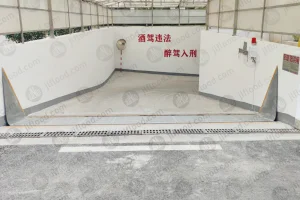
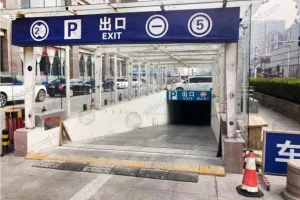
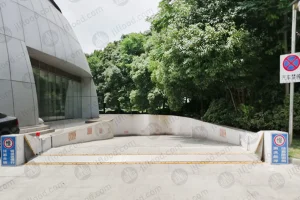
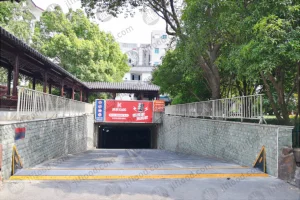
The Iberian Peninsula is undergoing a violent shift in meteorological patterns. The phenomenon known across Spain as DANA (Depresión Aislada en Niveles Altos) or the Gota Fría (Cold Drop) has evolved from a sporadic autumn occurrence into a recurring, hyper-destructive threat. Regions along the Mediterranean basin—specifically the Comunidad Valenciana, Región de Murcia, Andalucía, and Catalunya—as well as interior urban centers like Madrid and Zaragoza, face unprecedented flash floods where precipitation rates exceed 180mm to 300mm within mere hours.
When these catastrophic deluges hit densely populated cities, municipal storm sewer networks suffer instantaneous hydraulic surcharge. The excess runoff immediately seeks the lowest topographical points: underground garage ramps (garajes subterráneos), underground logistics bays, and metro connecting concourses. Within minutes, a multi-story subterranean parking facility transforms into a high-volume retention reservoir, destroying hundreds of vehicles, damaging critical electrical distribution sub-panels, and threatening human lives.
Spain's insurance framework, overseen by the Consorcio de Compensación de Seguros, enforces strict structural mitigation guidelines before issuing payouts for catastrophic flood claims. Commercial asset managers, residential homeowner associations (Comunidades de Propietarios), and industrial park developers face rising premiums unless physical, certified flood mitigation barriers are installed at subterranean entry portals.
Key Takeaway for Spanish EPC Contractors: Traditional manual sandbags and motorized flood gates are failing. Grid power loss during DANA storms leaves motorized gates dead. Power-free hydrodynamic automatic barriers are the new mandatory standard.
Designing flood defense systems for Spanish infrastructure requires strict adherence to both the Código Técnico de la Edificación (CTE DB-HS / DB-SE) and broad European structural Eurocodes (EN 1991 / EN 1999).
The Spanish Building Code (Código Técnico de la Edificación - Salubridad) mandates zero water ingress for underground spaces. Hydrodynamic self-closing barriers form an impermeable structural barrier, utilizing EPDM double-lip marine gaskets engineered for high hydrostatic heads.
Garage entry ramps must sustain continuous traffic from SUVs, delivery trucks, and fire appliances. Embedded frames are manufactured from high-yield 6063-T6 architectural aluminum or structural steel, rated up to 40-ton point axle load (EN 124 Class D400/E600).
For installations in Mediterranean coastal cities (Valencia, Alicante, Málaga), components are subjected to fluorocarbon surface treatments and anodic oxidation (thickness >25μm) to resist saline atmosphere oxidation and chemical runoff.
| Performance Parameter | Hydrodynamic Self-Closing Barrier | Electromechanical Motorized Gate | Manual Demountable Aluminum Planks |
|---|---|---|---|
| Power Source Requirement | Zero Power (Pure Hydrodynamic Buoyancy) | 230V/400V Grid Electric (Fails during blackouts) | Manual Human Labor Required |
| Deployment Speed | Immediate (< 0.1s buoyancy trigger) | 30 - 90 seconds (Motor delay) | 30 - 120 minutes (Manual assembly) |
| Human Dependency | 0% (100% Unattended Passive Defense) | 50% (Requires sensor/switch triggering) | 100% (Requires dedicated emergency crew) |
| Driveway Flush Fit | 100% Flush (Zero Ramp Height Loss) | Often creates a speed-bump lip | Requires post sockets inserted in ground |
| Life Expectancy | 25+ Years (Minimal mechanical moving parts) | 8 - 12 Years (Motor/sensor degradation) | 10 - 15 Years (Rubber seal deformation) |
Understanding the precise fluid mechanics that allow Junli technology to protect Spanish facilities without electricity, sensors, or human intervention.
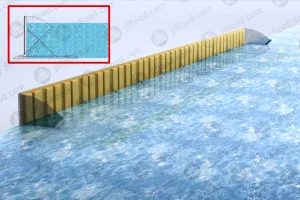
The core principle relies on basic archimedean fluid dynamics and hydrostatic pressure balances ($F_b = \rho \cdot V \cdot g$). The flood gate assembly is installed inside a recessed stainless steel or anodized aluminum bottom tray level with the garage drive ramp surface.
Our factory engineers calculate structural wall thickness based on the maximum flood height ($H_f$) specified by Spanish municipal hazard maps (e.g., Sistema Nacional de Cartografía de Zonas Inundables - SNCZI):
Every unit produced for Spanish export undergoes finite element analysis (FEA) to ensure structural integrity under dynamic wave impact and debris striking conditions.
How Spanish main contractors (Constructoras), architectural studios, and municipality engineering departments import and integrate Junli Flood Barriers.
Send your clear entrance width ($W$), ramp slope gradient (%), and maximum design flood height ($H$). Our engineering office returns customized Autocad (.DWG) and BIM (.RVT) embedded structural drawings within 24 hours.
Before shipment from our main manufacturing plant, every custom barrier is installed in our full-scale hydraulic pool test tank. Video documentation and factory acceptance test (FAT) inspection reports are provided per order.
Delivered direct to Spanish ports (Valencia, Barcelona, Algeciras, Bilbao) in sea-worthy reinforced wooden crates. Packages include pre-welded embedment frames, expansion anchor kits, and multilingual step-by-step manuals.
We are continuously advancing our mechanical hydrodynamic designs with smart municipal monitoring technologies for modern European smart city infrastructures.
While the mechanical lifting mechanism remains 100% passive and power-free, modern Spanish facilities often require remote notifications. Our barriers can be equipped with low-power LoRaWAN or NB-IoT wireless sensors. The moment water enters the bottom tray and initiates panel rise, an automated push signal is sent to the building management system (BMS) and facility manager mobile applications.
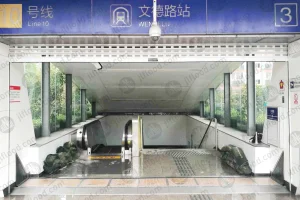
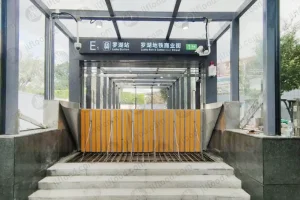
For wide logistics plazas, shopping center distribution hubs, and metro station concourses across Madrid and Barcelona, single-span barriers are insufficient. Our patented interlocking multi-leaf array allows continuous flood protection across openings exceeding 20 meters wide without requiring permanent center support pillars.
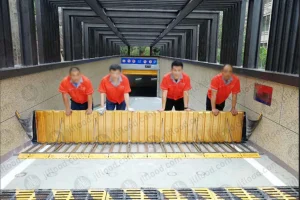
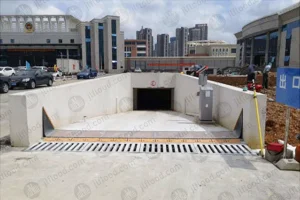
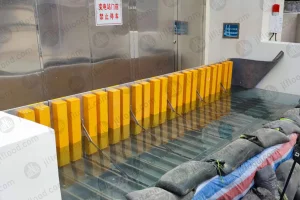
Explore our broad range of hydrodynamic self-closing gates, surface-mounted metro barriers, substation defense systems, and flip-up barriers available for factory-direct shipment to Spain.
Detailed answers to technical, regulatory, and procurement questions raised by Spanish building engineers and property developers.
Severe DANA weather events in Spain frequently cause sudden regional electrical grid failure due to lightning strikes or municipal substation flooding. Motorized flood barriers require uninterrupted electricity or complex battery backups that often fail after prolonged standing. Hydrodynamic barriers rely 100% on natural water buoyancy and hydrostatic pressure. As floodwaters rise, the gate deploys automatically without any electrical power, sensors, or manual labor—guaranteeing 100% operational readiness during grid blackouts.
Junli garage flood barriers engineered for Spanish exports feature heavy-duty structural top plates crafted from extruded 6063-T6 aluminum alloy or hot-dip galvanized structural steel. The frame is embedded flush with the surrounding concrete ramp slope, ensuring zero loss of vehicle clearance and zero bump impact. The structural rib architecture is rated to withstand heavy axle loadings (EN 124 Class D400 / E600 standard), supporting continuous daily traffic from private cars, heavy commercial vans, and emergency fire apparatus.
For embedded self-closing models, contractor civil teams must excavate a shallow trench matching our detailed dimensional drawings across the ramp threshold, connect a standard gravity drain line (DN100/DN150) to the municipal storm sewer or sump pit to handle normal rainfall, and pour a reinforced concrete foundation bed (C30/37 grade). For retrofit projects where ground excavation is restricted, surface-mounted or flip-up models can be anchored directly onto existing flat concrete aprons.
Nanjing Junli Technology provides full export documentation including CE conformity declarations, material test certificates (MTRs), FEA structural calculation packages, and factory water-test verification reports. All shipments to Spanish ports (Valencia, Barcelona, Algeciras) are packaged in ocean-proof, heavy-duty wooden crates. Complete English and Spanish installation manuals, embedment templates, and remote video technical support are included with every order.
Contact our senior flood protection engineering team for custom CAD layout drawings, structural calculations, and competitive factory-direct wholesale pricing tailored for Spanish projects.
Send Inquiry Now

